
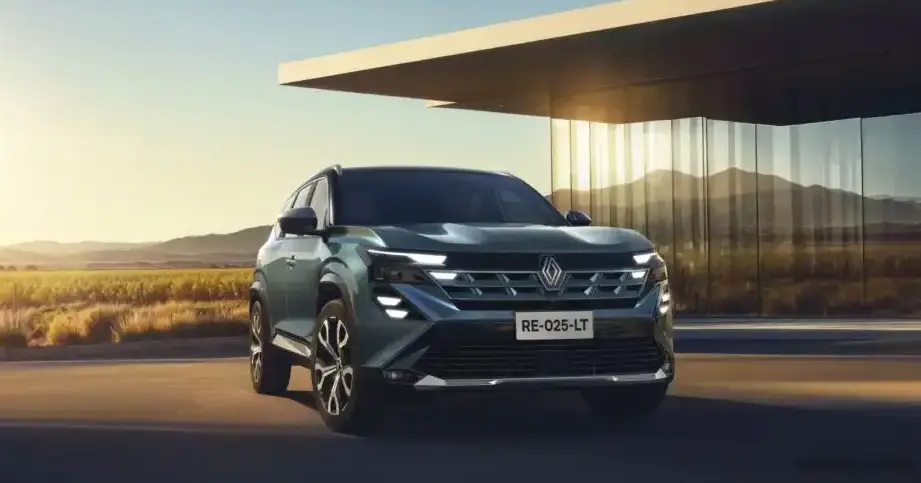
The Renault Boreal 1.3 TCe (156 hp) DCT is a five-door, five-seat compact SUV introduced by Renault in November 2025. Positioned as a mid-range offering within the Boreal lineup, it represents a balance between performance, fuel efficiency, and technology. The Boreal, designed to compete in the highly contested European and emerging markets SUV segment, leverages Renault’s latest design language and engineering advancements. This specific variant, equipped with the 1.3-liter turbocharged gasoline engine and a dual-clutch transmission (DCT), aims to appeal to buyers seeking a refined and practical driving experience.
Technical Specifications
| Brand | Renault |
| Model | Boreal |
| Type (Engine) | 1.3 TCe (156 Hp) DCT |
| Start of production | November, 2025 |
| Powertrain Architecture | Internal Combustion engine |
| Body type | SUV |
| Seats | 5 |
| Doors | 5 |
| Fuel consumption (economy) – urban | 11.2 l/100 km (21 US mpg, 25.2 UK mpg, 8.9 km/l) |
| Fuel consumption (economy) – extra urban | 13.6 l/100 km (17.3 US mpg, 20.8 UK mpg, 7.4 km/l) |
| Fuel Type | Petrol (Gasoline) |
| Acceleration 0 – 100 km/h | 9.8 sec |
| Acceleration 0 – 62 mph | 9.8 sec |
| Acceleration 0 – 60 mph | 9.3 sec |
| Maximum speed | 180 km/h (111.85 mph) |
| Weight-to-power ratio | 9.2 kg/Hp, 108.5 Hp/tonne |
| Weight-to-torque ratio | 5.3 kg/Nm, 187.8 Nm/tonne |
| Power | 156 Hp @ 5000 rpm |
| Power per litre | 117 Hp/l |
| Torque | 270 Nm @ 2000-2500 rpm (199.14 lb.-ft. @ 2000-2500 rpm) |
| Engine layout | Front, Transverse |
| Engine Model/Code | H5Ht |
| Engine displacement | 1333 cm3 (81.34 cu. in.) |
| Number of cylinders | 4 |
| Engine configuration | Inline |
| Number of valves per cylinder | 4 |
| Fuel injection system | Direct injection |
| Engine aspiration | Turbocharger, Intercooler |
| Engine systems | Start & Stop System |
| Kerb Weight | 1438 kg (3170.25 lbs.) |
| Max. weight | 1886 kg (4157.92 lbs.) |
| Max load | 448 kg (987.67 lbs.) |
| Trunk (boot) space – minimum | 586 l (20.69 cu. ft.) |
| Trunk (boot) space – maximum | 1770 l (62.51 cu. ft.) |
| Fuel tank capacity | 50 l (13.21 US gal | 11 UK gal) |
| Permitted trailer load with brakes (12%) | 1500 kg (3306.93 lbs.) |
| Length | 4556 mm (179.37 in.) |
| Width | 1841 mm (72.48 in.) |
| Width including mirrors | 2082 mm (81.97 in.) |
| Height | 1652 mm (65.04 in.) |
| Wheelbase | 2702 mm (106.38 in.) |
| Front track | 1560 mm (61.42 in.) |
| Rear (Back) track | 1557 mm (61.3 in.) |
| Front overhang | 861 mm (33.9 in.) |
| Rear overhang | 993 mm (39.09 in.) |
| Ride height (ground clearance) | 213 mm (8.39 in.) |
| Drivetrain Architecture | The Internal combustion engine (ICE) drives the front wheels of the vehicle. |
| Drive wheel | Front wheel drive |
| Number of gears and type of gearbox | 6 gears, automatic transmission DCT |
| Assisting systems | ABS (Anti-lock braking system) |
| Steering type | Steering rack and pinion |
| Power steering | Electric Steering |
| Tires size | 225/55 R18 98H; 205/55 R19 99V |
| Wheel rims size | 18; 19 |
Powertrain & Engine Architecture
At the heart of the Boreal 1.3 TCe DCT lies the Renault-developed H5Ht engine, a 1.3-liter inline-four cylinder gasoline engine. This engine is part of the Alliance’s (Renault-Nissan-Mitsubishi) modular engine family, designed for efficiency and scalability. It features direct fuel injection, a single turbocharger with an intercooler, and four valves per cylinder. The engine’s output of 156 horsepower at 5000 rpm and 270 Nm (199 lb-ft) of torque between 2000-2500 rpm is achieved through careful tuning of the engine management system and turbocharger boost. The engine also incorporates a Start & Stop system to further improve fuel economy in urban driving conditions.
The engine is paired with a seven-speed dual-clutch transmission (DCT). This DCT provides quick and smooth gear changes, contributing to both performance and fuel efficiency. The DCT’s programming is geared towards a balance of responsiveness and comfort, offering both automatic and manual shift modes. The front-wheel-drive configuration is standard for this variant.
Driving Characteristics
The Boreal 1.3 TCe DCT delivers a respectable driving experience. Acceleration from 0 to 60 mph takes approximately 9.3 seconds, and the top speed is limited to 111.85 mph. While not a performance-oriented SUV, the engine provides sufficient power for everyday driving and highway cruising. The DCT contributes to a responsive feel, with minimal turbo lag and smooth gear transitions. Compared to lower-powered Boreal variants, the 1.3 TCe offers noticeably improved acceleration and overtaking capability. However, it doesn’t match the performance of potential future higher-output engine options. The gear ratios are optimized for a blend of fuel efficiency and usable power across the rev range.
Equipment & Trim Levels
The Boreal 1.3 TCe DCT typically comes standard with features such as air conditioning, a touchscreen infotainment system with smartphone integration (Apple CarPlay and Android Auto), power windows and mirrors, and a suite of safety features including ABS, electronic stability control, and multiple airbags. Higher trim levels add features like automatic climate control, a larger touchscreen display, navigation, a rearview camera, parking sensors, and premium interior upholstery. Optional extras may include a panoramic sunroof, adaptive cruise control, and a premium sound system.
Chassis & Braking
The Boreal utilizes a MacPherson strut front suspension and a torsion beam rear suspension. This setup provides a comfortable ride quality while maintaining reasonable handling characteristics. The suspension is tuned to prioritize comfort over sporty handling. Braking duties are handled by disc brakes on the front wheels and drum brakes on the rear wheels. ABS (Anti-lock Braking System) is standard. The steering is electrically assisted, providing light and precise steering feel.
Market Reception & Comparison
The Renault Boreal 1.3 TCe DCT has been generally well-received by automotive critics. Reviewers have praised its comfortable ride, spacious interior, and fuel-efficient engine. However, some have noted that the interior materials could be of higher quality. Compared to other compact SUVs in its class, the Boreal 1.3 TCe DCT offers a competitive level of equipment and performance at its price point. Fuel economy is comparable to other 1.3-liter turbocharged gasoline engines, and reliability is expected to be good based on Renault’s recent track record.
Legacy
The Renault Boreal 1.3 TCe DCT represents a significant step forward for Renault in the compact SUV segment. The H5Ht engine, while relatively new, is expected to prove reliable due to its robust design and advanced technology. The DCT transmission, if properly maintained, should provide years of smooth and efficient operation. As the Boreal matures in the used car market, the 1.3 TCe DCT variant is likely to be a popular choice for buyers seeking a well-rounded and practical SUV.
