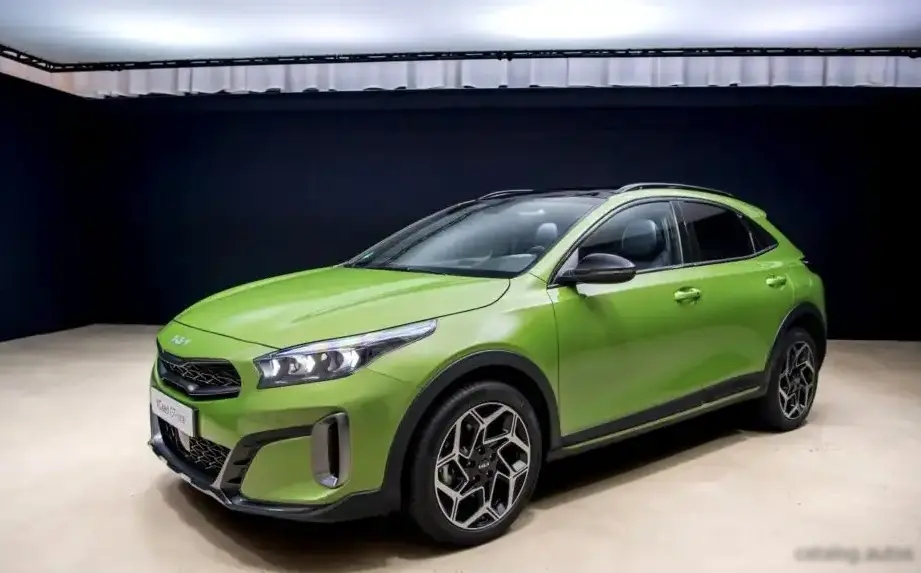
The Kia XCeed (facelift, introduced in 2022) 1.5 T-GDI, producing 140 horsepower, represents a key offering within Kia’s European-focused C-segment crossover lineup. Production of this specific variant began in May 2024 and continued through July 2025. Positioned as a mid-range option, it aimed to bridge the gap between more affordable base models and higher-performance or more luxurious trims. The XCeed itself is built upon the 1HX0 platform, shared with the Hyundai Venue and other compact Kia/Hyundai models, and was designed to appeal to buyers seeking a stylish, practical, and technologically advanced crossover. This facelift brought updated styling, improved technology, and refined powertrain options, including the 1.5 T-GDI engine.
Technical Specifications
| Brand | Kia |
| Model | XCeed |
| Generation | Xceed (facelift 2022) |
| Type (Engine) | 1.5 T-GDI (140 Hp) |
| Start of production | May, 2024 |
| End of production | July, 2025 |
| Powertrain Architecture | Internal Combustion engine |
| Body type | SUV, Crossover |
| Seats | 5 |
| Doors | 5 |
| Fuel consumption at Low speed (WLTP) | 7.6 l/100 km (30.9 US mpg, 37.2 UK mpg, 13.2 km/l) |
| Fuel consumption at Medium speed (WLTP) | 6.1 l/100 km (38.6 US mpg, 46.3 UK mpg, 16.4 km/l) |
| Fuel consumption at high speed (WLTP) | 5.5 l/100 km (42.8 US mpg, 51.4 UK mpg, 18.2 km/l) |
| Fuel consumption at very high speed (WLTP) | 7.0 l/100 km (33.6 US mpg, 40.4 UK mpg, 14.3 km/l) |
| Combined fuel consumption (WLTP) | 6.4 l/100 km (36.8 US mpg, 44.1 UK mpg, 15.6 km/l) |
| CO2 emissions (WLTP) | 146 g/km |
| Fuel Type | Petrol (Gasoline) |
| Acceleration 0 – 100 km/h | 10.2 sec |
| Acceleration 0 – 62 mph | 10.2 sec |
| Acceleration 0 – 60 mph | 9.7 sec |
| Maximum speed | 195 km/h (121.17 mph) |
| Emission standard | Euro 6e |
| Weight-to-power ratio | 9.3 kg/Hp, 108.1 Hp/tonne |
| Weight-to-torque ratio | 5.1 kg/Nm, 195.4 Nm/tonne |
| Power | 140 Hp @ 5500 rpm |
| Power per litre | 94.5 Hp/l |
| Torque | 253 Nm @ 1500-3000 rpm (186.6 lb.-ft. @ 1500-3000 rpm) |
| Engine layout | Front, Transverse |
| Engine Model/Code | G4LH |
| Engine displacement | 1482 cm3 (90.44 cu. in.) |
| Number of cylinders | 4 |
| Engine configuration | Inline |
| Cylinder Bore | 71.6 mm (2.82 in.) |
| Piston Stroke | 92 mm (3.62 in.) |
| Compression ratio | 10.5:1 |
| Number of valves per cylinder | 4 |
| Fuel injection system | Direct injection |
| Engine aspiration | Turbocharger, Intercooler |
| Engine oil capacity | 4.2 l (4.44 US qt | 3.7 UK qt) |
| Coolant | 6.1 l (6.45 US qt | 5.37 UK qt) |
| Kerb Weight | 1295-1416 kg (2854.99 – 3121.75 lbs.) |
| Max. weight | 1840 kg (4056.51 lbs.) |
| Max load | 424-545 kg (934.76 – 1201.52 lbs.) |
| Trunk (boot) space – minimum | 426 l (15.04 cu. ft.) |
| Trunk (boot) space – maximum | 1378 l (48.66 cu. ft.) |
| Fuel tank capacity | 50 l (13.21 US gal | 11 UK gal) |
| Max. roof load | 80 kg (176.37 lbs.) |
| Permitted trailer load with brakes (12%) | 1210 kg (2667.59 lbs.) |
| Permitted trailer load without brakes | 610 kg (1344.82 lbs.) |
| Permitted towbar download | 75 kg (165.35 lbs.) |
| Length | 4395 mm (173.03 in.) |
| Width | 1826 mm (71.89 in.) |
| Height | 1495 mm (58.86 in.) |
| Wheelbase | 2650 mm (104.33 in.) |
| Front track | 1575 mm (62.01 in.) |
| Rear (Back) track | 1573 mm (61.93 in.) |
| Front overhang | 905 mm (35.63 in.) |
| Rear overhang | 840 mm (33.07 in.) |
| Minimum turning circle (turning diameter) | 10.6 m (34.78 ft.) |
| Drivetrain Architecture | The Internal combustion engine (ICE) drives the front wheels of the vehicle. |
| Drive wheel | Front wheel drive |
| Number of gears and type of gearbox | 6 gears, manual transmission |
| Front suspension | Independent type McPherson |
| Rear suspension | Independent multi-link spring suspension with stabilizer |
| Front brakes | Ventilated discs, 305×25 mm |
| Rear brakes | Disc, 284×10 mm |
| Assisting systems | ABS (Anti-lock braking system) |
| Steering type | Steering rack and pinion |
| Power steering | Electric Steering |
| Tires size | 235/45 R18 94V |
| Wheel rims size | 7.5J x 18 ET45 |
Powertrain & Engine Architecture
The heart of this XCeed variant is the Hyundai-Kia G4LH 1.5-liter turbocharged four-cylinder gasoline engine. This engine is part of Kia’s “Smartstream” engine family, designed for improved efficiency and reduced emissions. The G4LH utilizes direct fuel injection, a single-scroll turbocharger, and an intercooler to deliver a balance of power and fuel economy. The engine’s architecture features a cast iron block and an aluminum cylinder head with four valves per cylinder. The 1.5 T-GDI engine produces 140 horsepower at 5,500 rpm and 253 Nm (186.6 lb-ft) of torque between 1,500 and 3,000 rpm. This engine is paired with a 6-speed manual transmission, delivering power to the front wheels. The engine also incorporates a Start & Stop system and a particulate filter to meet Euro 6e emission standards.
Driving Characteristics
The 1.5 T-GDI with the 6-speed manual transmission offers a reasonably engaging driving experience. While not a performance-oriented trim, the turbocharger provides a noticeable boost in power during acceleration. The 0-60 mph time of around 9.7 seconds is respectable for a crossover in this class. The gear ratios are well-matched for everyday driving, providing adequate power for merging onto highways and overtaking. Compared to higher-output versions of the XCeed, this variant feels less urgent, but it offers better fuel economy. The manual transmission provides drivers with more control, but the clutch engagement is smooth and predictable. The suspension is tuned for comfort, absorbing bumps and imperfections in the road well, but it may exhibit some body roll during spirited cornering.
Equipment & Trim Levels
The 1.5 T-GDI trim typically includes standard features such as air conditioning, a touchscreen infotainment system with Apple CarPlay and Android Auto compatibility, Bluetooth connectivity, and a suite of safety features including ABS, ESC, and multiple airbags. Higher trim levels add features like a larger touchscreen display, navigation system, a rearview camera, parking sensors, and advanced driver-assistance systems (ADAS) such as lane keeping assist and automatic emergency braking. Interior upholstery is typically cloth, with options for leather or partial leather upgrades. Wheel sizes range from 17 to 18 inches, depending on the trim level.
Chassis & Braking
The XCeed utilizes a front-wheel-drive platform with an independent McPherson strut suspension in the front and an independent multi-link suspension in the rear. This setup provides a good balance of ride comfort and handling. The front brakes are ventilated discs measuring 305x25mm, while the rear brakes are solid discs measuring 284x10mm. The braking system is assisted by ABS (Anti-lock Braking System) and ESC (Electronic Stability Control). The electric power steering provides light and precise steering feel.
Market Reception & Comparison
The Kia XCeed 1.5 T-GDI was generally well-received by automotive critics. It was praised for its stylish design, spacious interior, and good value for money. The 1.5 T-GDI engine was considered a good compromise between performance and fuel economy. Compared to the more powerful engine options, such as the 1.6 T-GDI, this variant offered lower running costs and a more relaxed driving experience. Fuel economy figures of around 36.8 US mpg (combined WLTP) were competitive in its class. Reliability reports suggest that the G4LH engine is generally reliable, but regular maintenance is essential to ensure long-term durability.
Legacy
The Kia XCeed 1.5 T-GDI (2024-2025) represents a significant step forward for Kia in the European crossover market. The combination of a stylish design, practical interior, and efficient powertrain made it a popular choice among buyers. While the model has been superseded by newer iterations, the 1.5 T-GDI engine continues to be used in other Kia and Hyundai models. On the used car market, these models are generally considered a good value, offering a reliable and well-equipped crossover at a competitive price. The G4LH engine, when properly maintained, is expected to provide years of reliable service.