Technical Specifications
| Brand | Ford |
| Model | Transit Connect |
| Generation | Transit Connect II Panel Van L1 |
| Type (Engine) | 1.6 TDCi (75 Hp) |
| Start of production | 2013 |
| End of production | 2016 |
| Powertrain Architecture | Internal Combustion engine |
| Body type | Minivan |
| Seats | 2-3 |
| Doors | 4-5 |
| Fuel consumption (economy) – urban (NEDC) | 5.5 l/100 km (42.8 US mpg, 51.4 UK mpg, 18.2 km/l) |
| Fuel consumption (economy) – extra urban (NEDC) | 4.3 l/100 km (54.7 US mpg, 65.7 UK mpg, 23.3 km/l) |
| Fuel consumption (economy) – combined (NEDC) | 4.8 l/100 km (49 US mpg, 58.9 UK mpg, 20.8 km/l) |
| CO2 emissions (NEDC) | 124 g/km |
| Fuel Type | Diesel |
| Emission standard | Euro 5 |
| Weight-to-power ratio | 18.4 kg/Hp, 54.3 Hp/tonne |
| Weight-to-torque ratio | 6.3 kg/Nm, 159.4 Nm/tonne |
| Power | 75 Hp @ 3500 rpm |
| Power per litre | 48.1 Hp/l |
| Torque | 220 Nm @ 1500 rpm (162.26 lb.-ft. @ 1500 rpm) |
| Engine layout | Front, Transverse |
| Engine Model/Code | Duratorq / UBGA |
| Engine displacement | 1560 cm3 (95.2 cu. in.) |
| Number of cylinders | 4 |
| Engine configuration | Inline |
| Cylinder Bore | 75 mm (2.95 in.) |
| Piston Stroke | 88.3 mm (3.48 in.) |
| Compression ratio | 16:1 |
| Number of valves per cylinder | 2 |
| Fuel injection system | Diesel Commonrail |
| Engine aspiration | Turbocharger, Intercooler |
| Valvetrain | SOHC |
| Engine oil capacity | 6.2 l (6.55 US qt | 5.46 UK qt) |
| Coolant | 7.3 l (7.71 US qt | 6.42 UK qt) |
| Kerb Weight | 1380-1417 kg (3042.38 – 3123.95 lbs.) |
| Max. weight | 2005-2215 kg (4420.27 – 4883.24 lbs.) |
| Max load | 625-798 kg (1377.89 – 1759.29 lbs.) |
| Trunk (boot) space – minimum | 2630 l (92.88 cu. ft.) |
| Trunk (boot) space – maximum | 3700 l (130.66 cu. ft.) |
| Fuel tank capacity | 60 l (15.85 US gal | 13.2 UK gal) |
| Permitted trailer load with brakes (12%) | 1200 kg (2645.55 lbs.) |
| Permitted trailer load without brakes | 730 kg (1609.37 lbs.) |
| Length | 4418 mm (173.94 in.) |
| Width | 1835 mm (72.24 in.) |
| Width including mirrors | 2137 mm (84.13 in.) |
| Height | 1861 mm (73.27 in.) |
| Wheelbase | 2662 mm (104.8 in.) |
| Front track | 1568 mm (61.73 in.) |
| Rear (Back) track | 1584-1585 mm (62.36 – 62.4 in.) |
| Front overhang | 878 mm (34.57 in.) |
| Rear overhang | 878 mm (34.57 in.) |
| Ride height (ground clearance) | 152 mm (5.98 in.) |
| Minimum turning circle (turning diameter) | 11.7 m (38.39 ft.) |
| Drivetrain Architecture | The Internal combustion engine (ICE) drives the front wheels of the vehicle. |
| Drive wheel | Front wheel drive |
| Number of gears and type of gearbox | 5 gears, manual transmission |
| Front suspension | Independent, type McPherson with coil spring and anti-roll bar |
| Rear suspension | Coil spring, Torsion |
| Front brakes | Ventilated discs, 300 mm |
| Rear brakes | Disc, 280 mm |
| Assisting systems | ABS (Anti-lock braking system) |
| Steering type | Steering rack and pinion |
| Power steering | Electric Steering |
| Tires size | 205/60 R16 |
| Wheel rims size | 6.5J x 16 |
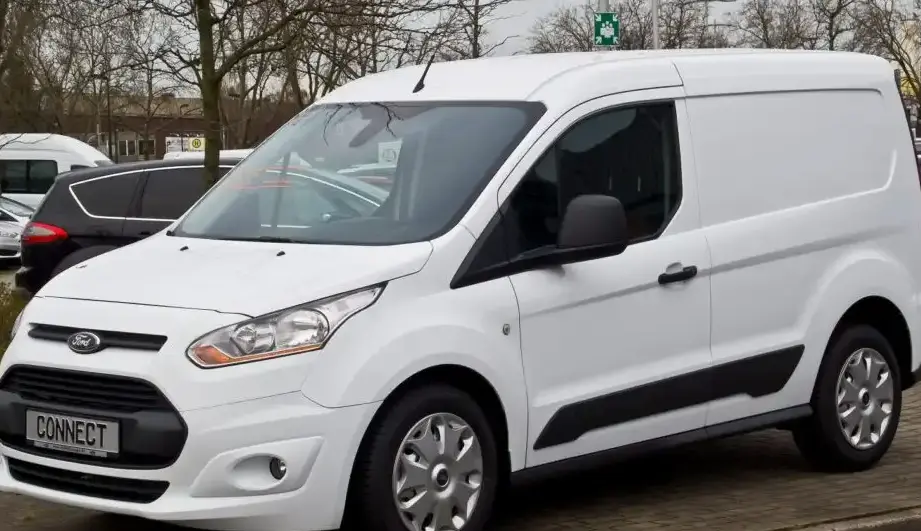
The Ford Transit Connect II, launched in 2013, represented a significant update to Ford’s compact van range. Built on the global C1 platform (shared with the Ford Focus), the L1 short-wheelbase panel van offered a versatile and efficient solution for commercial operators. The 1.6 TDCi 75 hp variant was specifically targeted at businesses prioritizing low running costs and practicality over outright performance. This model served as the entry point to the Transit Connect lineup, appealing to those with lighter-duty delivery needs and a focus on fuel economy. It was a popular choice for urban delivery services, maintenance crews, and small businesses.
Powertrain & Engine Architecture
At the heart of the Transit Connect L1 1.6 TDCi (75 hp) lies Ford’s Duratorq 1.6-liter inline-four turbodiesel engine, designated with the engine code UBGA. This engine utilizes a common-rail direct fuel injection system, delivering fuel at high pressure directly into the combustion chamber for improved efficiency and reduced emissions. The engine features a single overhead camshaft (SOHC) valvetrain operating two valves per cylinder. A turbocharger with an intercooler is employed to boost power output and improve torque across a wider rev range. The 75 horsepower output is achieved at 3500 rpm, while peak torque of 220 Nm (162 lb-ft) is available from just 1500 rpm. This low-end torque is particularly beneficial for load-carrying applications. The engine is paired with a five-speed manual transmission, chosen for its simplicity and contribution to fuel efficiency. The transmission’s gear ratios are optimized for maximizing fuel economy and providing adequate acceleration for typical urban and highway driving conditions.
Driving Characteristics
The 1.6 TDCi 75 hp Transit Connect L1 delivers a functional, rather than sporty, driving experience. Acceleration is modest, and the van is not designed for rapid overtaking. However, the engine’s strong low-end torque makes it capable of carrying a reasonable load without feeling overly strained. The five-speed manual transmission requires frequent shifting, particularly when ascending hills or accelerating with a full load. Compared to higher-output versions of the Transit Connect, such as those equipped with the 1.6-liter 95 hp or 1.0-liter EcoBoost engines, the 75 hp variant feels noticeably slower. However, it offers a smoother and more predictable power delivery, making it easier to drive in congested urban environments. The gear ratios are spaced to prioritize fuel efficiency, resulting in a relatively low engine speed at highway cruising speeds.
Equipment & Trim Levels
The Transit Connect L1 1.6 TDCi (75 hp) typically came with a basic level of equipment, reflecting its position as an entry-level work van. Standard features generally included power steering, an adjustable steering column, a driver’s airbag, and basic instrumentation. The interior was typically finished with durable, hard-wearing plastics designed for practicality and ease of cleaning. Upholstery was typically vinyl or a basic cloth material. Options available included air conditioning, a radio/CD player, electric windows, and central locking. Higher trim levels offered additional features such as upgraded upholstery, body-colored bumpers, and alloy wheels, but these were not typically fitted to the base 75 hp model.
Chassis & Braking
The Transit Connect L1 utilizes a McPherson strut independent suspension setup at the front, providing a comfortable ride and good handling characteristics. The rear suspension employs a coil spring and torsion beam arrangement, which is cost-effective and provides adequate load-carrying capacity. The braking system consists of ventilated discs at the front and solid discs at the rear. Anti-lock Braking System (ABS) was standard, enhancing safety and stability during emergency braking. The van’s relatively light weight contributes to its manageable handling and braking performance. The steering is rack and pinion, providing precise and responsive steering feel.
Market Reception & Comparison
The Ford Transit Connect L1 1.6 TDCi (75 hp) was generally well-received by critics as a practical and economical work van. Its fuel efficiency was a major selling point, and its compact size made it easy to maneuver in urban environments. However, some reviewers criticized its lack of power, particularly when fully loaded. Compared to other vans in its class, such as the Volkswagen Caddy and the Citroën Berlingo, the Transit Connect offered a competitive combination of price, fuel economy, and load capacity. The 75 hp engine was often seen as adequate for lighter-duty applications, but those requiring more performance were advised to consider the higher-output engine options.
Legacy
The 1.6 TDCi Duratorq engine, in its various iterations, proved to be a relatively reliable powertrain. While not without its issues (such as potential problems with the diesel particulate filter and fuel injectors), it generally offered good longevity with regular maintenance. Today, used examples of the Transit Connect L1 1.6 TDCi (75 hp) remain relatively affordable and represent a practical option for small businesses and tradespeople on a budget. Its simplicity and fuel efficiency continue to make it a viable choice for those prioritizing low running costs over outright performance. However, potential buyers should be aware of the age-related wear and tear common to all used vehicles and ensure a thorough inspection is carried out before purchase.