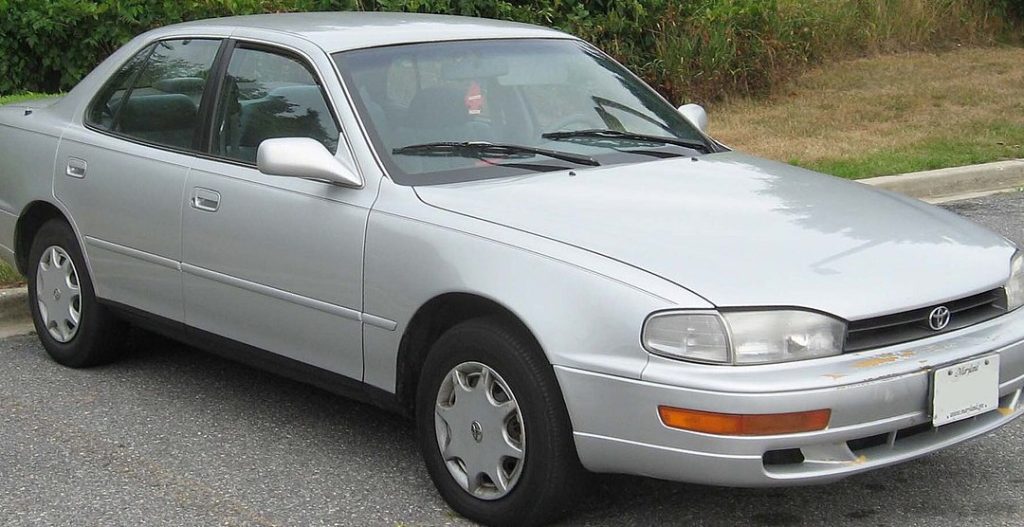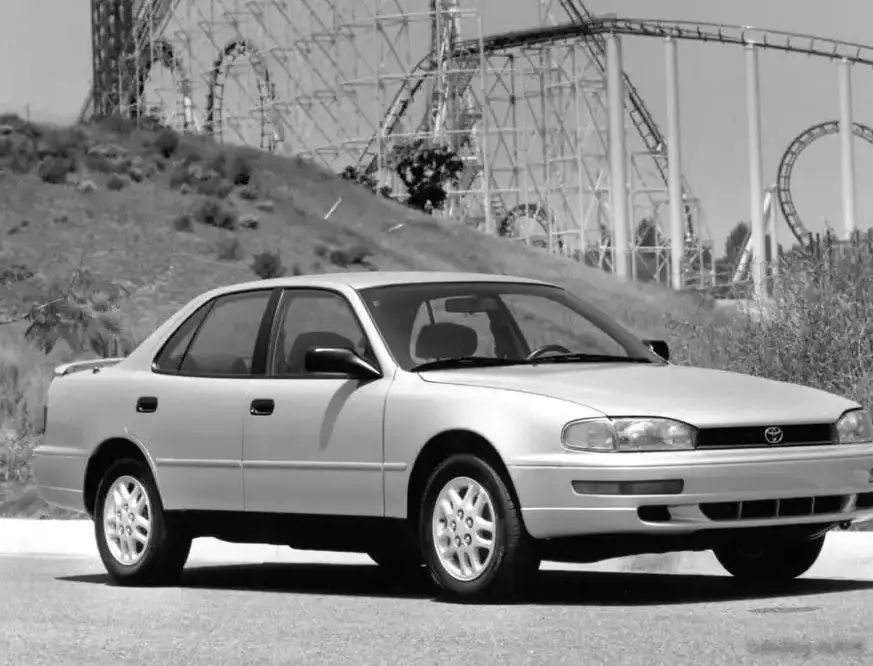
The Toyota Camry XV10, produced between 1991 and 1996, represented a significant step forward for Toyota’s mid-size sedan. This generation Camry aimed to balance comfort, reliability, and affordability, becoming a mainstay in the American family car market. The 2.2-liter (136 hp) automatic variant occupied a middle ground within the XV10 lineup, offering a blend of reasonable performance and convenience features. It was positioned above the base 2.0-liter models and below the more powerful 3.0-liter V6 options, targeting buyers who prioritized fuel efficiency and ease of driving over outright speed.
Technical Specifications
| Brand | Toyota |
| Model | Camry |
| Generation | Camry III (XV10) |
| Type (Engine) | 2.2 (136 Hp) Automatic |
| Start of production | 1991 |
| End of production | 1996 |
| Powertrain Architecture | Internal Combustion engine |
| Body type | Sedan |
| Seats | 5 |
| Doors | 4 |
| Fuel Type | Petrol (Gasoline) |
| Acceleration 0 – 100 km/h | 11.8 sec |
| Acceleration 0 – 62 mph | 11.8 sec |
| Acceleration 0 – 60 mph | 11.2 sec |
| Maximum speed | 195 km/h (121.17 mph) |
| Weight-to-power ratio | 10.6 kg/Hp, 94.1 Hp/tonne |
| Weight-to-torque ratio | 7.4 kg/Nm, 135.6 Nm/tonne |
| Power | 136 Hp @ 5400 rpm |
| Power per litre | 62.8 Hp/l |
| Torque | 196 Nm @ 4200 rpm (144.56 lb.-ft. @ 4200 rpm) |
| Engine layout | Front, Transverse |
| Engine Model/Code | 5S-FE |
| Engine displacement | 2164 cm3 (132.06 cu. in.) |
| Number of cylinders | 4 |
| Engine configuration | Inline |
| Cylinder Bore | 87.1 mm (3.43 in.) |
| Piston Stroke | 90.9 mm (3.58 in.) |
| Compression ratio | 9.7:1 |
| Number of valves per cylinder | 4 |
| Fuel injection system | Multi-port manifold injection |
| Engine aspiration | Naturally aspirated engine |
| Valvetrain | DOHC |
| Engine oil capacity | 3.6 l (3.8 US qt | 3.17 UK qt) |
| Coolant | 6.5 l (6.87 US qt | 5.72 UK qt) |
| Kerb Weight | 1445 kg (3185.68 lbs.) |
| Max. weight | 1820 kg (4012.41 lbs.) |
| Max load | 375 kg (826.73 lbs.) |
| Trunk (boot) space – maximum | 517 l (18.26 cu. ft.) |
| Fuel tank capacity | 70 l (18.49 US gal | 15.4 UK gal) |
| Length | 4725 mm (186.02 in.) |
| Width | 1770 mm (69.69 in.) |
| Height | 1420 mm (55.91 in.) |
| Wheelbase | 2620 mm (103.15 in.) |
| Minimum turning circle | 10.6 m (34.78 ft.) |
| Drivetrain Architecture | The Internal combustion engine (ICE) drives the front wheels of the vehicle. |
| Drive wheel | Front wheel drive |
| Number of gears and type of gearbox | 4 gears, automatic transmission |
| Front suspension | Independent, type McPherson with coil spring and anti-roll bar |
| Rear suspension | Independent multi-link suspension |
| Front brakes | Ventilated discs |
| Rear brakes | Ventilated discs |
| Assisting systems | ABS (Anti-lock braking system) |
| Steering type | Steering rack and pinion |
| Power steering | Hydraulic Steering |
| Tires size | 195/70 R14 |
| Wheel rims size | 14 |
Powertrain & Engine Architecture
The heart of the XV10 2.2 Camry was the 5S-FE inline-four cylinder engine. This 2.2-liter powerplant featured a cast iron block and an aluminum cylinder head, a common configuration for Toyota engines of the era. The 5S-FE utilized multi-port fuel injection, delivering fuel directly to each intake port for improved efficiency and responsiveness. Its dual overhead camshaft (DOHC) valvetrain, with four valves per cylinder, further enhanced breathing and contributed to the engine’s respectable power output for its displacement. The automatic transmission paired with this engine was a four-speed unit, designed for smooth and comfortable shifts. While not particularly sporty, it provided adequate performance for everyday driving. The transmission’s shift logic was tuned for fuel economy, prioritizing gentle acceleration over aggressive downshifts.
Driving Characteristics
The 2.2-liter automatic Camry offered a comfortable and predictable driving experience. Acceleration from a standstill to 60 mph took around 11.2 seconds, which was adequate for merging onto highways and navigating city streets, but noticeably slower than the V6 models. The four-speed automatic transmission, while smooth, lacked the responsiveness of a manual gearbox. Gear ratios were optimized for fuel efficiency, meaning the engine often felt strained during quick acceleration or when climbing hills. The suspension, tuned for comfort, absorbed bumps and road imperfections well, providing a pleasant ride quality. Steering was light and easy, making the Camry effortless to maneuver in urban environments.
Equipment & Trim Levels
The 2.2-liter automatic Camry typically came standard with features like air conditioning, power steering, power windows, and an AM/FM stereo. Higher trim levels, such as the LE, added features like cruise control, upgraded upholstery, and a more sophisticated sound system. Optional extras included a sunroof, alloy wheels, and a CD player. Interior upholstery was typically cloth, with higher trims offering options for velour or leather. The dashboard layout was functional and straightforward, prioritizing ease of use over stylistic flair.
Chassis & Braking
The XV10 Camry featured an independent McPherson strut suspension in the front and an independent multi-link suspension in the rear. This setup provided a good balance of ride comfort and handling. The 2.2-liter models were equipped with ventilated disc brakes on all four wheels, providing adequate stopping power for the vehicle’s weight. An Anti-lock Braking System (ABS) was often included as standard equipment, enhancing safety by preventing wheel lockup during hard braking. The steering system utilized a rack-and-pinion setup with hydraulic power assist, offering precise and responsive steering feel.
Market Reception & Comparison
The Camry XV10 2.2-liter automatic was generally well-received by critics and consumers alike. It was praised for its reliability, fuel efficiency, and comfortable ride. However, some reviewers noted its lack of sporty handling and relatively slow acceleration compared to competitors like the Honda Accord. Compared to the 3.0-liter V6 Camry, the 2.2-liter model offered significantly better fuel economy but lacked the V6’s power and refinement. Against the base 2.0-liter Camry, the 2.2-liter provided a noticeable performance boost without a substantial increase in price.
Legacy
The Toyota Camry XV10, particularly the 2.2-liter variant, has earned a reputation for exceptional long-term reliability. The 5S-FE engine is known for its durability and ability to withstand high mileage with proper maintenance. Today, well-maintained XV10 Camrys are still found on the road, a testament to Toyota’s engineering prowess. In the used car market, these Camrys are often sought after by buyers looking for an affordable, dependable, and fuel-efficient vehicle. While not a performance icon, the XV10 2.2-liter automatic played a crucial role in solidifying the Camry’s position as a leading mid-size sedan in the United States and beyond.