Technical Specifications
| Brand | Porsche |
| Model | Cayenne |
| Generation | Cayenne II |
| Type (Engine) | S 3.0 V6 (380 Hp) Hybrid Tiptronic S |
| Start of production | 2010 |
| End of production | 2014 |
| Powertrain Architecture | FHEV (Full Hybrid Electric Vehicle) |
| Body type | SUV |
| Seats | 5 |
| Doors | 5 |
| Fuel consumption (economy) – urban (NEDC) | 8.7 l/100 km (27 US mpg, 32.5 UK mpg, 11.5 km/l) |
| Fuel consumption (economy) – extra urban (NEDC) | 7.9 l/100 km (29.8 US mpg, 35.8 UK mpg, 12.7 km/l) |
| Fuel consumption (economy) – combined (NEDC) | 8.2 l/100 km (28.7 US mpg, 34.4 UK mpg, 12.2 km/l) |
| CO2 emissions (NEDC) | 193 g/km |
| Fuel Type | Petrol (Gasoline) |
| Acceleration 0 – 100 km/h | 6.5 sec |
| Acceleration 0 – 62 mph | 6.5 sec |
| Acceleration 0 – 60 mph | 6.2 sec |
| Maximum speed | 242 km/h (150.37 mph) |
| Emission standard | Euro 5 |
| Weight-to-power ratio | 5.9 kg/Hp, 169.6 Hp/tonne |
| Weight-to-torque ratio | 3.9 kg/Nm, 258.9 Nm/tonne |
| Gross battery capacity | 1.7 kWh |
| Battery voltage | 288 V |
| Battery technology | Nickel-metal hydride (NiMH) |
| Battery weight | 80 kg (176.37 lbs) |
| Battery location | Under the trunk |
| Electric motor power | 47 Hp @ 1150 rpm |
| Electric motor Torque | 300 Nm @ 0-1150 rpm (221.27 lb.-ft. @ 0-1150 rpm) |
| Electric motor location | Between the combustion engine and the transmission |
| System power | 380 Hp @ 5500 rpm |
| System torque | 580 Nm @ 1000 rpm (427.79 lb.-ft. @ 1000 rpm) |
| Power | 333 Hp @ 5500-6500 rpm |
| Power per litre | 111.2 Hp/l |
| Torque | 440 Nm @ 3000-5250 rpm (324.53 lb.-ft. @ 3000-5250 rpm) |
| Maximum engine speed | 6500 rpm |
| Engine layout | Front, Longitudinal |
| Engine Model/Code | 06EC, CGE, CGEA, CGFA |
| Engine displacement | 2995 cm3 (182.77 cu. in) |
| Number of cylinders | 6 |
| Engine configuration | V-engine |
| Cylinder Bore | 84.5 mm (3.33 in) |
| Piston Stroke | 89 mm (3.5 in) |
| Compression ratio | 10.5:1 |
| Number of valves per cylinder | 4 |
| Fuel injection system | Direct injection |
| Engine aspiration | Supercharger, Intercooler |
| Valvetrain | DOHC |
| Engine oil capacity | 8.1 l (8.56 US qt | 7.13 UK qt) |
| Kerb Weight | 2240 kg (4938.35 lbs) |
| Max. weight | 2910 kg (6415.45 lbs) |
| Max load | 670 kg (1477.1 lbs) |
| Trunk (boot) space – minimum | 580 l (20.48 cu. ft) |
| Trunk (boot) space – maximum | 1690 l (59.68 cu. ft) |
| Fuel tank capacity | 85 l (22.45 US gal | 18.7 UK gal) |
| Max. roof load | 100 kg (220.46 lbs) |
| Length | 4846 mm (190.79 in) |
| Width | 1939 mm (76.34 in) |
| Width including mirrors | 2155 mm (84.84 in) |
| Height | 1705 mm (67.13 in) |
| Wheelbase | 2895 mm (113.98 in) |
| Front track | 1655 mm (65.16 in) |
| Rear (Back) track | 1669 mm (65.71 in) |
| Ride height (ground clearance) | 215 mm (8.46 in) |
| Drag coefficient (Cd) | 0.36 |
| Approach angle | 26° |
| Departure angle | 24.5° |
| Ramp-over (brakeover) angle | 20.5° |
| Wading depth | 500 mm (19.69 in) |
| Drivetrain Architecture | The Internal combustion engine (ICE) and the electric motor permanently drive the four wheels of the car with the ability to work in full electric or mixed mode. |
| Drive wheel | All wheel drive (4×4) |
| Number of gears and type of gearbox | 8 gears, automatic transmission Tiptronic S |
| Front suspension | Double wishbone |
| Rear suspension | Independent multi-link suspension |
| Front brakes | Ventilated discs, 360×36 mm |
| Rear brakes | Ventilated discs, 330×28 mm |
| Assisting systems | ABS (Anti-lock braking system) |
| Steering type | Steering rack and pinion |
| Power steering | Hydraulic Steering |
| Tires size | 255/55 R18 |
| Wheel rims size | 8J x 18 |
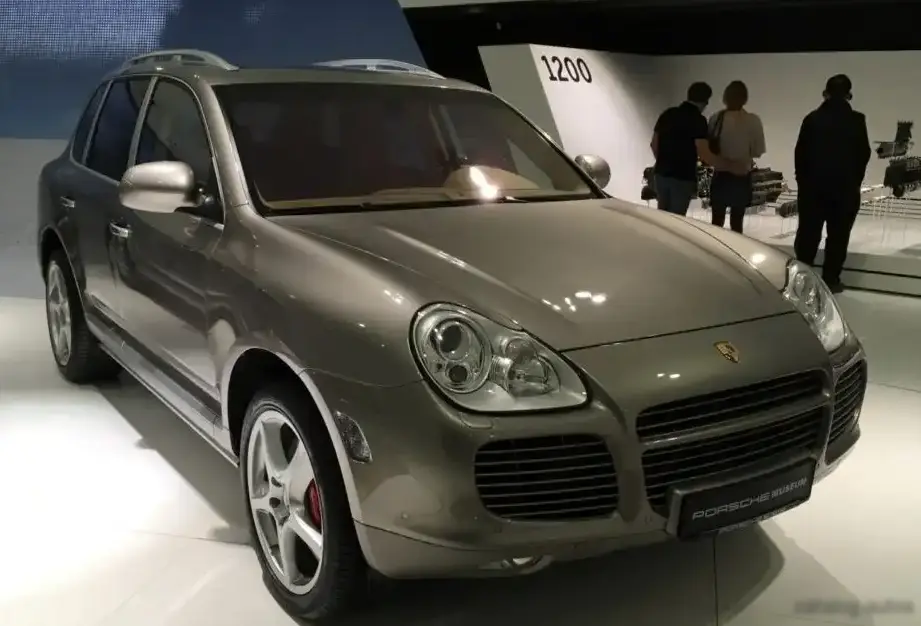
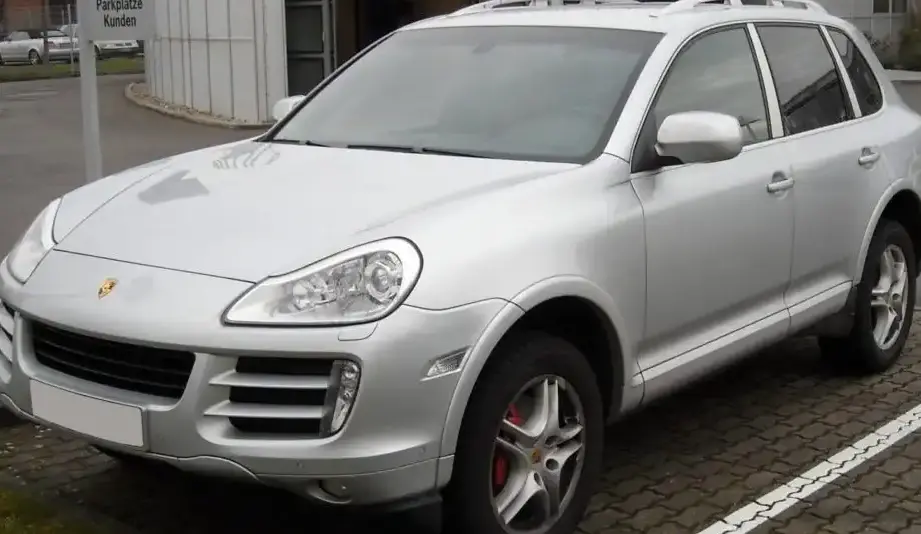
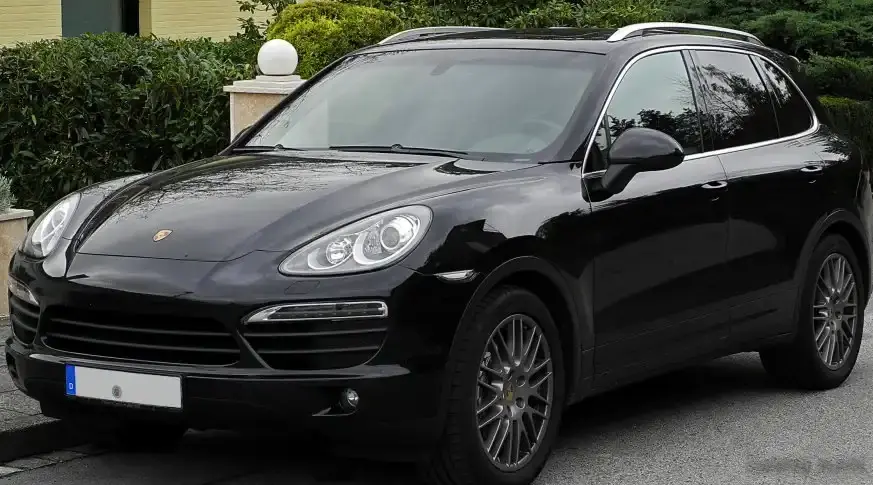
The Porsche Cayenne II S 3.0 V6 Hybrid Tiptronic S, introduced in 2010, marked Porsche’s initial step into hybrid technology within the popular Cayenne SUV lineup. Built on the 1HX0/A3 platform, this variant aimed to deliver a more fuel-efficient alternative to the gasoline-only Cayennes without compromising the brand’s renowned performance and luxury. It occupied a middle position in the Cayenne II range, sitting above the base V6 model but below the more potent S and Turbo versions. The hybrid system was engineered to improve efficiency in urban driving and provide an extra power boost when needed.
Powertrain & Engine Architecture
The Cayenne S Hybrid’s core was Porsche’s 3.0-liter V6 engine, identified by the engine code CGEA. This engine featured direct fuel injection and a mechanically driven supercharger, producing 333 horsepower. The supercharger provided immediate boost at lower engine speeds, minimizing turbo lag and enhancing responsiveness. Paired with this engine was a 47-horsepower electric motor, powered by a 1.7 kWh nickel-metal hydride (NiMH) battery pack situated under the trunk floor. The electric motor was integrated between the engine and the eight-speed Tiptronic S automatic transmission. This setup allowed for electric-only driving at low speeds and assisted the gasoline engine during acceleration. The Tiptronic S transmission offered both automatic and manual shift modes, giving drivers greater control. The hybrid system intelligently managed the interaction between the engine and electric motor, optimizing for fuel efficiency or performance as required.
Driving Characteristics
The Cayenne S Hybrid offered a distinctive driving experience. In electric-only mode, it could travel short distances at low speeds, providing near-silent operation and zero emissions. However, the electric range was limited. During typical driving, the hybrid system seamlessly combined the power from the V6 engine and the electric motor, resulting in a combined output of 380 horsepower and 427.79 lb-ft of torque. Acceleration from 0 to 60 mph took around 6.2 seconds, competitive for its class but slightly slower than the non-hybrid Cayenne S. The Tiptronic S transmission delivered smooth and rapid gear changes. While the hybrid system added weight, the overall handling remained true to Porsche’s standards, with precise steering and a well-controlled suspension. The regenerative braking system helped recapture energy during deceleration, further improving efficiency.
Equipment & Trim Levels
The Cayenne S Hybrid came standard with a comprehensive array of features, including leather upholstery, a touchscreen infotainment system, automatic climate control, and a power liftgate. Optional extras included adaptive air suspension, heated and ventilated front seats, a panoramic sunroof, and a premium sound system. The interior trim could be customized with various wood and leather options. The Cayenne S Hybrid also featured unique hybrid-specific displays within the instrument cluster, providing information about the hybrid system’s operation and energy flow. Exterior styling was largely consistent with other Cayenne II models, with subtle “Hybrid” badging for identification.
Chassis & Braking
The Cayenne S Hybrid utilized a double-wishbone front suspension and an independent multi-link rear suspension, providing a comfortable ride and precise handling. The suspension was tuned to accommodate the added weight of the hybrid system. Brakes consisted of ventilated discs on all four wheels, providing ample stopping power. The Cayenne S Hybrid was equipped with Porsche’s Anti-lock Braking System (ABS) and other advanced safety features. The vehicle’s weight distribution was carefully managed to maintain balanced handling characteristics.
Market Reception & Comparison
The Cayenne S Hybrid received a mixed reception from automotive critics. While praised for its fuel efficiency and innovative hybrid technology, some reviewers found its performance to be somewhat underwhelming compared to the non-hybrid Cayenne S. Fuel economy was rated at approximately 28.7 US mpg combined, a significant improvement over the gasoline-only models. However, the hybrid system added complexity and potential maintenance costs. Compared to the Cayenne S, the Hybrid offered better fuel economy but slightly slower acceleration. Compared to the base V6 Cayenne, the Hybrid provided more power and a more refined driving experience. The higher initial cost of the Hybrid was a consideration for some buyers.
Legacy
The Porsche Cayenne S Hybrid paved the way for Porsche’s wider adoption of hybrid technology across its model range. While the first-generation Cayenne Hybrid wasn’t a massive sales success, it demonstrated Porsche’s commitment to improving fuel efficiency and reducing emissions. The powertrain proved to be relatively reliable, although the NiMH battery pack eventually required replacement, which could be a substantial expense. On the used car market, the Cayenne S Hybrid remains a relatively affordable option for those seeking a luxury SUV with improved fuel economy and a unique driving experience. It represents a significant step in Porsche’s evolution towards electrification.