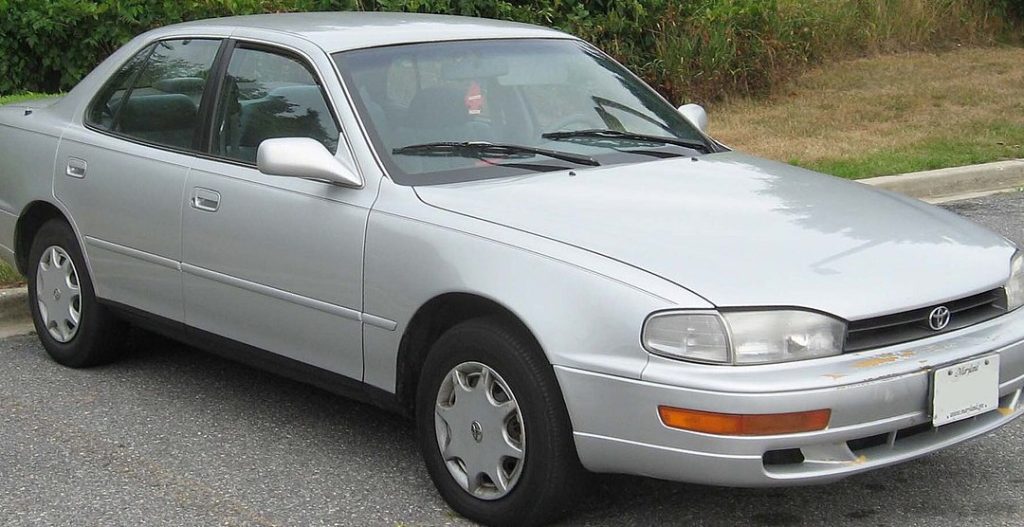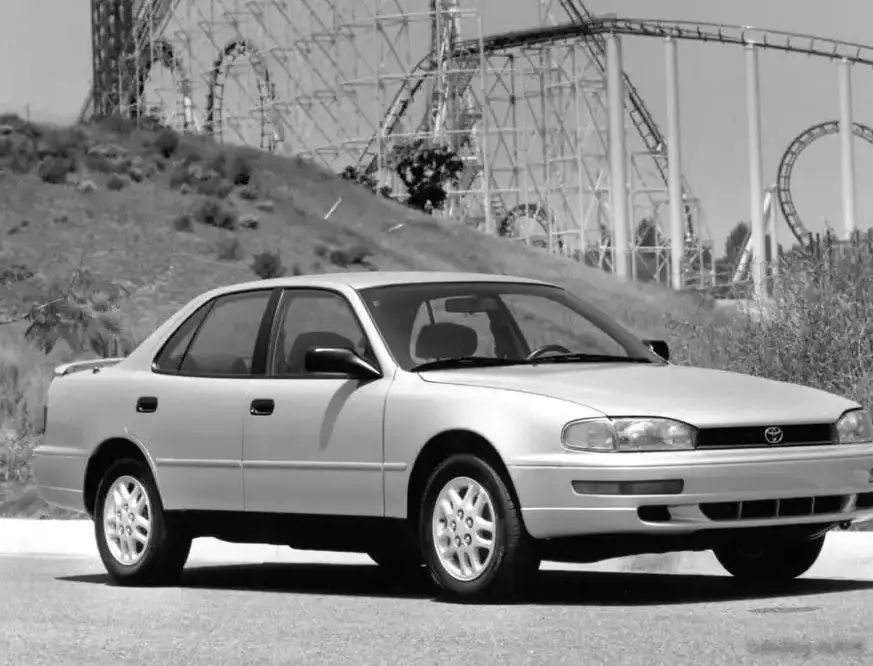
The Toyota Camry XV10, produced between 1991 and 1996, represented a significant step forward for Toyota’s mid-size sedan. The third generation Camry aimed to broaden its appeal, offering a more refined driving experience and increased interior space. Within the XV10 range, the 3.0 V6 24V variant, producing 188 horsepower, occupied the premium position, offering a substantial performance upgrade over the base four-cylinder models. This model was primarily marketed in North America and select international markets where larger displacement engines were favored. It was a key competitor to the Honda Accord and Ford Taurus, aiming for buyers seeking a comfortable, reliable, and relatively powerful family sedan.
Technical Specifications
| Brand | Toyota |
| Model | Camry |
| Generation | Camry III (XV10) |
| Type (Engine) | 3.0 V6 24V (188 Hp) |
| Start of production | 1991 |
| End of production | 1996 |
| Powertrain Architecture | Internal Combustion engine |
| Body type | Sedan |
| Seats | 5 |
| Doors | 4 |
| Fuel consumption (combined) | 10.3 l/100 km (22.8 US mpg, 27.4 UK mpg, 9.7 km/l) |
| Fuel Type | Petrol (Gasoline) |
| Weight-to-power ratio | 7.8 kg/Hp, 127.9 Hp/tonne |
| Weight-to-torque ratio | 5.8 kg/Nm, 173.5 Nm/tonne |
| Power | 188 Hp @ 5400 rpm |
| Power per litre | 63.5 Hp/l |
| Torque | 255 Nm @ 4400 rpm (188.08 lb.-ft. @ 4400 rpm) |
| Engine layout | Front, Transverse |
| Engine Model/Code | 3VZ-FE |
| Engine displacement | 2959 cm3 (180.57 cu. in.) |
| Number of cylinders | 6 |
| Engine configuration | V-engine |
| Cylinder Bore | 87.5 mm (3.44 in.) |
| Piston Stroke | 82 mm (3.23 in.) |
| Compression ratio | 9.6:1 |
| Number of valves per cylinder | 4 |
| Fuel injection system | Multi-port manifold injection |
| Engine aspiration | Naturally aspirated engine |
| Valvetrain | DOHC |
| Engine oil capacity | 4.4 l (4.65 US qt | 3.87 UK qt) |
| Coolant capacity | 8.5 l (8.98 US qt | 7.48 UK qt) |
| Kerb Weight | 1470 kg (3240.8 lbs.) |
| Max. weight | 1930 kg (4254.92 lbs.) |
| Max load | 460 kg (1014.13 lbs.) |
| Trunk (boot) space – maximum | 517 l (18.26 cu. ft.) |
| Fuel tank capacity | 70 l (18.49 US gal | 15.4 UK gal) |
| Max. roof load | 100 kg (220.46 lbs.) |
| Permitted trailer load with brakes (12%) | 1500 kg (3306.93 lbs.) |
| Permitted trailer load without brakes | 500 kg (1102.31 lbs.) |
| Length | 4725 mm (186.02 in.) |
| Width | 1770 mm (69.69 in.) |
| Height | 1420 mm (55.91 in.) |
| Wheelbase | 2620 mm (103.15 in.) |
| Minimum turning circle | 10.6 m (34.78 ft.) |
| Drivetrain Architecture | Front wheel drive, Internal Combustion engine |
| Number of gears and type of gearbox | 5 gears, manual transmission |
| Front suspension | Independent, type McPherson with coil spring and anti-roll bar |
| Rear suspension | Independent multi-link suspension |
| Front brakes | Ventilated discs |
| Rear brakes | Disc |
| Assisting systems | ABS (Anti-lock braking system) |
| Steering type | Steering rack and pinion |
| Power steering | Hydraulic Steering |
| Tires size | 205/65 R15 |
| Wheel rims size | 15 |
Powertrain & Engine Architecture
The heart of the XV10 Camry 3.0 V6 was the 3VZ-FE engine, a 2.959-liter (180.6 cubic inch) naturally aspirated V6. This engine featured a 60-degree V-angle, contributing to a smoother engine operation. It utilized a multi-port fuel injection system, delivering fuel directly to each intake port for improved efficiency and power. The engine employed a double overhead camshaft (DOHC) valvetrain with four valves per cylinder, enhancing volumetric efficiency and allowing for higher engine speeds. The 3VZ-FE was known for its robust construction and relatively simple design, contributing to its reputation for reliability. The five-speed manual transmission paired with this engine offered precise gear changes and allowed drivers to fully utilize the engine’s power band.
Driving Characteristics
The 188-horsepower V6 significantly altered the driving experience compared to the base four-cylinder Camry. Acceleration was brisk, allowing for confident merging and overtaking maneuvers. While not a sports car, the V6 provided ample power for everyday driving situations. The five-speed manual transmission allowed for a more engaging driving experience, providing greater control over the engine’s power delivery. The gear ratios were well-spaced, offering a balance between acceleration and fuel economy. Compared to the automatic transmission option, the manual version felt more responsive and connected to the road. The suspension, tuned for comfort, provided a smooth ride, but the increased weight of the V6 engine could be felt during cornering, resulting in slightly more body roll than the lighter models.
Equipment & Trim Levels
The 3.0 V6 Camry typically came with a higher level of standard equipment than the base models. This included features such as power windows, power locks, air conditioning, and an upgraded sound system. Interior upholstery was typically cloth, but leather options were available. Optional extras included a sunroof, cruise control, and upgraded audio systems. The dashboard layout was functional and straightforward, prioritizing ease of use. The V6 models often featured unique exterior trim elements, such as alloy wheels and body-colored side moldings, to distinguish them from the lower trims.
Chassis & Braking
The XV10 Camry utilized an independent McPherson strut suspension in the front and an independent multi-link suspension in the rear. This setup provided a comfortable ride and decent handling characteristics. The V6 models often featured a thicker front stabilizer bar to reduce body roll during cornering. Braking duties were handled by ventilated discs in the front and solid discs in the rear. An Anti-lock Braking System (ABS) was standard equipment, enhancing safety by preventing wheel lockup during hard braking. The steering system was a rack-and-pinion setup with hydraulic power assistance, providing precise and responsive steering feel.
Market Reception & Comparison
The Camry 3.0 V6 was generally well-received by automotive critics. It was praised for its smooth engine, comfortable ride, and spacious interior. However, some critics noted that the handling was not as sporty as some of its competitors, such as the Honda Accord. Fuel economy was also a concern for some, as the V6 engine consumed more fuel than the four-cylinder options. Compared to the four-cylinder Camry, the V6 offered a significant performance upgrade, but at a higher price point. The V6 also required slightly more frequent maintenance due to its more complex engine design. Against rivals like the Ford Taurus SHO, the Camry offered a more refined and reliable experience, though lacked the SHO’s outright performance.
Legacy
The 3VZ-FE engine, while not without its quirks (such as potential for oil leaks as it aged), proved to be a durable and reliable powerplant. Camry XV10s with this engine continue to be found on the used car market today, often with high mileage but still running strong. The 3.0 V6 variant is particularly sought after by enthusiasts who appreciate its smooth power delivery and relatively simple mechanical design. Parts availability remains good, making maintenance and repairs relatively straightforward. The XV10 Camry 3.0 V6 represents a solid and dependable family sedan that has stood the test of time, and remains a popular choice for those seeking a classic, reliable, and affordable vehicle.