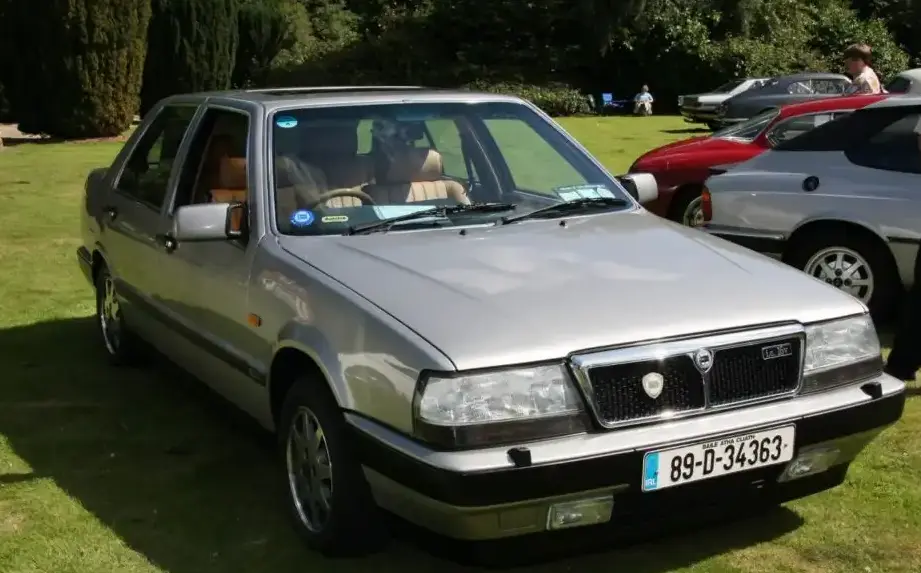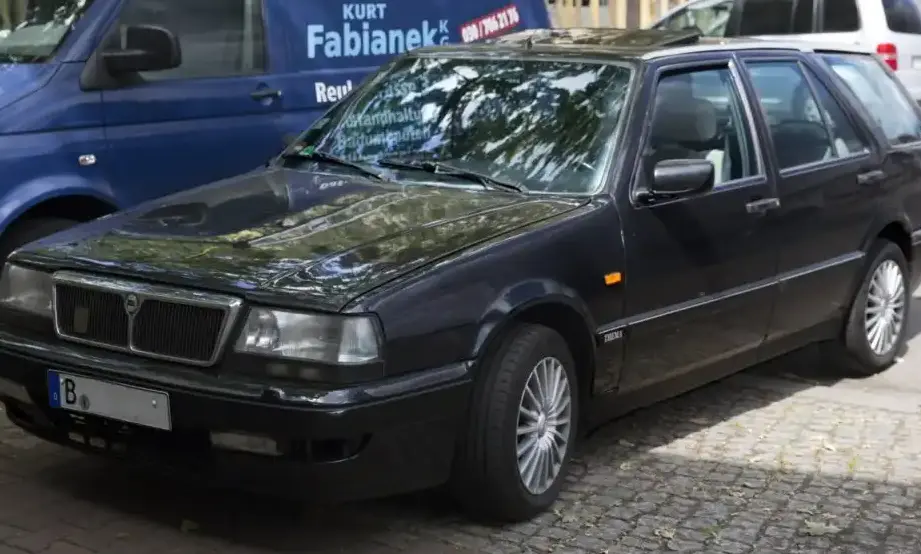
The Lancia Thema Station Wagon (834) 2000 Turbo 16V, produced between 1989 and 1992, represented a sophisticated and powerful offering in the European executive estate car segment. This variant, powered by the 834 C.146 engine, was positioned as a premium option within the Thema range, blending performance with the practicality of a station wagon body style. It built upon the success of the original Thema, launched in 1984, and aimed to provide a more dynamic driving experience compared to the naturally aspirated models while offering a spacious and luxurious interior. The 834 series specifically denotes the station wagon body style, distinguishing it from the sedan versions.
Technical Specifications
| Brand | Lancia |
| Model | Thema |
| Generation | Thema Station Wagon (834) |
| Type (Engine) | 2000 Turbo 16V (150 Hp) |
| Start of production | 1989 |
| End of production | 1992 |
| Powertrain Architecture | Internal Combustion engine |
| Body type | Station wagon (estate) |
| Fuel Type | Petrol (Gasoline) |
| Power | 150 Hp |
| Engine Model/Code | 834 C.146 |
| Engine aspiration | Turbocharger |
| Engine oil capacity | 5.5 l (5.81 US qt | 4.84 UK qt) |
| Coolant capacity | 8 l (8.45 US qt | 7.04 UK qt) |
Powertrain & Engine Architecture
The heart of the Thema 2000 Turbo 16V was the 834 C.146 engine, a 1995cc, inline-four cylinder powerplant. This engine was a significant evolution of Lancia’s earlier designs, featuring a cast iron block and an aluminum cylinder head. The “16V” designation indicates the four valves per cylinder, enhancing breathing and contributing to increased power output. Crucially, the engine employed a turbocharger with an intercooler, boosting horsepower to 150 hp. Fuel delivery was managed by Bosch Motronic electronic fuel injection, a sophisticated system for its time, optimizing fuel efficiency and emissions. The engine’s valvetrain utilized a dual overhead camshaft (DOHC) configuration, further improving valve control and engine responsiveness. The Thema 2000 Turbo 16V was typically paired with a four-speed automatic transmission, although a five-speed manual was also available, albeit less common. The automatic transmission was designed to provide smooth shifts and comfortable cruising, aligning with the luxury character of the vehicle.
Driving Characteristics
The 2000 Turbo 16V offered a noticeably more engaging driving experience than the naturally aspirated Thema variants. The turbocharger provided a substantial boost in torque, making overtaking maneuvers effortless. While not a sports car, the Thema Turbo delivered brisk acceleration, estimated around 8.5 seconds for the 0-60 mph sprint. The automatic transmission, while smooth, did introduce some power loss compared to the manual version. Gear ratios were tuned for comfortable highway cruising, with a focus on maximizing fuel efficiency at higher speeds. The suspension, a combination of independent front suspension and a semi-independent rear axle, provided a good balance between ride comfort and handling. The turbo lag, typical of turbochargers of that era, was present but manageable, delivering a surge of power once the boost built up. Compared to the base model Thema, the Turbo 16V offered a more refined and responsive driving experience, appealing to drivers who desired performance without sacrificing comfort.
Equipment & Trim Levels
The Thema Station Wagon 2000 Turbo 16V was generally well-equipped, reflecting its position as a premium vehicle. Standard features typically included central locking, electric windows, power steering, and an adjustable steering column. The interior was characterized by comfortable seating upholstered in high-quality cloth or optional leather. Dashboard design was functional and elegant, featuring wood trim and a comprehensive instrument cluster. Optional extras included a sunroof, upgraded audio system, and climate control. The station wagon body style itself added to the practicality, offering a generous cargo capacity and a versatile interior space. Trim levels varied slightly depending on the market, but generally, the Turbo 16V received a higher level of standard equipment than the base models.
Chassis & Braking
The Thema Station Wagon featured a robust chassis designed to handle the increased power of the Turbo 16V engine. The front suspension utilized independent MacPherson struts, while the rear employed a semi-independent torsion beam setup. This configuration provided a good compromise between ride comfort and handling stability. Braking duties were handled by disc brakes on all four wheels, providing ample stopping power. Anti-lock braking system (ABS) was often included as standard equipment or an optional extra, enhancing safety. Stabilizer bars were fitted to both the front and rear axles, reducing body roll during cornering. The Thema’s chassis was designed to provide a stable and predictable driving experience, even when fully loaded with passengers and luggage.
Market Reception & Comparison
The Lancia Thema Station Wagon 2000 Turbo 16V was generally well-received by automotive critics. It was praised for its powerful engine, comfortable ride, and spacious interior. However, some critics noted the turbo lag and the slightly dated design compared to newer competitors. Compared to other executive estates of the time, such as the Volvo 940 Turbo or the BMW 5 Series Touring, the Thema offered a unique blend of Italian style and performance. Fuel economy was reasonable for a turbocharged engine of that era, averaging around 22-26 mpg. Reliability was generally good, although the complexity of the fuel injection and turbocharging systems could lead to occasional maintenance issues. The Thema Turbo 16V appealed to buyers who wanted a stylish, comfortable, and powerful estate car with a touch of Italian flair.
Legacy
The Lancia Thema Station Wagon 2000 Turbo 16V remains a relatively rare and sought-after classic car today. The 834 C.146 engine, while complex, is generally considered to be durable if properly maintained. Parts availability can be a challenge, but a dedicated community of Lancia enthusiasts helps to keep these cars on the road. The Thema Turbo 16V represents a high point in Lancia’s engineering and design, offering a unique and rewarding driving experience. In the used car market, well-maintained examples command a premium price, reflecting their rarity and desirability. The car’s legacy lies in its combination of performance, luxury, and practicality, making it a memorable and distinctive vehicle from the late 1980s and early 1990s.