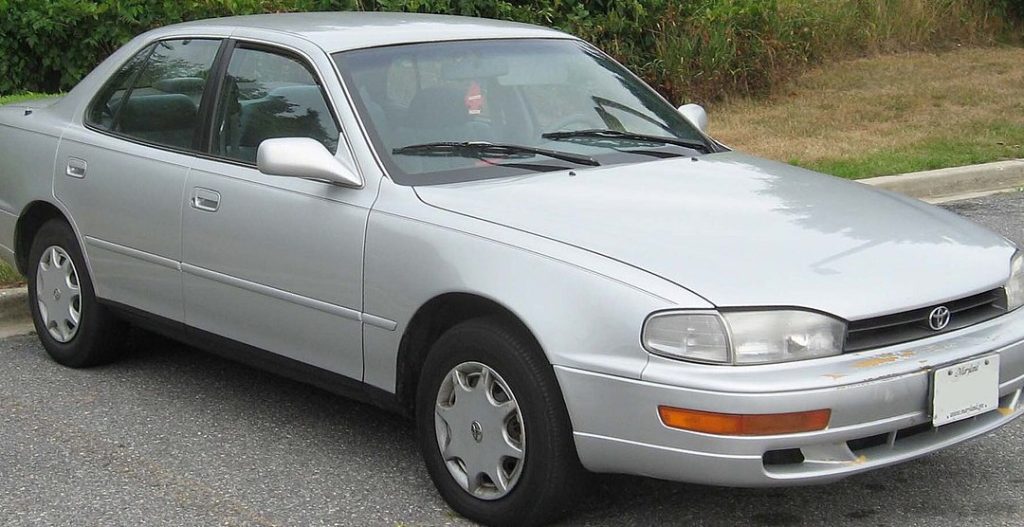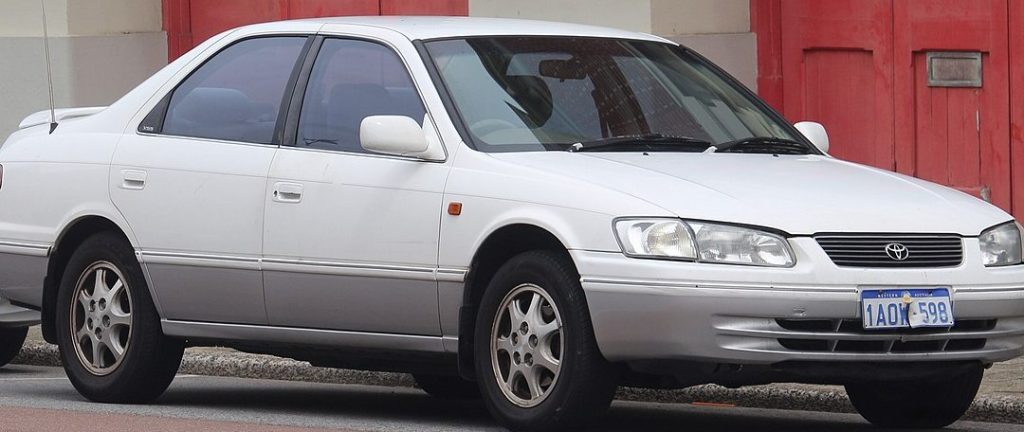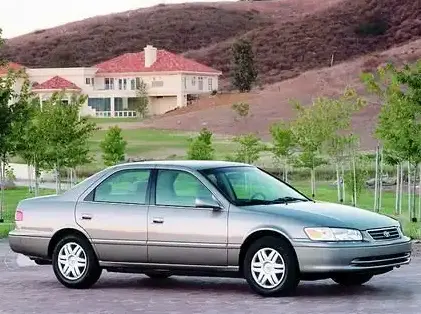
The Toyota Camry XV20, produced between 1996 and 1999, represented a significant step forward for Toyota’s mid-size sedan. Within the XV20 generation, the 3.0 V6 24V variant with an automatic transmission occupied a premium position, offering a blend of performance and comfort not found in the base four-cylinder models. This version aimed to appeal to buyers seeking a more refined and powerful Camry experience, particularly in the North American market where larger engines were highly favored. It served as a direct competitor to the Honda Accord V6 and Mazda 626, offering a compelling alternative with Toyota’s reputation for reliability.
Technical Specifications
| Brand | Toyota |
| Model | Camry |
| Generation | Camry IV (XV20) |
| Type (Engine) | 3.0 V6 24V (190 Hp) Automatic |
| Start of production | 1996 |
| End of production | 1999 |
| Powertrain Architecture | Internal Combustion engine |
| Body type | Sedan |
| Seats | 5 |
| Doors | 4 |
| Fuel consumption (urban) | 16.2 l/100 km (14.5 US mpg, 17.4 UK mpg, 6.2 km/l) |
| Fuel consumption (extra urban) | 8.7 l/100 km (27 US mpg, 32.5 UK mpg, 11.5 km/l) |
| Fuel Type | Petrol (Gasoline) |
| Acceleration 0 – 100 km/h | 9 sec |
| Acceleration 0 – 62 mph | 9 sec |
| Acceleration 0 – 60 mph | 8.6 sec |
| Maximum speed | 220 km/h (136.7 mph) |
| Weight-to-power ratio | 7.6 kg/Hp, 131.5 Hp/tonne |
| Weight-to-torque ratio | 5.3 kg/Nm, 190.3 Nm/tonne |
| Power | 190 Hp @ 5400 rpm |
| Power per litre | 63.4 Hp/l |
| Torque | 275 Nm @ 4400 rpm (202.83 lb.-ft. @ 4400 rpm) |
| Engine layout | Front, Transverse |
| Engine Model/Code | 1MZ-FE |
| Engine displacement | 2995 cm3 (182.77 cu. in.) |
| Number of cylinders | 6 |
| Engine configuration | V-engine |
| Cylinder Bore | 87.4 mm (3.44 in.) |
| Piston Stroke | 83.1 mm (3.27 in.) |
| Compression ratio | 10.5:1 |
| Number of valves per cylinder | 4 |
| Fuel injection system | Multi-port manifold injection |
| Engine aspiration | Naturally aspirated engine |
| Valvetrain | DOHC |
| Engine oil capacity | 4.7 l (4.97 US qt | 4.14 UK qt) |
| Coolant | 9.2 l (9.72 US qt | 8.09 UK qt) |
| Kerb Weight | 1445 kg (3185.68 lbs.) |
| Max. weight | 1915 kg (4221.85 lbs.) |
| Max load | 470 kg (1036.17 lbs.) |
| Trunk (boot) space – minimum | 518 l (18.29 cu. ft.) |
| Fuel tank capacity | 70 l (18.49 US gal | 15.4 UK gal) |
| Permitted trailer load with brakes (12%) | 1500 kg (3306.93 lbs.) |
| Permitted towbar download | 75 kg (165.35 lbs.) |
| Length | 4765 mm (187.6 in.) |
| Width | 1785 mm (70.28 in.) |
| Height | 1430 mm (56.3 in.) |
| Wheelbase | 2670 mm (105.12 in.) |
| Front track | 1545 mm (60.83 in.) |
| Rear (Back) track | 1520 mm (59.84 in.) |
| Front overhang | 960 mm (37.8 in.) |
| Rear overhang | 1135 mm (44.69 in.) |
| Drag coefficient (Cd) | 0.31 |
| Minimum turning circle (turning diameter) | 11.8 m (38.71 ft.) |
| Drivetrain Architecture | The Internal combustion engine (ICE) drives the front wheels of the vehicle. |
| Drive wheel | Front wheel drive |
| Number of gears and type of gearbox | 4 gears, automatic transmission |
| Front suspension | Independent type McPherson |
| Rear suspension | McPherson |
| Front brakes | Ventilated discs |
| Rear brakes | Disc |
| Assisting systems | ABS (Anti-lock braking system) |
| Steering type | Steering rack and pinion |
| Power steering | Hydraulic Steering |
| Tires size | 205/65 R15 |
| Wheel rims size | 15 |
Powertrain & Engine Architecture
The heart of this Camry variant is the 1MZ-FE 3.0-liter V6 engine. This engine, a member of Toyota’s MZ series, is a naturally aspirated, 24-valve (four valves per cylinder) powerplant featuring a double overhead camshaft (DOHC) design. The 1MZ-FE utilizes multi-port fuel injection, delivering fuel directly to each intake port for optimized combustion. The engine’s architecture prioritized smoothness and refinement over outright peak power, a characteristic typical of Toyota’s approach to V6 engines during this era. Paired with the engine was a four-speed automatic transmission, designed for comfortable cruising and ease of use. This transmission, while not offering the sportiness of a manual, provided smooth shifts and was well-suited to the Camry’s intended role as a family sedan. The automatic transmission featured electronically controlled torque converter lock-up for improved fuel efficiency at highway speeds.
Driving Characteristics
The 3.0 V6 automatic Camry offered a noticeable performance upgrade over the base 2.2-liter four-cylinder models. Acceleration to 60 mph took approximately 8.6 seconds, and the car felt responsive in everyday driving situations. While not a sports car, the V6 provided ample power for merging onto highways and passing other vehicles. The automatic transmission, while smooth, did exhibit some of the characteristics common to older four-speed automatics – occasional hunting for the right gear and a slight delay in downshifts. Compared to a manual transmission equipped Camry, the automatic sacrificed some responsiveness, but gained significantly in convenience. The gear ratios were tuned for comfortable cruising, prioritizing fuel economy and quiet operation over aggressive acceleration.
Equipment & Trim Levels
The 3.0 V6 Camry typically came well-equipped, often representing the upper echelon of the XV20 lineup. Standard features generally included air conditioning, power windows and locks, cruise control, and an upgraded sound system. Higher trim levels, often denoted by “XLE” or similar designations, added features such as leather upholstery, a sunroof, alloy wheels, and upgraded interior trim. Optional extras could include a CD changer, upgraded audio systems, and traction control. The interior design focused on comfort and practicality, with a spacious cabin and user-friendly controls.
Chassis & Braking
The Camry XV20 utilized an independent McPherson strut suspension in the front and a McPherson strut suspension in the rear. This setup provided a comfortable ride quality, absorbing bumps and irregularities in the road effectively. The 3.0 V6 models typically featured larger brakes than the four-cylinder versions, with ventilated discs up front and solid discs in the rear. Anti-lock brakes (ABS) were standard, enhancing safety and control during emergency braking situations. The steering was rack-and-pinion with hydraulic power assist, providing a responsive and predictable feel.
Market Reception & Comparison
The 3.0 V6 Camry was generally well-received by automotive critics. It was praised for its smooth engine, comfortable ride, and Toyota’s renowned reliability. However, some reviewers noted that the automatic transmission could feel somewhat dated compared to newer designs. Fuel economy, while acceptable, was not a strong point, particularly in city driving. Compared to the four-cylinder Camry, the V6 offered a significant performance boost but came at a higher price and with slightly lower fuel efficiency. Against competitors like the Honda Accord V6, the Camry offered a similar level of refinement and performance, often with a slight edge in perceived reliability.
Legacy
The 1MZ-FE engine, in general, proved to be a remarkably durable and reliable powerplant. Camry models equipped with this engine have a reputation for longevity, and many examples are still on the road today with high mileage. The four-speed automatic transmission, while not as sophisticated as modern transmissions, also proved to be relatively reliable. In the used car market, the 3.0 V6 Camry XV20 remains a popular choice for buyers seeking a comfortable, reliable, and relatively affordable mid-size sedan. Maintenance costs are generally reasonable, and parts availability is good. However, potential buyers should be aware of the possibility of age-related issues, such as worn suspension components and potential oil leaks.