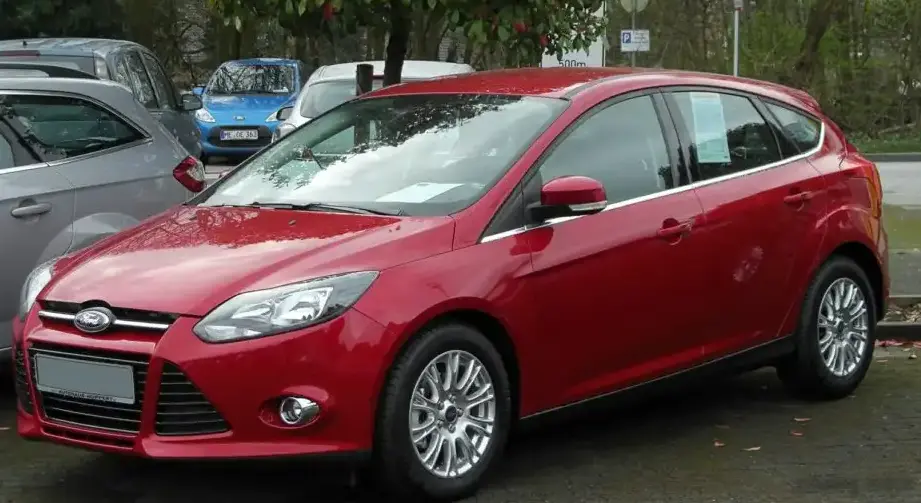
The Ford Focus III Hatchback, produced from 2010 to 2014, represented a significant step forward for Ford’s global compact car. The 2.0 Ti-VCT (160 Hp) PowerShift variant occupied a mid-range position within the Focus III lineup, offering a balance between performance and fuel efficiency. This model was primarily aimed at buyers seeking a more engaging driving experience than the base 1.6L engine offered, without the higher price tag of the performance-oriented ST model. It was a key offering in both European and North American markets, though its popularity varied depending on regional preferences for transmission types.
Technical Specifications
| Brand | Ford |
| Model | Focus |
| Generation | Focus III Hatchback |
| Type (Engine) | 2.0 Ti-VCT (160 Hp) PowerShift |
| Start of production | 2010 |
| End of production | 2014 |
| Powertrain Architecture | Internal Combustion engine |
| Body type | Hatchback |
| Seats | 5 |
| Doors | 5 |
| Fuel consumption (urban) | 8.4-8.7 l/100 km (28-27 US mpg) |
| Fuel consumption (extra urban) | 5.9-6.4 l/100 km (39.9-36.8 US mpg) |
| Fuel consumption (combined) | 7.1-7.6 l/100 km (33.1-30.9 US mpg) |
| Fuel Type | Petrol (Gasoline) |
| Emission standard | SULEV |
| Weight-to-power ratio | 8.4 kg/Hp |
| Weight-to-torque ratio | 6.8 kg/Nm |
| Power | 160 Hp @ 6500 rpm |
| Power per litre | 80 Hp/l |
| Torque | 198 Nm @ 4450 rpm (146.04 lb.-ft. @ 4450 rpm) |
| Engine layout | Front, Transverse |
| Engine Model/Code | Duratec |
| Engine displacement | 1999 cm3 (121.99 cu. in.) |
| Number of cylinders | 4 |
| Engine configuration | Inline |
| Cylinder Bore | 87.5 mm (3.44 in.) |
| Piston Stroke | 83.1 mm (3.27 in.) |
| Compression ratio | 12:1 |
| Number of valves per cylinder | 4 |
| Fuel injection system | Direct injection |
| Engine aspiration | Naturally aspirated engine |
| Valvetrain | DOHC, Ti-VCT |
| Engine oil capacity | 4.3 l (4.54 US qt | 3.78 UK qt) |
| Coolant capacity | 5 l (5.28 US qt | 4.4 UK qt) |
| Kerb Weight | 1337 kg (2947.58 lbs.) |
| Trunk (boot) space – minimum | 316 l (11.16 cu. ft.) |
| Trunk (boot) space – maximum | 1101 l (38.88 cu. ft.) |
| Fuel tank capacity | 47 l (12.42 US gal | 10.34 UK gal) |
| Length | 4359 mm (171.61 in.) |
| Width | 1824 mm (71.81 in.) |
| Height | 1466 mm (57.72 in.) |
| Wheelbase | 2649 mm (104.29 in.) |
| Front track | 1554 mm (61.18 in.) |
| Rear track | 1534 mm (60.39 in.) |
| Minimum turning circle | 11 m (36.09 ft.) |
| Drivetrain | Front wheel drive |
| Number of gears | 6 |
| Gearbox type | Automatic transmission PowerShift |
| Front suspension | Independent, McPherson with coil spring and anti-roll bar |
| Rear suspension | Independent multi-link spring suspension with stabilizer |
| Front brakes | Ventilated discs, 278 mm |
| Rear brakes | Drum, 228 mm |
| Assisting systems | ABS (Anti-lock braking system) |
| Steering type | Steering rack and pinion |
| Power steering | Electric Steering |
| Tires size | 195/65 R15; 215/55 R16; 215/50 R17; 235/40 R18 |
| Wheel rims size | 15; 16; 17; 18 |
INTRODUCTION
The Ford Focus III, launched in 2010, was a globally significant vehicle for Ford, representing a move towards a “One Ford” strategy – a single, unified platform for the compact car across multiple markets. The 2.0 Ti-VCT PowerShift variant, available from 2010-2014, was positioned as a step up from the base 1.6L engine, offering increased performance and a more sophisticated driving experience. It utilized Ford’s PowerShift dual-clutch transmission (DCT), a technology aimed at providing the efficiency of a manual gearbox with the convenience of an automatic. This particular configuration was popular in Europe and North America, offering a compelling alternative to traditional automatic transmissions.
Powertrain & Engine Architecture
At the heart of the 2.0 Ti-VCT model lies Ford’s Duratec 2.0-liter inline-four cylinder engine. This engine, internally designated with various codes depending on the market, featured direct fuel injection and Ford’s Twin Independent Variable Camshaft Timing (Ti-VCT) technology. Ti-VCT allowed for independent control of intake and exhaust valve timing, optimizing engine performance and efficiency across a wider range of engine speeds. The engine produced 160 horsepower at 6500 rpm and 198 Nm (146 lb-ft) of torque at 4450 rpm. The PowerShift 6-speed dual-clutch transmission (DCT) was a key component. Unlike a traditional automatic, PowerShift uses two separate clutches – one for odd-numbered gears and one for even-numbered gears – allowing for quicker, smoother shifts and improved fuel economy. The transmission’s control unit managed gear selection based on driving conditions and driver input.
Driving Characteristics
The 2.0 Ti-VCT PowerShift Focus offered a noticeable improvement in performance compared to the 1.6L base model. The dual-clutch transmission provided quick and responsive shifts, particularly during spirited driving. While not a sports car, the 160 hp engine provided adequate power for everyday driving and highway cruising. The PowerShift transmission, however, wasn’t without its quirks. Some drivers reported occasional low-speed jerkiness or hesitation, particularly during parking maneuvers. The gear ratios were tuned for a balance between acceleration and fuel economy, with a relatively tall sixth gear for efficient highway cruising. Compared to the manual transmission versions of the 2.0L engine, the PowerShift offered convenience but slightly diminished fuel economy and a less direct connection to the drivetrain.
Equipment & Trim Levels
The 2.0 Ti-VCT PowerShift was typically offered in mid-range trim levels, such as the SEL or Limited (depending on the market). Standard features generally included air conditioning, power windows and locks, a basic audio system with USB connectivity, and alloy wheels. Higher trim levels added features like leather upholstery, a sunroof, a premium audio system, and advanced safety features such as stability control and traction control. Optional extras included navigation systems, rear parking sensors, and automatic climate control. Interior upholstery was typically cloth on lower trims and leather on higher trims. The dashboard layout was generally functional and well-designed, with a focus on ergonomics.
Chassis & Braking
The Focus III utilized a McPherson strut front suspension and an independent multi-link rear suspension. This setup provided a good balance between ride comfort and handling. The 2.0 Ti-VCT models typically featured slightly stiffer suspension components compared to the base models to better manage the increased power. Braking systems varied depending on trim level. Lower trims often featured disc brakes up front and drum brakes in the rear, while higher trims typically had disc brakes on all four wheels. All models were equipped with ABS (Anti-lock Braking System) as standard. Stabilizer bars were fitted to both the front and rear suspension to reduce body roll during cornering.
Market Reception & Comparison
The 2.0 Ti-VCT PowerShift Focus received generally positive reviews from automotive critics. The engine was praised for its smooth power delivery and fuel efficiency, while the PowerShift transmission was lauded for its quick shifts. However, the transmission’s occasional jerkiness and reliability concerns were also noted. Compared to the 1.6L base model, the 2.0 Ti-VCT offered a significant performance upgrade. Compared to the higher-performance ST model, it provided a more comfortable ride and better fuel economy, albeit with less outright performance. Fuel economy figures were competitive for the segment, typically ranging from 30-33 mpg combined. Reliability was a mixed bag, with some owners reporting issues with the PowerShift transmission, including clutch failures and software glitches.
Legacy
The Ford Focus III 2.0 Ti-VCT PowerShift remains a relatively common sight on used car lots today. While the PowerShift transmission’s reliability has been a concern, many examples have proven to be durable with proper maintenance. The engine itself is generally considered to be reliable. The model’s legacy lies in its contribution to Ford’s global compact car strategy and its introduction of dual-clutch transmission technology to a wider audience. The 2.0 Ti-VCT PowerShift variant offers a compelling combination of performance, fuel efficiency, and features for buyers seeking a well-rounded compact hatchback, but potential buyers should be aware of the potential for PowerShift transmission issues and factor that into their purchasing decision.