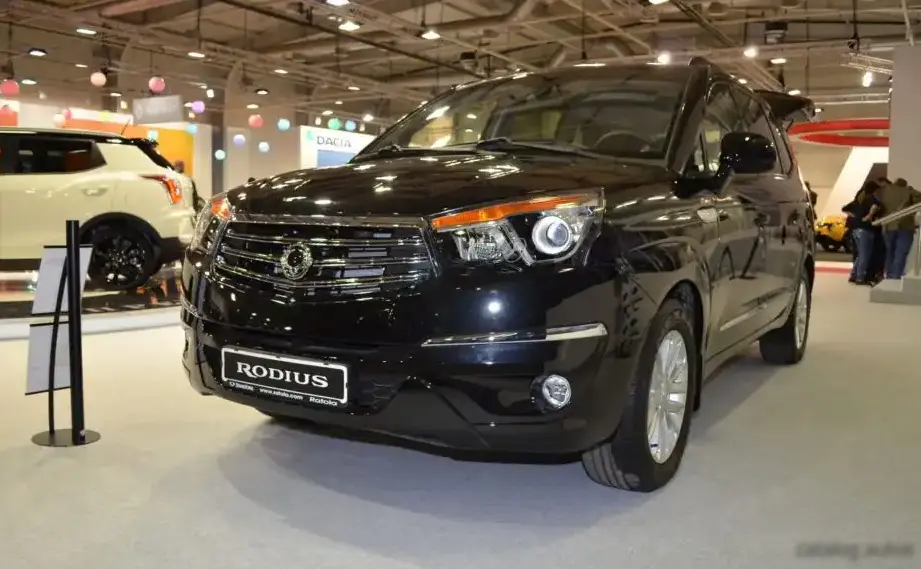
The SsangYong Rodius I 2.7 20V, producing 163 horsepower, was a seven to eight-seat minivan manufactured by the South Korean automaker SsangYong from 2004 to 2013. Positioned as a larger, more utilitarian alternative to conventional MPVs, the Rodius aimed to provide spaciousness and all-wheel-drive capability at a competitive price point. It was primarily marketed in Europe and Asia, with limited sales in other regions. The Rodius I represented SsangYong’s attempt to enter the family vehicle segment with a focus on practicality and off-road ability, leveraging their expertise in SUV technology. This particular 2.7-liter diesel variant occupied a mid-range position within the Rodius lineup, offering a balance between performance and fuel economy.
Technical Specifications
| Brand | SsangYong |
| Model | Rodiuss |
| Generation | Rodiuss I |
| Type (Engine) | 2.7 20V (163 Hp) |
| Start of production | 2004 |
| End of production | 2013 |
| Powertrain Architecture | Internal Combustion engine |
| Body type | Minivan |
| Seats | 7 |
| Doors | 5 |
| Fuel consumption (urban) | 11 l/100 km (21.4 US mpg) |
| Fuel consumption (extra urban) | 7.2 l/100 km (32.7 US mpg) |
| Fuel Type | Diesel |
| Acceleration 0 – 100 km/h | 13.5 sec |
| Acceleration 0 – 62 mph | 13.5 sec |
| Acceleration 0 – 60 mph | 12.8 sec |
| Maximum speed | 169 km/h (105.01 mph) |
| Weight-to-power ratio | 12.3 kg/Hp |
| Weight-to-torque ratio | 5.8 kg/Nm |
| Power | 163 Hp @ 4000 rpm |
| Torque | 345 Nm @ 1800 rpm (254.46 lb.-ft. @ 1800 rpm) |
| Engine layout | Front, Longitudinal |
| Engine Model/Code | D27DT |
| Engine displacement | 2696 cm3 (164.52 cu. in.) |
| Number of cylinders | 5 |
| Engine configuration | Inline |
| Cylinder Bore | 86.2 mm (3.39 in.) |
| Piston Stroke | 92.4 mm (3.64 in.) |
| Compression ratio | 18:1 |
| Number of valves per cylinder | 4 |
| Fuel injection system | Diesel Commonrail |
| Engine oil capacity | 8 l (8.45 US qt | 7.04 UK qt) |
| Kerb Weight | 2010 kg (4431.29 lbs.) |
| Max. weight | 2750 kg (6062.71 lbs.) |
| Max load | 740 kg (1631.42 lbs.) |
| Trunk (boot) space – minimum | 893 l (31.54 cu. ft.) |
| Trunk (boot) space – maximum | 3322 l (117.32 cu. ft.) |
| Fuel tank capacity | 80 l (21.13 US gal | 17.6 UK gal) |
| Length | 5130 mm (201.97 in.) |
| Width | 1915 mm (75.39 in.) |
| Height | 1820 mm (71.65 in.) |
| Wheelbase | 3000 mm (118.11 in.) |
| Front track | 1590 mm (62.6 in.) |
| Rear (Back) track | 1580 mm (62.2 in.) |
| Drive wheel | All wheel drive (4×4) |
| Number of gears and type of gearbox | 5 gears, manual transmission |
| Front suspension | Coil spring |
| Rear suspension | Coil spring |
| Front brakes | Disc |
| Rear brakes | Disc |
| Assisting systems | ABS (Anti-lock braking system) |
| Steering type | Steering rack and pinion |
| Tires size | 235/70 R16 |
Powertrain & Engine Architecture
The Rodius I 2.7 20V was powered by the D27DT, a 2.7-liter inline five-cylinder diesel engine. This engine was a product of SsangYong’s own development, and featured a cast iron block and aluminum cylinder head. The engine utilized a common rail direct injection system, delivering fuel at high pressure for improved combustion efficiency and reduced emissions. A turbocharger with an intercooler was employed to boost power output. The engine produced 163 horsepower at 4000 rpm and 345 Nm (254.46 lb-ft) of torque at 1800 rpm. The five-speed manual transmission was the standard offering for this variant, providing a relatively conventional driving experience. The engine’s longitudinal mounting allowed for a traditional rear-wheel-drive layout, with all-wheel drive functionality added through a transfer case.
Driving Characteristics
The 2.7-liter diesel engine in the Rodius I provided adequate, though not particularly brisk, performance. Acceleration from 0-60 mph took around 12.8 seconds, and top speed was limited to 105 mph. The engine’s torque peak at 1800 rpm meant that it offered reasonable pulling power for everyday driving and when fully loaded. However, the five-speed manual transmission’s gear ratios were spaced to prioritize fuel economy over outright acceleration. Compared to potential higher-output versions (which were not widely available), this 163 hp variant felt less strained during highway cruising but lacked the responsiveness needed for more dynamic driving. The all-wheel-drive system provided enhanced traction in slippery conditions, making it suitable for rural areas or inclement weather.
Equipment & Trim Levels
The Rodius I 2.7 20V typically came equipped with features such as air conditioning, power windows, central locking, and an audio system. Higher trim levels added options like leather upholstery, alloy wheels, a sunroof, and parking sensors. Interior materials were generally durable and practical, reflecting the vehicle’s utilitarian focus. The spacious cabin was a key selling point, offering comfortable seating for seven or eight passengers depending on the configuration. The rear seats could be folded flat or even removed entirely to maximize cargo space. Safety features included ABS brakes and, on some models, airbags.
Chassis & Braking
The Rodius I utilized a body-on-frame construction, which contributed to its robust feel and off-road capability. The front suspension consisted of coil springs and a stabilizer bar, while the rear suspension also employed coil springs. Brakes were discs all around, providing adequate stopping power for the vehicle’s weight. The all-wheel-drive system featured a part-time four-wheel-drive mode, selectable by the driver. The steering was a rack-and-pinion system, offering reasonable precision but lacking the feel of more modern steering setups.
Market Reception & Comparison
The SsangYong Rodius I received mixed reviews from automotive critics. While its spaciousness and all-wheel-drive capability were praised, its styling was often criticized as being unconventional and somewhat awkward. The 2.7-liter diesel engine was considered adequate for its intended purpose, but some reviewers noted its lack of refinement compared to engines from established European manufacturers. Fuel economy was reasonable for a vehicle of its size and type, averaging around 21.4 mpg in urban driving and 32.7 mpg on the highway. Compared to other MPVs on the market, the Rodius offered a unique combination of features and affordability, but its limited brand recognition and polarizing styling hindered its sales success.
Legacy
The SsangYong Rodius I, particularly the 2.7-liter diesel variant, has developed a reputation for being a relatively reliable and durable vehicle. The D27DT engine, while not known for being particularly high-tech, proved to be robust and capable of handling high mileage with proper maintenance. On the used car market, the Rodius I represents an affordable option for those seeking a spacious and practical vehicle with all-wheel-drive capability. However, potential buyers should be aware of the vehicle’s age and the potential for wear and tear on components such as the suspension and brakes. Parts availability can sometimes be a challenge, depending on the region. Despite its limited commercial success, the Rodius I remains a distinctive and interesting vehicle in the history of SsangYong.