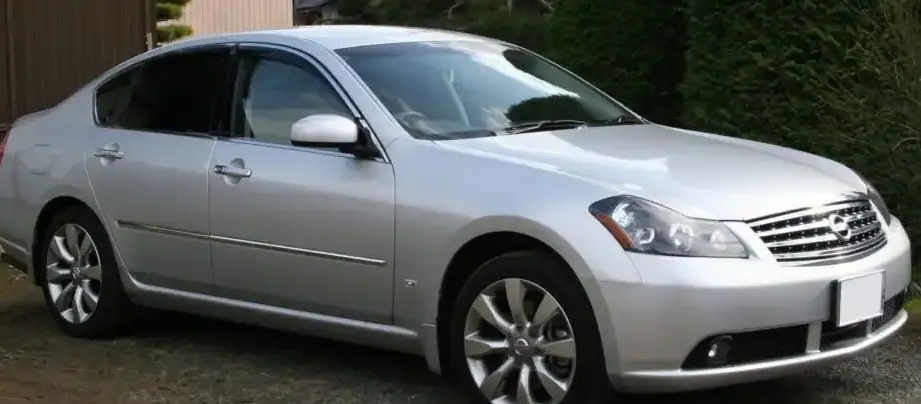
Technical Specifications
| Brand | Nissan |
| Model | Fuga |
| Generation | Fuga I (Y50, facelift 2007) |
| Type (Engine) | 2.5L V6 (223 Hp) |
| Start of production | 2006 |
| End of production | 2009 |
| Powertrain Architecture | Internal Combustion engine |
| Body type | Sedan |
| Seats | 5 |
| Doors | 4 |
| Fuel Type | Petrol (Gasoline) |
| Weight-to-power ratio | 7.6 kg/Hp, 132 Hp/tonne |
| Weight-to-torque ratio | 6.4 kg/Nm, 155.6 Nm/tonne |
| Power | 223 Hp @ 6800 rpm |
| Power per litre | 89.4 Hp/l |
| Torque | 263 Nm @ 4800 rpm, 193.98 lb.-ft. @ 4800 rpm |
| Engine layout | Front, Longitudinal |
| Engine Model/Code | VQ25HR |
| Engine displacement | 2495 cm3, 152.25 cu. in. |
| Number of cylinders | 6 |
| Engine configuration | V-engine |
| Number of valves per cylinder | 4 |
| Fuel injection system | Multi-port manifold injection |
| Engine aspiration | Naturally aspirated engine |
| Engine oil capacity | 4.7 l, 4.97 US qt | 4.14 UK qt |
| Kerb Weight | 1690 kg, 3725.81 lbs |
| Max. weight | 1965 kg, 4332.08 lbs |
| Max load | 275 kg, 606.27 lbs |
| Fuel tank capacity | 80 l, 21.13 US gal | 17.6 UK gal |
| Length | 4930 mm, 194.09 in |
| Width | 1805 mm, 71.06 in |
| Height | 1510 mm, 59.45 in |
| Wheelbase | 2900 mm, 114.17 in |
| Front track | 1540 mm, 60.63 in |
| Rear (Back) track | 1555 mm, 61.22 in |
| Drivetrain Architecture | The Internal combustion engine (ICE) drives the rear wheels of the vehicle. |
| Drive wheel | Rear wheel drive |
| Number of gears and type of gearbox | 5 gears, automatic transmission |
| Front brakes | Ventilated discs |
| Rear brakes | Ventilated discs |
| Assisting systems | ABS (Anti-lock braking system) |
| Tires size | 225/55 R17 |
The Nissan Fuga Y50, launched in 2004, was a pivotal model for Nissan, aiming to compete with established luxury sedans from Toyota (Aristo/Lexus GS) and Honda (Inspire/Acura RL). The 2007 facelift brought revised styling, including a more prominent grille and updated interior elements. The 2.5L V6 variant, powered by the VQ25HR engine, served as the entry point to the Fuga range in Japan. It offered a more accessible price point compared to the 3.5L V6 models, appealing to buyers prioritizing comfort and refinement over outright performance. The Fuga was built on the Nissan S platform, shared with other Nissan and Renault vehicles.
Powertrain & Engine Architecture
The heart of this Fuga variant is the VQ25HR 2.5-liter V6 engine. This engine is part of Nissan’s highly regarded VQ engine family, known for its smooth operation and reliability. The ‘HR’ designation signifies ‘High Revolution,’ indicating a focus on higher engine speeds and improved breathing. The VQ25HR utilizes a dual overhead camshaft (DOHC) valvetrain with four valves per cylinder, and a multi-port fuel injection system. Nissan’s Continuously Variable Valve Timing Control System (CVTCS) optimizes valve timing for improved performance and fuel efficiency across the rev range. The engine produces 223 horsepower at 6800 rpm and 263 Nm (193.98 lb-ft) of torque at 4800 rpm. The engine is longitudinally mounted, driving the rear wheels. The transmission is a 5-speed automatic, offering smooth shifts but lacking the efficiency of more modern transmissions. This automatic transmission was chosen for its comfort and ease of use, aligning with the Fuga’s luxury positioning.
Driving Characteristics
The 2.5L Fuga with the 5-speed automatic delivers a comfortable and refined driving experience. Acceleration is adequate for everyday driving, but it doesn’t offer the briskness of the 3.5L models. The automatic transmission is tuned for smooth shifts, prioritizing comfort over sporty responsiveness. The gear ratios are optimized for cruising, making it a pleasant highway companion. Compared to the manual transmission options available on some Fuga trims, the automatic sacrifices some driver engagement. The rear-wheel-drive configuration provides a balanced feel, although it doesn’t offer the dynamic handling of some European competitors. The weight of the vehicle (1690 kg / 3725.81 lbs) is noticeable, particularly during spirited driving.
Equipment & Trim Levels
The 2.5L Fuga typically came equipped with a generous amount of standard features, reflecting its luxury positioning. These included leather upholstery, power-adjustable front seats, a premium audio system, automatic climate control, and woodgrain interior trim. Optional extras included a navigation system, sunroof, and advanced safety features like adaptive cruise control and lane departure warning. The interior design emphasized spaciousness and comfort, with a focus on high-quality materials. Trim levels varied depending on the specific package selected, but generally offered a refined and well-appointed cabin.
Chassis & Braking
The Fuga Y50 utilizes a MacPherson strut front suspension and a multi-link rear suspension. This setup provides a comfortable ride, absorbing bumps and imperfections in the road effectively. Stabilizer bars are fitted to both the front and rear axles to reduce body roll during cornering. The braking system consists of ventilated discs on all four wheels, providing ample stopping power. Anti-lock braking system (ABS) is standard, enhancing safety and control. The suspension tuning is geared towards comfort rather than sporty handling, prioritizing a smooth and relaxed driving experience.
Market Reception & Comparison
The 2.5L Fuga was well-received in the Japanese market as a comfortable and stylish luxury sedan. Critics praised its spacious interior, smooth ride, and refined engine. However, some noted that its performance was not as exhilarating as the 3.5L models. Fuel economy was considered average for its class. Compared to the 3.5L Fuga, the 2.5L offered a more affordable entry point, but at the expense of performance. The 3.5L models were favored by buyers seeking a more dynamic driving experience. Compared to European rivals like the BMW 5 Series and Mercedes-Benz E-Class, the Fuga offered a competitive level of luxury and features at a lower price point.
Legacy
The Nissan Fuga Y50, particularly the 2.5L variant, has proven to be a reliable and durable vehicle. The VQ25HR engine is known for its longevity, and with proper maintenance, can provide many years of trouble-free service. The 5-speed automatic transmission is also generally reliable, although it may require servicing as it ages. In the used car market, the 2.5L Fuga represents a good value proposition, offering a comfortable and well-equipped luxury sedan at an affordable price. While it may not be as sought after as the higher-performance 3.5L models, it remains a popular choice for buyers seeking a refined and reliable Japanese luxury car.