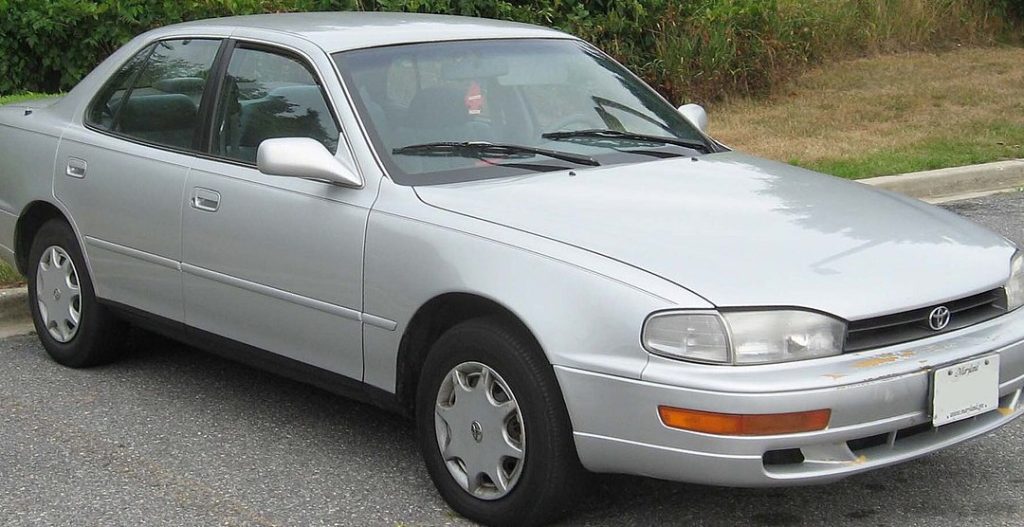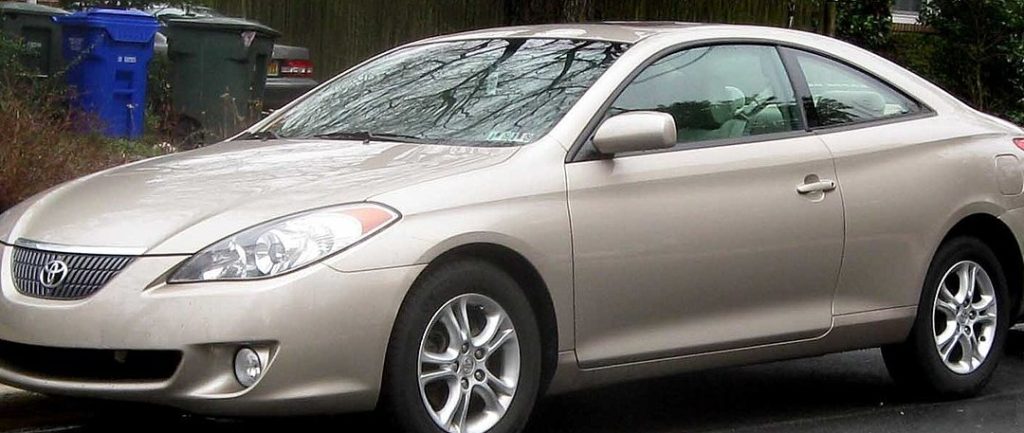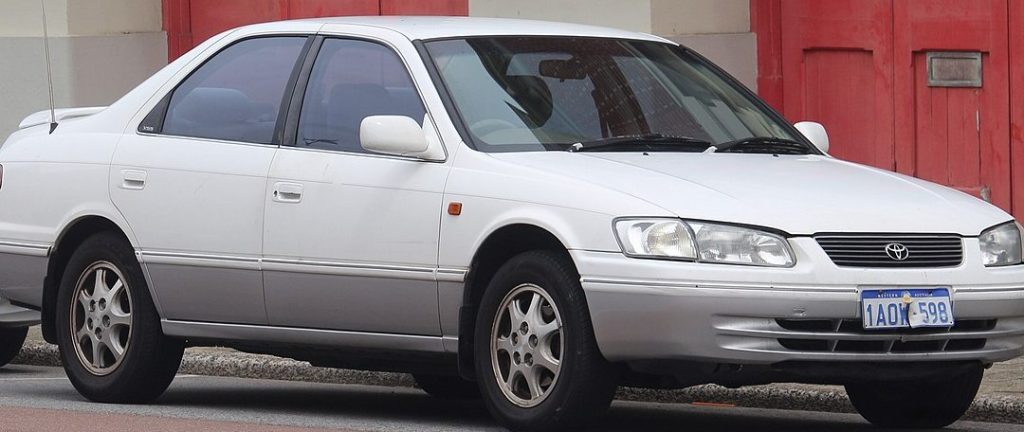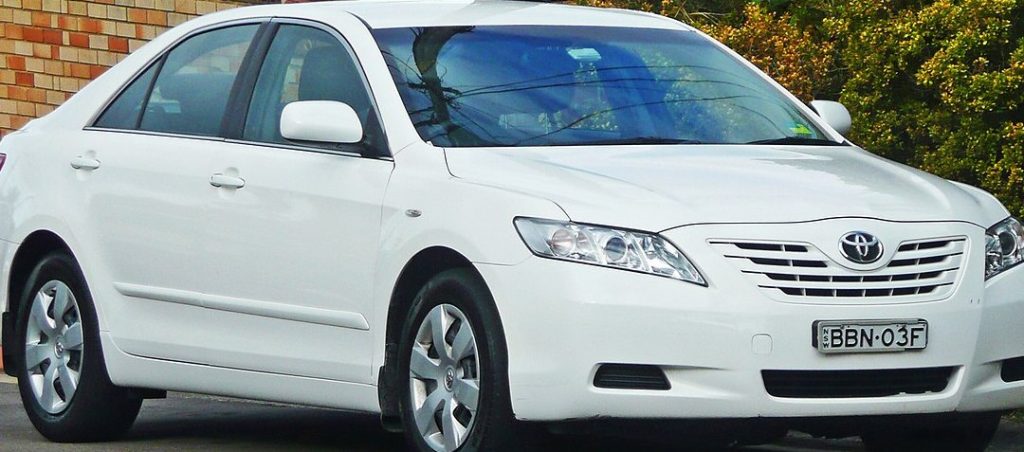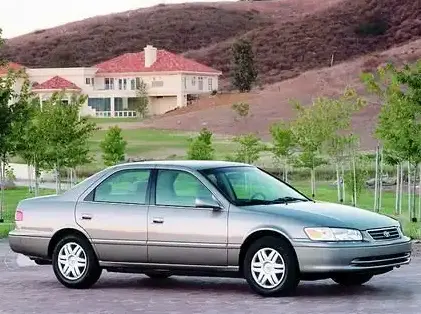
The Toyota Camry IV (XV20) Sport 2.2, produced between 1996 and 1999, represented a significant evolution in Toyota’s mid-size sedan offering. Positioned as a sportier variant within the fourth-generation Camry lineup (XV20 chassis), it aimed to attract buyers seeking a balance between practicality, reliability, and a more engaging driving experience. This model occupied a middle ground in the XV20 range, offering more performance than the base models but falling short of the luxury appointments found in higher trim levels. The XV20 generation Camry was a crucial model for Toyota, solidifying its reputation for quality and dependability in the North American market, where it was increasingly becoming a dominant force in the family sedan segment.
Technical Specifications
| Brand | Toyota |
| Model | Camry |
| Generation | Camry IV (XV20) |
| Type | Sport 2.2 (128 Hp) |
| Start of production | 1996 |
| End of production | 1999 |
| Powertrain Architecture | Internal Combustion engine |
| Body type | Sedan |
| Seats | 5 |
| Doors | 4 |
| Fuel Type | Petrol (Gasoline) |
| Acceleration 0 – 100 km/h | 10.4 sec |
| Acceleration 0 – 62 mph | 10.4 sec |
| Acceleration 0 – 60 mph | 9.9 sec |
| Maximum speed | 195 km/h (121.17 mph) |
| Weight-to-power ratio | 10.8 kg/Hp, 92.4 Hp/tonne |
| Weight-to-torque ratio | 7.1 kg/Nm, 140.1 Nm/tonne |
| Power | 128 Hp @ 5400 rpm |
| Power per litre | 59.1 Hp/l |
| Torque | 194 Nm @ 4400 rpm (143.09 lb.-ft. @ 4400 rpm) |
| Engine layout | Front, Transverse |
| Engine Model/Code | 5S-FE |
| Engine displacement | 2164 cm3 (132.06 cu. in.) |
| Number of cylinders | 4 |
| Engine configuration | Inline |
| Cylinder Bore | 87 mm (3.43 in.) |
| Piston Stroke | 91 mm (3.58 in.) |
| Compression ratio | 9.8:1 |
| Number of valves per cylinder | 4 |
| Fuel injection system | Multi-port manifold injection |
| Engine aspiration | Naturally aspirated engine |
| Valvetrain | DOHC |
| Engine oil capacity | 3.6 l (3.8 US qt | 3.17 UK qt) |
| Coolant | 6.2 l (6.55 US qt | 5.46 UK qt) |
| Kerb Weight | 1385 kg (3053.4 lbs) |
| Max. weight | 1860 kg (4100.6 lbs) |
| Max load | 475 kg (1047.2 lbs) |
| Trunk (boot) space – minimum | 518 l (18.29 cu. ft.) |
| Fuel tank capacity | 70 l (18.49 US gal | 15.4 UK gal) |
| Permitted trailer load with brakes (12%) | 1500 kg (3306.93 lbs) |
| Permitted towbar download | 75 kg (165.35 lbs) |
| Length | 4765 mm (187.6 in.) |
| Width | 1785 mm (70.28 in.) |
| Height | 1410 mm (55.51 in.) |
| Wheelbase | 2670 mm (105.12 in.) |
| Front track | 1545 mm (60.83 in.) |
| Rear (Back) track | 1520 mm (59.84 in.) |
| Front overhang | 960 mm (37.8 in.) |
| Rear overhang | 1135 mm (44.69 in.) |
| Drag coefficient (Cd) | 0.31 |
| Minimum turning circle (turning diameter) | 11.8 m (38.71 ft) |
| Drivetrain Architecture | The Internal combustion engine (ICE) drives the front wheels of the vehicle. |
| Drive wheel | Front wheel drive |
| Number of gears and type of gearbox | 5 gears, manual transmission |
| Front suspension | Independent type McPherson |
| Rear suspension | McPherson |
| Front brakes | Ventilated discs |
| Rear brakes | Disc |
| Assisting systems | ABS (Anti-lock braking system) |
| Steering type | Steering rack and pinion |
| Power steering | Hydraulic Steering |
| Tires size | 205/65 R15 |
| Wheel rims size | 15 |
INTRODUCTION
The XV20 Camry Sport 2.2 was a key component of Toyota’s strategy to broaden the Camry’s appeal. While the Camry had already established itself as a reliable and comfortable family sedan, Toyota recognized the need to offer a version that catered to drivers seeking a slightly more dynamic experience. The “Sport” designation indicated a focus on improved handling and a more responsive engine, though it remained firmly rooted in the Camry’s core values of practicality and dependability. This variant was primarily sold in North America, where the demand for sporty-leaning sedans was growing, and it played a role in attracting a younger demographic to the Camry nameplate.
Powertrain & Engine Architecture
At the heart of the Camry Sport 2.2 lay the 5S-FE 2.2-liter inline-four engine. This engine was a staple of Toyota’s lineup during the 1990s, known for its robust construction and relatively simple design. The 5S-FE featured a double overhead camshaft (DOHC) valvetrain, operating four valves per cylinder, and utilized a multi-port fuel injection system for precise fuel delivery. The engine produced 128 horsepower at 5400 rpm and 194 Nm (143 lb-ft) of torque at 4400 rpm. The engine’s relatively high compression ratio of 9.8:1 contributed to its efficiency and responsiveness. The engine was transversely mounted in the front of the vehicle, driving the front wheels. The standard transmission for the Sport 2.2 was a five-speed manual, although a four-speed automatic transmission was also available, impacting the vehicle’s acceleration and fuel economy.
Driving Characteristics
The Camry Sport 2.2 with the five-speed manual transmission offered a reasonably engaging driving experience for its time. While not a true sports sedan, the 2.2-liter engine provided adequate power for everyday driving and highway passing. The manual gearbox allowed drivers to take greater control over the engine’s powerband, resulting in quicker acceleration and a more connected feel. The automatic transmission, while offering convenience, noticeably dulled the car’s responsiveness. The gear ratios were tuned for fuel efficiency rather than outright performance. Compared to the base 2.2-liter Camry, the Sport model benefited from a slightly firmer suspension setup, which reduced body roll and improved handling. However, it still prioritized ride comfort over razor-sharp cornering ability. Compared to the V6-powered Camry models, the Sport 2.2 offered significantly less power, resulting in slower acceleration times, but it also provided better fuel economy.
Equipment & Trim Levels
The Camry Sport 2.2 typically included features such as power windows, power locks, and air conditioning as standard equipment. The interior featured cloth upholstery, and the dashboard layout was functional and straightforward. Optional extras included a sunroof, upgraded audio system, and alloy wheels. The Sport trim also often featured unique exterior styling cues, such as a rear spoiler and body-colored side moldings, to differentiate it from the more conservatively styled base models. The interior trim was generally focused on durability and ease of use, rather than luxurious materials.
Chassis & Braking
The XV20 Camry utilized a McPherson strut suspension setup at both the front and rear. This independent suspension design provided a good balance between ride comfort and handling. The Sport 2.2 often featured a slightly thicker front stabilizer bar compared to the base models, further reducing body roll. Braking duties were handled by ventilated discs at the front and solid discs at the rear. An anti-lock braking system (ABS) was standard, enhancing safety and control during emergency braking situations. The steering system was a rack-and-pinion setup with hydraulic power assistance, providing responsive and precise steering feel.
Market Reception & Comparison
The Camry Sport 2.2 was generally well-received by automotive critics as a competent and reliable mid-size sedan. However, some reviewers noted that the “Sport” designation was somewhat misleading, as the car didn’t offer the same level of performance as true sports sedans. Compared to other trims in the Camry lineup, the Sport 2.2 offered a more engaging driving experience at a relatively affordable price. Its fuel economy was comparable to the base 2.2-liter models, but its performance was noticeably improved. Against competitors like the Honda Accord and Nissan Sentra, the Camry Sport 2.2 offered a strong value proposition, combining reliability, practicality, and a reasonable level of performance.
Legacy
The 5S-FE engine, found in the Camry Sport 2.2, is known for its exceptional durability and longevity. Many examples of this engine are still running reliably today, even with high mileage. The XV20 Camry, in general, has earned a reputation as a dependable and long-lasting vehicle. In the used car market, the Sport 2.2 is often sought after by buyers looking for a reliable and affordable mid-size sedan with a slightly more sporty character. While not a collector’s item, it remains a popular choice for those seeking a practical and dependable vehicle with a proven track record. The XV20 generation Camry solidified Toyota’s position as a leader in the mid-size sedan segment, and the Sport 2.2 variant played a role in attracting a wider range of buyers to the Camry nameplate.