
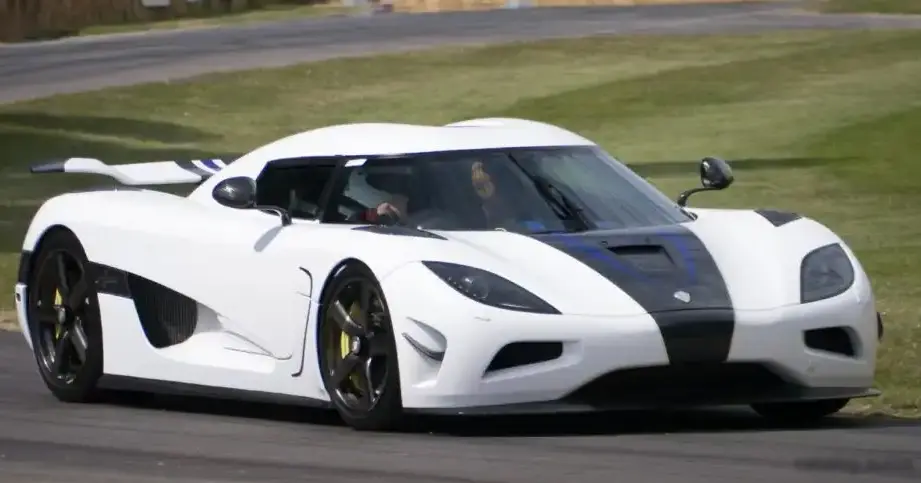
The Koenigsegg Agera R 5.0 V8 (1140 Hp) Automatic, produced from 2013 to 2014, represents a pinnacle of hypercar engineering. Positioned as a high-performance variant within the broader Agera lineage, the Agera R was designed to push the boundaries of speed and exclusivity. It utilized a sophisticated blend of lightweight materials, a powerful twin-turbocharged V8 engine, and, crucially for this variant, a 7-speed automatic transmission. The Agera R aimed to deliver an unparalleled driving experience, competing directly with other ultra-high-performance vehicles from manufacturers like Bugatti and McLaren. Its targa top configuration offered a unique open-air experience, further enhancing its appeal to discerning enthusiasts.
Technical Specifications
| Brand | Koenigsegg |
| Model | Agera |
| Generation | Agera |
| Type (Engine) | R 5.0 V8 (1140 Hp) Automatic |
| Start of production | 2013 |
| End of production | 2014 |
| Powertrain Architecture | Internal Combustion engine |
| Body type | Targa |
| Seats | 2 |
| Doors | 2 |
| Fuel consumption (economy) – extra urban | 12.5 l/100 km (18.8 US mpg, 22.6 UK mpg, 8 km/l) |
| Fuel consumption (economy) – combined | 14.7 l/100 km (16 US mpg, 19.2 UK mpg, 6.8 km/l) |
| Fuel Type | Petrol (Gasoline) |
| Acceleration 0 – 100 km/h | 2.8 sec |
| Acceleration 0 – 62 mph | 2.8 sec |
| Acceleration 0 – 60 mph | 2.9 sec |
| Acceleration 0 – 200 km/h | 7.8 sec |
| Maximum speed | 420 km/h (260.98 mph) |
| 100 km/h – 0 | 30.5 m |
| Emission standard | Euro 5 |
| Weight-to-power ratio | 1.3 kg/Hp, 794.4 Hp/tonne |
| Weight-to-torque ratio | 1.2 kg/Nm, 836.2 Nm/tonne |
| Power | 1140 Hp @ 7100 rpm |
| Power per litre | 226.6 Hp/l |
| Torque | 1200 Nm @ 4100 rpm (885.07 lb.-ft. @ 4100 rpm) |
| Maximum engine speed | 7500 rpm |
| Engine layout | Middle, Longitudinal |
| Engine displacement | 5032 cm3 (307.07 cu. in.) |
| Number of cylinders | 8 |
| Engine configuration | V-engine |
| Cylinder Bore | 91.7 mm (3.61 in.) |
| Piston Stroke | 95.25 mm (3.75 in.) |
| Compression ratio | 9:1 |
| Number of valves per cylinder | 4 |
| Fuel injection system | Multi-port manifold injection |
| Engine aspiration | Twin-Turbo, Intercooler |
| Valvetrain | DOHC |
| Kerb Weight | 1435 kg (3163.63 lbs.) |
| Max. weight | 1650 kg (3637.63 lbs.) |
| Max load | 215 kg (473.99 lbs.) |
| Trunk (boot) space – minimum | 120 l (4.24 cu. ft.) |
| Fuel tank capacity | 80 l (21.13 US gal | 17.6 UK gal) |
| Length | 4293 mm (169.02 in.) |
| Width including mirrors | 1996 mm (78.58 in.) |
| Height | 1120 mm (44.09 in.) |
| Wheelbase | 2662 mm (104.8 in.) |
| Front track | 1700 mm (66.93 in.) |
| Rear (Back) track | 1650 mm (64.96 in.) |
| Front overhang | 885 mm (34.84 in.) |
| Rear overhang | 752 mm (29.61 in.) |
| Ride height (ground clearance) | 100 mm (3.94 in.) |
| Drag coefficient (Cd) | 0.33-0.37 |
| Minimum turning circle (turning diameter) | 11 m (36.09 ft.) |
| Drivetrain Architecture | The Internal combustion engine (ICE) drives the rear wheels of the vehicle. |
| Drive wheel | Rear wheel drive |
| Number of gears and type of gearbox | 7 gears, automatic transmission |
| Front suspension | Double wishbone |
| Rear suspension | Double wishbone |
| Front brakes | Ventilated discs |
| Rear brakes | Ventilated discs |
| Assisting systems | ABS (Anti-lock braking system) |
| Steering type | Steering rack and pinion |
| Power steering | Electric Steering |
| Tires size | 265/35 R19; 345/30 R20 |
| Wheel rims size | 9.5J x 19; 12.5J x 20 |
Powertrain & Engine Architecture
At the heart of the Agera R 5.0 lies a 5.0-liter V8 engine, designated as the R50. This engine is constructed from aluminum and features a 90-degree V-angle. The engine utilizes a dry-sump lubrication system, crucial for maintaining oil supply during the extreme cornering forces the car is capable of. The twin-turbocharger setup, employing precision ball bearings, delivers an astonishing 1140 horsepower at 7100 rpm and 1200 Nm (885 lb-ft) of torque at 4100 rpm. Fuel is delivered via multi-port fuel injection. The engine’s valvetrain employs double overhead camshafts (DOHC) and four valves per cylinder. The 7-speed automatic transmission, developed in-house by Koenigsegg, is a key differentiator for this variant. Unlike traditional automatics, it features incredibly fast shift times, optimized for performance rather than fuel economy. The transmission is designed to handle the immense power output of the engine and deliver seamless gear changes.
Driving Characteristics
The Agera R 5.0 Automatic delivers a driving experience that is both exhilarating and surprisingly manageable. The automatic transmission, while not offering the ultimate control of a manual, provides a level of convenience and ease of use that appeals to a wider range of drivers. Gear changes are exceptionally quick, minimizing power interruption during acceleration. The car’s lightweight construction (1435 kg / 3163.63 lbs) and immense power result in breathtaking acceleration – 0 to 60 mph in just 2.9 seconds and a top speed of 420 km/h (260.98 mph). Compared to a manual Agera R, the automatic version sacrifices a small degree of driver engagement but gains in accessibility and ease of operation, particularly in traffic or during extended drives. The power delivery is remarkably linear, thanks to the sophisticated engine management system and the twin-turbochargers.
Equipment & Trim Levels
The Agera R 5.0 Automatic was largely a bespoke vehicle, with a high degree of customization available to buyers. Standard equipment included a carbon fiber body, adjustable Öhlins dampers, ventilated ceramic brakes, and a luxurious interior trimmed with leather and Alcantara. The targa top, removable for open-air driving, was a defining feature. Optional extras included a variety of carbon fiber trim pieces, bespoke paint finishes, and upgraded audio systems. Interior features were focused on functionality and lightweighting, with minimal extraneous features. The focus was on creating a driver-centric environment.
Chassis & Braking
The Agera R utilizes a lightweight chassis constructed primarily from carbon fiber and aluminum. The suspension system employs double wishbones at both the front and rear, with adjustable Öhlins dampers and anti-roll bars. Braking is provided by ventilated ceramic discs, offering exceptional stopping power and resistance to fade. The car’s aerodynamic design, including a large rear wing and front splitter, generates significant downforce, enhancing stability at high speeds. The steering system is a rack and pinion setup with electric power assistance.
Market Reception & Comparison
The Koenigsegg Agera R 5.0 Automatic was met with widespread acclaim from automotive journalists and enthusiasts. Critics praised its incredible performance, advanced technology, and luxurious interior. The automatic transmission was generally well-received, with many reviewers noting its speed and smoothness. Compared to other hypercars of the time, such as the Bugatti Veyron and McLaren P1, the Agera R offered a unique combination of raw power, lightweight construction, and Scandinavian design. Fuel economy, while not a primary concern for buyers of this caliber, was surprisingly reasonable for a car of its performance – around 16 US mpg combined.
Legacy
The Koenigsegg Agera R 5.0 Automatic remains a highly sought-after vehicle in the collector car market. Its limited production run and exceptional performance have ensured its status as a modern classic. The powertrain, while complex, has proven to be relatively reliable, provided it is properly maintained. The Agera R’s innovative use of materials and technology has influenced the design and engineering of subsequent hypercars, solidifying Koenigsegg’s position as a leader in the automotive industry. Today, examples command significant prices, reflecting their rarity and desirability.
