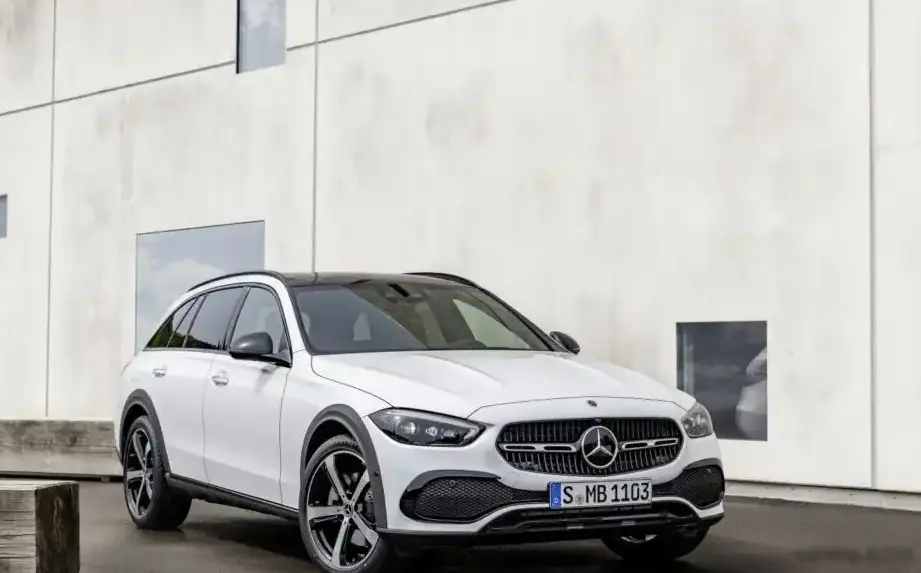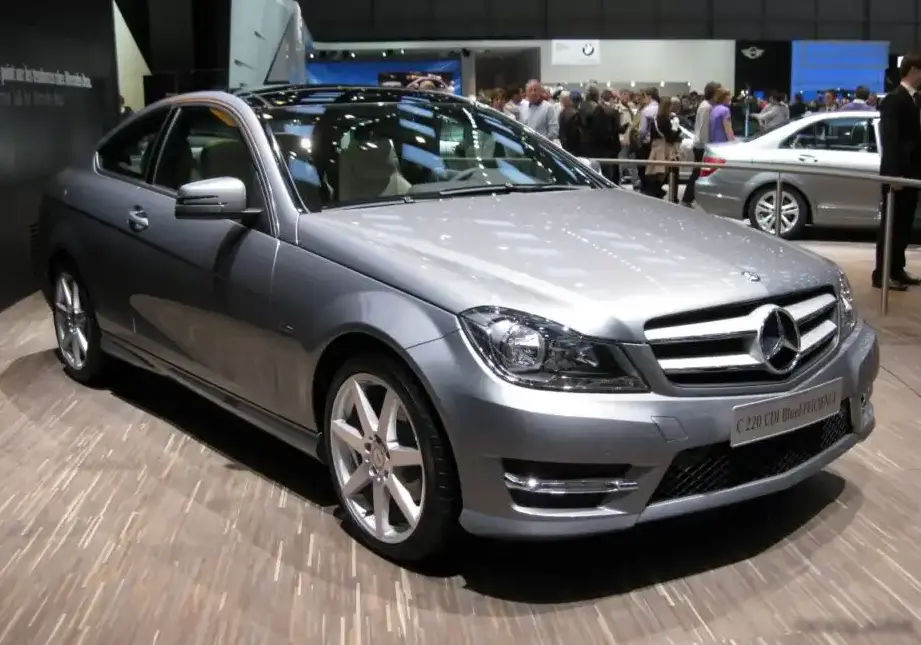
The Mercedes-Benz C-Class T-modell (S203) C 200 CDI, produced from February 2001 to June 2003, represented a practical and fuel-efficient entry point into the premium compact estate (wagon) market. Positioned within the broader S203 C-Class range – the first official wagon variant of the C-Class – the C 200 CDI offered a diesel-powered alternative focused on economy and usability rather than outright performance. It served as a key model for buyers prioritizing cargo space and lower running costs within the Mercedes-Benz lineup. This variant utilized a rear-wheel drive configuration, a hallmark of Mercedes-Benz engineering at the time, and was offered alongside more powerful gasoline and diesel engine options.
Technical Specifications
| Brand | Mercedes-Benz |
| Model | C-class |
| Generation | C-class T-modell (S203) |
| Type (Engine) | C 200 CDI (116 Hp) |
| Start of production | February, 2001 |
| End of production | June, 2003 |
| Powertrain Architecture | Internal Combustion engine |
| Body type | Station wagon (estate) |
| Seats | 5 |
| Doors | 5 |
| Fuel consumption (economy) – urban (NEDC) | 8.9 l/100 km (26.4 US mpg, 31.7 UK mpg, 11.2 km/l) |
| Fuel consumption (economy) – extra urban (NEDC) | 5.4 l/100 km (43.6 US mpg, 52.3 UK mpg, 18.5 km/l) |
| Fuel consumption (economy) – combined (NEDC) | 6.7 l/100 km (35.1 US mpg, 42.2 UK mpg, 14.9 km/l) |
| CO2 emissions (NEDC) | 177 g/km |
| Fuel Type | Diesel |
| Acceleration 0 – 100 km/h | 12.6 sec |
| Acceleration 0 – 62 mph | 12.6 sec |
| Acceleration 0 – 60 mph | 12 sec |
| Maximum speed | 197 km/h (122.41 mph) |
| Emission standard | Euro 3 |
| Weight-to-power ratio | 12.8 kg/Hp, 78.4 Hp/tonne |
| Weight-to-torque ratio | 5.9 kg/Nm, 168.9 Nm/tonne |
| Power | 116 Hp @ 4200 rpm |
| Power per litre | 54 Hp/l |
| Torque | 250 Nm @ 1400-2600 rpm (184.39 lb.-ft. @ 1400-2600 rpm) |
| Engine layout | Front, Longitudinal |
| Engine Model/Code | OM 611.962 |
| Engine displacement | 2148 cm3 (131.08 cu. in.) |
| Number of cylinders | 4 |
| Engine configuration | Inline |
| Cylinder Bore | 88 mm (3.46 in.) |
| Piston Stroke | 88.3 mm (3.48 in.) |
| Compression ratio | 18:1 |
| Number of valves per cylinder | 4 |
| Fuel injection system | Diesel Commonrail |
| Engine aspiration | Turbocharger, Intercooler |
| Valvetrain | DOHC |
| Engine oil capacity | 6.5 l (6.87 US qt | 5.72 UK qt) |
| Coolant | 8.5 l (8.98 US qt | 7.48 UK qt) |
| Kerb Weight | 1480 kg (3262.84 lbs.) |
| Max. weight | 2080 kg (4585.62 lbs.) |
| Max load | 600 kg (1322.77 lbs.) |
| Trunk (boot) space – minimum | 470 l (16.6 cu. ft.) |
| Trunk (boot) space – maximum | 1384 l (48.88 cu. ft.) |
| Fuel tank capacity | 62 l (16.38 US gal | 13.64 UK gal) |
| Max. roof load | 100 kg (220.46 lbs.) |
| Permitted trailer load with brakes (12%) | 1500 kg (3306.93 lbs.) |
| Permitted trailer load without brakes | 750 kg (1653.47 lbs.) |
| Length | 4541 mm (178.78 in.) |
| Width | 1728 mm (68.03 in.) |
| Width including mirrors | 1980 mm (77.95 in.) |
| Height | 1465 mm (57.68 in.) |
| Wheelbase | 2715 mm (106.89 in.) |
| Front track | 1505 mm (59.25 in.) |
| Rear (Back) track | 1476 mm (58.11 in.) |
| Front overhang | 755 mm (29.72 in.) |
| Rear overhang | 1071 mm (42.17 in.) |
| Drag coefficient (Cd) | 0.31 |
| Minimum turning circle (turning diameter) | 10.76 m (35.3 ft.) |
| Drivetrain Architecture | The Internal combustion engine (ICE) drives the rear wheels of the vehicle. |
| Drive wheel | Rear wheel drive |
| Number of gears and type of gearbox | 6 gears, manual transmission |
| Front suspension | Independent type McPherson, Transverse stabilizer |
| Rear suspension | Independent multi-link suspension, Transverse stabilizer |
| Front brakes | Ventilated discs |
| Rear brakes | Disc |
| Assisting systems | ABS (Anti-lock braking system) |
| Steering type | Steering rack and pinion |
| Power steering | Hydraulic Steering |
| Tires size | 195/65 R 15 91 H |
| Wheel rims size | 6 J x 15 H 2 |
Powertrain & Engine Architecture
The C 200 CDI was powered by the OM 611.962, a 2.2-liter inline-four cylinder diesel engine. This engine was a mainstay of the Mercedes-Benz lineup during the early 2000s, known for its durability and relatively refined operation for a diesel of its era. The OM 611 featured a cast iron block and aluminum cylinder head, incorporating a turbocharger with an intercooler to boost power output. Crucially, it utilized common rail direct injection, a technology that allowed for precise fuel delivery and improved combustion efficiency. The common rail system, operating at very high pressures, contributed to reduced noise and emissions compared to older diesel injection systems. The engine’s DOHC (Double Overhead Camshaft) valvetrain further enhanced its breathing and overall performance. The 6-speed manual transmission was standard, providing a wide range of gear ratios to optimize fuel economy and performance.
Driving Characteristics
The C 200 CDI, with its 116 horsepower and 250 Nm (184 lb-ft) of torque, offered a comfortable and relaxed driving experience. Acceleration was adequate for everyday driving, with a 0-60 mph time of around 12 seconds, but it wasn’t designed for sporty performance. The engine’s torque peak, available from 1400-2600 rpm, provided good responsiveness in typical driving situations, making overtaking and merging onto highways relatively effortless. Compared to the more powerful C 220 CDI or gasoline-powered C 200 Kompressor models, the C 200 CDI prioritized fuel efficiency over outright speed. The manual transmission, while offering driver engagement, had relatively long throws. The rear-wheel drive configuration provided balanced handling, though it wasn’t as agile as some front-wheel drive competitors.
Equipment & Trim Levels
The C 200 CDI T-modell typically came equipped with a reasonable level of standard features, reflecting its position as a mid-range offering. Standard equipment included automatic climate control, power windows, central locking, and an audio system. Interior upholstery was typically cloth, though leather options were available. Optional extras included a sunroof, upgraded audio systems, parking sensors, and alloy wheels. The dashboard layout was typical of Mercedes-Benz at the time, characterized by a functional and understated design. Safety features such as ABS (Anti-lock Braking System) and airbags were standard.
Chassis & Braking
The S203 C-Class featured an independent suspension system all around, with McPherson struts at the front and a multi-link setup at the rear. This configuration provided a comfortable ride and good handling characteristics. Stabilizer bars were fitted to both axles to reduce body roll during cornering. Braking duties were handled by ventilated discs at the front and solid discs at the rear. The ABS system ensured effective braking performance in a variety of conditions. The C 200 CDI, being a diesel variant, carried slightly more weight than its gasoline counterparts, which influenced the suspension tuning to maintain ride comfort.
Market Reception & Comparison
The C 200 CDI T-modell was generally well-received by critics as a practical and economical estate car. Its fuel efficiency was a major selling point, particularly in Europe where diesel fuel was more affordable than gasoline. Compared to the C 220 CDI, the C 200 CDI offered a lower purchase price but with slightly reduced performance. Against gasoline-powered rivals, the C 200 CDI provided significantly better fuel economy, though it lacked the same level of refinement and responsiveness. Reliability was generally good, typical of Mercedes-Benz vehicles of this era, though diesel particulate filters (DPFs) could require maintenance over time.
Legacy
The OM 611 engine family, including the OM 611.962 found in the C 200 CDI, proved to be remarkably durable. Many examples remain on the road today, testament to their robust construction. In the used car market, the C 200 CDI T-modell represents a relatively affordable entry point into Mercedes-Benz ownership. While not a performance icon, it offers a comfortable, practical, and fuel-efficient option for those seeking a well-built estate car. Maintenance costs are generally reasonable, though potential buyers should be aware of the possibility of DPF issues and the need for regular servicing.