
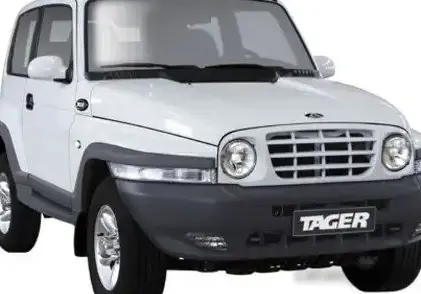
Technical Specifications
| Brand | SsangYong |
| Model | Tager |
| Generation | Tager |
| Type (Engine) | 2.3 i 16V (140 Hp) |
| Start of production | 2008 |
| End of production | 2014 |
| Powertrain Architecture | Internal Combustion engine |
| Body type | Off-road vehicle |
| Seats | 5 |
| Doors | 3 |
| Fuel consumption (urban) | 17.1 l/100 km (13.8 US mpg / 16.5 UK mpg) |
| Fuel consumption (extra urban) | 10 l/100 km (23.5 US mpg / 28.2 UK mpg) |
| Fuel Type | Petrol (Gasoline) |
| Acceleration 0 – 100 km/h | 12.5 sec |
| Acceleration 0 – 62 mph | 12.5 sec |
| Acceleration 0 – 60 mph | 11.9 sec |
| Maximum speed | 165 km/h (102.53 mph) |
| Weight-to-power ratio | 12.8 kg/Hp |
| Weight-to-torque ratio | 8.8 kg/Nm |
| Power | 140 Hp @ 5300 rpm |
| Power per litre | 61 Hp/l |
| Torque | 204 Nm @ 4500 rpm (150.46 lb.-ft. @ 4500 rpm) |
| Engine layout | Front, Longitudinal |
| Engine displacement | 2295 cm3 (140.05 cu. in.) |
| Number of cylinders | 4 |
| Engine configuration | Inline |
| Cylinder Bore | 90.9 mm (3.58 in.) |
| Piston Stroke | 88.4 mm (3.48 in.) |
| Compression ratio | 10.4:1 |
| Number of valves per cylinder | 4 |
| Fuel injection system | Multi-port manifold injection |
| Engine aspiration | Naturally aspirated engine |
| Valvetrain | DOHC |
| Engine oil capacity | 7.5 l (7.93 US qt | 6.6 UK qt) |
| Kerb Weight | 1785 kg (3935.25 lbs.) |
| Max. weight | 2515 kg (5544.63 lbs.) |
| Max load | 730 kg (1609.37 lbs.) |
| Trunk (boot) space – minimum | 300 l (10.59 cu. ft.) |
| Trunk (boot) space – maximum | 1200 l (42.38 cu. ft.) |
| Fuel tank capacity | 70 l (18.49 US gal | 15.4 UK gal) |
| Length | 4330 mm (170.47 in.) |
| Width | 1841 mm (72.48 in.) |
| Height | 1940 mm (76.38 in.) |
| Wheelbase | 2480 mm (97.64 in.) |
| Front track | 1510 mm (59.45 in.) |
| Rear (Back) track | 1520 mm (59.84 in.) |
| Drive wheel | All wheel drive (4×4) |
| Number of gears and type of gearbox | 5 gears, manual transmission |
| Front suspension | Torsion |
| Rear suspension | Rigid axle suspension |
| Front brakes | Ventilated discs |
| Rear brakes | Disc |
| Assisting systems | ABS (Anti-lock braking system) |
| Steering type | Steering rack and pinion |
| Power steering | Hydraulic Steering |
| Tires size | 235/75 R15 |
The SsangYong Tager 2.3 i 16V, produced from 2008 to 2014, was a compact SUV designed to appeal to buyers prioritizing off-road capability and practicality. It represented SsangYong’s entry into the growing small SUV segment, offering a more affordable and robust alternative to established competitors. The Tager was based on a modified platform derived from the previous generation SsangYong Korando, and was primarily sold in South Korea and select export markets. This 2.3-liter, 140 horsepower variant occupied a mid-range position within the Tager lineup, balancing performance and fuel economy. It sat above the base models and below any potential higher-performance or diesel-powered options.
Powertrain & Engine Architecture
The SsangYong Tager 2.3 i 16V is powered by a SsangYong-developed 2.3-liter inline-four cylinder gasoline engine. This engine, while not particularly advanced technologically, was known for its durability and relatively simple design. It features a multi-port fuel injection system, delivering fuel directly into the intake ports, and a double overhead camshaft (DOHC) valvetrain operating 16 valves (four per cylinder). The engine produces 140 horsepower at 5300 rpm and 204 Nm (150.46 lb-ft) of torque at 4500 rpm. The engine’s longitudinal mounting allowed for a traditional front-engine, all-wheel-drive layout. Importantly, the Tager 2.3 i 16V was exclusively offered with a five-speed manual transmission. While an automatic transmission was available on other Tager models, it was not paired with this specific engine configuration.
Driving Characteristics
The 2.3-liter engine, coupled with the five-speed manual transmission, provided adequate, though not exhilarating, performance. Acceleration from 0 to 60 mph took approximately 11.9 seconds, and the top speed was around 102.53 mph. The engine’s torque curve was relatively flat, providing usable power across a broad range of engine speeds. However, it did require frequent downshifting, especially when tackling hills or overtaking. Compared to potential diesel variants, the 2.3-liter gasoline engine felt less responsive at lower RPMs. The manual transmission offered a more engaging driving experience than an automatic would have, but the gear ratios were spaced to prioritize fuel economy and off-road crawling ability rather than outright acceleration. The all-wheel-drive system provided good traction on loose surfaces, making the Tager a capable off-roader.
Equipment & Trim Levels
The Tager 2.3 i 16V typically came with a fairly basic level of equipment, reflecting its positioning as a value-oriented SUV. Standard features generally included air conditioning, power windows, central locking, and an AM/FM radio. Interior upholstery was typically cloth, and the dashboard featured a functional, if somewhat utilitarian, design. Optional extras could include alloy wheels, a sunroof, and upgraded audio systems. Safety features were relatively limited by modern standards, typically consisting of ABS brakes and a driver’s airbag. Higher trim levels, if available, might have added features like fog lights and a more comprehensive audio system.
Chassis & Braking
The Tager utilized a body-on-frame construction, contributing to its robust and durable nature. The front suspension employed a torsion bar setup, while the rear suspension featured a rigid axle. This configuration prioritized off-road capability and load-carrying capacity over on-road refinement. The braking system consisted of ventilated discs at the front and solid discs at the rear. While adequate for everyday driving, the braking performance was not particularly strong. The steering was a rack-and-pinion system with hydraulic power assistance, providing reasonable steering feel and maneuverability.
Market Reception & Comparison
The SsangYong Tager 2.3 i 16V received mixed reviews from automotive critics. It was generally praised for its off-road capability, rugged construction, and affordability. However, it was often criticized for its dated interior, basic equipment levels, and relatively unrefined driving experience. Compared to competitors like the Suzuki Grand Vitara or the Kia Sportage, the Tager offered a more utilitarian experience, prioritizing functionality over style and comfort. Fuel economy was also a concern, with the 2.3-liter engine consuming a significant amount of fuel, especially in urban driving conditions.
Legacy
The SsangYong Tager, while not a commercial success in many markets, established SsangYong as a player in the compact SUV segment. The 2.3-liter engine proved to be relatively reliable, although regular maintenance was essential. Today, the Tager 2.3 i 16V can be found on the used car market at very affordable prices. Its simplicity and robust construction make it an appealing option for those seeking a capable and inexpensive off-road vehicle. However, potential buyers should be aware of its age and the potential for maintenance issues associated with older vehicles. Parts availability can also be a challenge in some regions.
