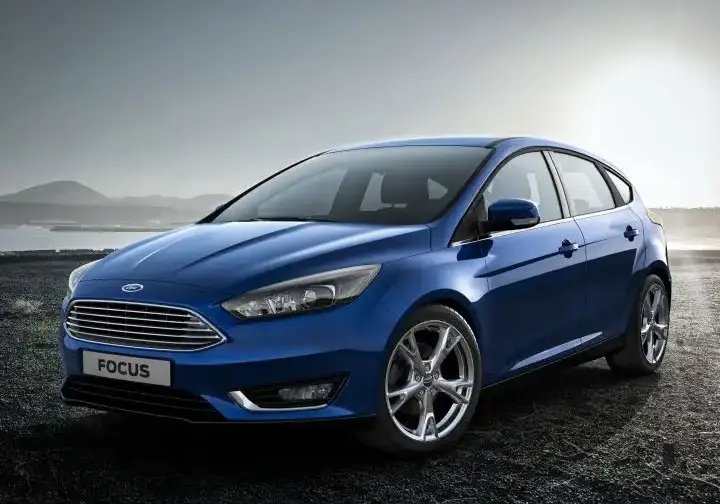
The Ford Focus III Hatchback, specifically the facelifted version produced from 2014 to 2018, represented a significant evolution of Ford’s globally successful compact car. Within the third generation (Mk3) Focus range, the 1.5 TDCi 120 horsepower variant equipped with the PowerShift dual-clutch transmission occupied a middle ground, aiming to balance fuel efficiency with acceptable performance and convenience. This model was primarily targeted at European markets, where diesel engines and automatic transmissions were increasingly popular, offering a practical and economical option for daily commuting and longer journeys. It sat between the lower-powered 1.6 TDCi models and the more performance-oriented petrol variants.
Technical Specifications
| Brand | Ford |
| Model | Focus |
| Generation | Focus III Hatchback (facelift 2014) |
| Type (Engine) | 1.5 TDCi (120 Hp) PowerShift |
| Start of production | 2014 |
| End of production | 2018 |
| Powertrain Architecture | Internal Combustion engine |
| Body type | Hatchback |
| Seats | 5 |
| Doors | 5 |
| Fuel consumption (urban) | 4.7 l/100 km (50 US mpg, 60.1 UK mpg, 21.3 km/l) |
| Fuel consumption (extra urban) | 3.9 l/100 km (60.3 US mpg, 72.4 UK mpg, 25.6 km/l) |
| Fuel consumption (combined) | 4.2 l/100 km (56 US mpg, 67.3 UK mpg, 23.8 km/l) |
| CO2 emissions | 109 g/km |
| Fuel Type | Diesel |
| Acceleration 0 – 100 km/h | 10.8 sec |
| Acceleration 0 – 62 mph | 10.8 sec |
| Acceleration 0 – 60 mph | 10.3 sec |
| Maximum speed | 191 km/h (118.68 mph) |
| Emission standard | Euro 6 |
| Weight-to-power ratio | 10.7 kg/Hp, 93.1 Hp/tonne |
| Weight-to-torque ratio | 4.3 kg/Nm, 232.7 Nm/tonne |
| Power | 120 Hp @ 3600 rpm |
| Power per litre | 80.1 Hp/l |
| Torque | 300 Nm @ 1750-2500 rpm (221.27 lb.-ft. @ 1750-2500 rpm) |
| Engine layout | Front, Transverse |
| Engine Model/Code | XWDA, XWDB, XWDC, XWDD, XWDE |
| Engine displacement | 1499 cm3 (91.47 cu. in.) |
| Number of cylinders | 4 |
| Engine configuration | Inline |
| Cylinder Bore | 73.5 mm (2.89 in.) |
| Piston Stroke | 88.3 mm (3.48 in.) |
| Compression ratio | 16:1 |
| Number of valves per cylinder | 2 |
| Fuel injection system | Diesel Commonrail |
| Engine aspiration | Turbocharger, Intercooler |
| Valvetrain | SOHC |
| Engine oil capacity | 3.85 l (4.07 US qt | 3.39 UK qt) |
| Coolant | 7.3 l (7.71 US qt | 6.42 UK qt) |
| Kerb Weight | 1289 kg (2841.76 lbs.) |
| Max. weight | 1900 kg (4188.78 lbs.) |
| Max load | 611 kg (1347.02 lbs.) |
| Trunk (boot) space – minimum | 277 l (9.78 cu. ft.) |
| Trunk (boot) space – maximum | 1062 l (37.5 cu. ft.) |
| Fuel tank capacity | 53 l (14 US gal | 11.66 UK gal) |
| Max. roof load | 75 kg (165.35 lbs.) |
| Permitted trailer load with brakes (12%) | 1200 kg (2645.55 lbs.) |
| Permitted trailer load without brakes | 680 kg (1499.14 lbs.) |
| Length | 4358 mm (171.57 in.) |
| Width | 1823 mm (71.77 in.) |
| Width with mirrors folded | 1858 mm (73.15 in.) |
| Width including mirrors | 2010 mm (79.13 in.) |
| Height | 1484 mm (58.43 in.) |
| Wheelbase | 2648 mm (104.25 in.) |
| Front track | 1544-1559 mm (60.79 – 61.38 in.) |
| Rear (Back) track | 1534-1549 mm (60.39 – 60.98 in.) |
| Minimum turning circle | 11 m (36.09 ft.) |
| Drivetrain Architecture | Front wheel drive |
| Number of gears and type of gearbox | 6 gears, automatic transmission PowerShift |
| Front suspension | Independent, type McPherson with coil spring and anti-roll bar |
| Rear suspension | Independent multi-link spring suspension with stabilizer |
| Front brakes | Ventilated discs, 278×25 mm |
| Rear brakes | Drum, 228×40 mm |
INTRODUCTION
The 1.5 TDCi 120 PS PowerShift variant of the Ford Focus III facelift (introduced in 2014) was a key offering in Ford’s European lineup. Building upon the success of the Mk3 Focus, which debuted in 2011, the facelift brought revised styling, updated technology, and a new engine family. The 1.5-liter TDCi engine replaced the older 1.6-liter unit, offering improved efficiency and refinement. Coupled with Ford’s six-speed PowerShift dual-clutch transmission, this version aimed to provide a comfortable and economical driving experience for a broad range of customers. It was positioned as a practical, well-equipped, and relatively affordable option within the Focus range.
Powertrain & Engine Architecture
The heart of this Focus variant is the 1.5-liter TDCi diesel engine, specifically utilizing engine codes like XWDA, XWDB, XWDC, XWDD, and XWDE depending on the specific market and emissions regulations. This engine is a four-cylinder, inline configuration, featuring a turbocharger with intercooling to boost power and efficiency. It employs a common-rail direct fuel injection system, delivering fuel directly into the combustion chamber at extremely high pressure for optimized combustion. The engine utilizes a Single Overhead Camshaft (SOHC) valvetrain with two valves per cylinder. The PowerShift transmission is a six-speed dual-clutch transmission (DCT) that offers automated gear changes while maintaining a degree of driver control. It essentially combines the efficiency of a manual transmission with the convenience of an automatic. Unlike a traditional torque converter automatic, the PowerShift uses two separate clutches for odd and even gears, allowing for quicker and smoother shifts.
Driving Characteristics
The 1.5 TDCi 120 PS PowerShift Focus delivers a respectable, if not exhilarating, driving experience. With 120 horsepower and 300 Nm (221 lb-ft) of torque, acceleration from 0-60 mph takes around 10.3 seconds, and it reaches a top speed of 118.68 mph. The PowerShift transmission provides relatively quick gear changes, especially in the ‘Sport’ mode, but can sometimes exhibit a slight hesitation at low speeds. Compared to the higher-output petrol versions, the 1.5 TDCi feels less responsive, but it offers significantly better fuel economy. The gear ratios are tuned for efficiency, prioritizing fuel savings over outright performance. The torque delivery is strong from relatively low RPMs, making it suitable for everyday driving and overtaking maneuvers. Compared to a manual transmission equipped Focus, the PowerShift offers greater convenience, particularly in urban traffic, but some drivers may prefer the more direct feel of a manual gearbox.
Equipment & Trim Levels
The 1.5 TDCi 120 PS PowerShift was typically offered in mid-range trim levels, such as Zetec or Trend in Europe. Standard equipment generally included air conditioning, power windows, power mirrors, a basic audio system with USB connectivity, and stability control. Higher trim levels added features like alloy wheels, a more advanced infotainment system with touchscreen display, rear parking sensors, cruise control, and automatic headlights and wipers. Interior upholstery was typically cloth, with options for partial leather trim. Optional extras included a panoramic sunroof, heated seats, and a premium sound system.
Chassis & Braking
The Focus III utilizes an independent front suspension with McPherson struts and a multi-link independent rear suspension, providing a comfortable and controlled ride. The front suspension incorporates a coil spring and anti-roll bar to reduce body roll during cornering. Braking duties are handled by ventilated discs at the front and drum brakes at the rear. ABS (Anti-lock Braking System) is standard. The suspension setup is tuned to balance comfort and handling, offering a good compromise for everyday driving. Stabilizer bar thickness varied slightly depending on the specific trim level and market.
Market Reception & Comparison
The 1.5 TDCi 120 PS PowerShift Focus was generally well-received by automotive critics as a practical and economical choice. Its fuel economy of around 56 US mpg combined was a major selling point. However, the PowerShift transmission received some criticism for its occasional hesitation and lack of refinement compared to traditional automatic transmissions. Compared to the 1.6 TDCi models, the 1.5 TDCi offered improved refinement and slightly better fuel economy. The petrol versions provided more spirited performance but at the cost of significantly higher fuel consumption. Reliability was generally good, although some owners reported issues with the PowerShift transmission, particularly early units.
Legacy
The 1.5 TDCi engine and PowerShift transmission combination proved to be a popular choice in the European market. While the PowerShift transmission had its share of issues, particularly with clutch pack wear, many examples have proven to be reliable with proper maintenance. Today, used examples of the 2014-2018 Focus 1.5 TDCi PowerShift offer a relatively affordable and economical option for buyers seeking a practical and well-equipped compact hatchback. However, potential buyers should be aware of the potential for PowerShift transmission issues and ensure a thorough inspection before purchase.