
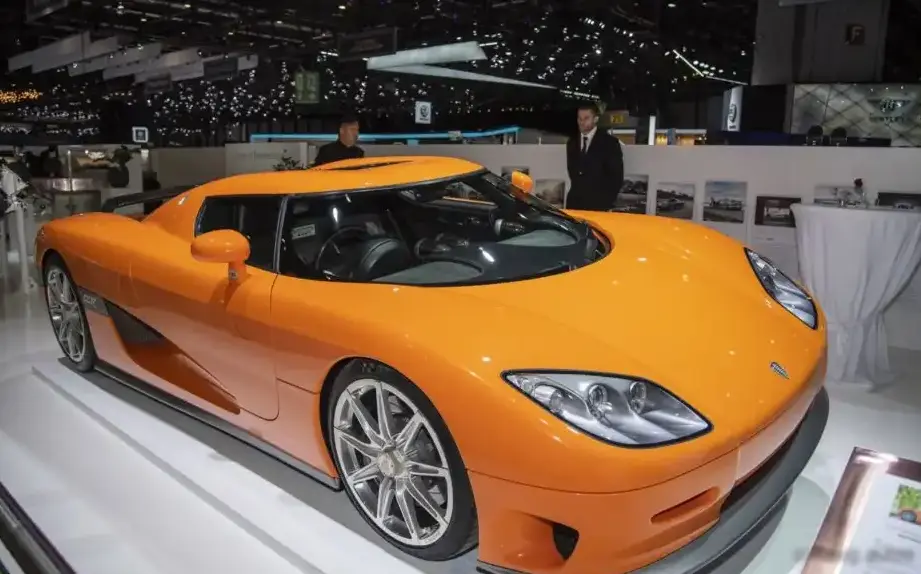
The Koenigsegg CCR, produced between 2004 and 2006, represents a pivotal evolution in the Swedish automaker’s pursuit of extreme performance. Building upon the foundation laid by the original CC8S, the CCR was designed as a more refined and powerful successor, aimed at establishing Koenigsegg as a serious contender in the hypercar segment. This variant, equipped with a 4.7-liter twin-supercharged V8 engine producing 806 horsepower, showcased Koenigsegg’s engineering prowess and commitment to pushing the boundaries of automotive capability. The CCR was a limited-production model, with only 24 examples built, making it a highly sought-after collector’s item today.
Technical Specifications
| Brand | Koenigsegg |
| Model | CC |
| Generation | CCR |
| Type (Engine) | 4.7 i V8 32V (806 Hp) |
| Start of production | 2004 |
| End of production | 2006 |
| Powertrain Architecture | Internal Combustion engine |
| Body type | Coupe |
| Seats | 2 |
| Doors | 2 |
| Fuel consumption (urban) | 25 l/100 km (9.4 US mpg, 11.3 UK mpg, 4 km/l) |
| Fuel consumption (extra urban) | 13 l/100 km (18.1 US mpg, 21.7 UK mpg, 7.7 km/l) |
| Fuel consumption (combined) | 17 l/100 km (13.8 US mpg, 16.6 UK mpg, 5.9 km/l) |
| Fuel Type | Petrol (Gasoline) |
| Acceleration 0 – 100 km/h | 3.2 sec |
| Acceleration 0 – 62 mph | 3.2 sec |
| Acceleration 0 – 60 mph | 3 sec |
| Maximum speed | 395 km/h (245.44 mph) |
| Weight-to-power ratio | 1.5 kg/Hp, 683.1 Hp/tonne |
| Weight-to-torque ratio | 1.3 kg/Nm, 778.8 Nm/tonne |
| Power | 806 Hp @ 6900 rpm |
| Power per litre | 170.8 Hp/l |
| Torque | 919 Nm @ 5700 rpm (677.82 lb.-ft. @ 5700 rpm) |
| Engine layout | Middle, Longitudinal |
| Engine displacement | 4719 cm3 (287.97 cu. in.) |
| Number of cylinders | 8 |
| Engine configuration | V-engine |
| Compression ratio | 8.6:1 |
| Number of valves per cylinder | 4 |
| Fuel injection system | Multi-port manifold injection |
| Engine aspiration | Turbocharger, Intercooler |
| Kerb Weight | 1180 kg (2601.45 lbs.) |
| Trunk (boot) space – maximum | 120 l (4.24 cu. ft.) |
| Fuel tank capacity | 80 l (21.13 US gal | 17.6 UK gal) |
| Length | 4293 mm (169.02 in.) |
| Width | 1996 mm (78.58 in.) |
| Height | 1020 mm (40.16 in.) |
| Wheelbase | 2660 mm (104.72 in.) |
| Drivetrain Architecture | Rear wheel drive |
| Number of gears and type of gearbox | 6 gears, manual transmission |
| Front suspension | Double wishbone |
| Rear suspension | Double wishbone |
| Front brakes | Ventilated discs |
| Rear brakes | Ventilated discs |
| Assisting systems | ABS (Anti-lock braking system) |
| Steering type | Steering rack and pinion |
| Tires size | 255/35 ZR19; 335/30 ZR20 |
| Wheel rims size | 9.5J x 19; 12.5J x 20 |
Powertrain & Engine Architecture
At the heart of the CCR lies its 4.7-liter V8 engine, designated as a Koenigsegg internal combustion engine. This engine is notable for its twin-supercharger setup – one supercharger mechanically driven by the crankshaft and another driven by a separate electric motor. This configuration provides instant boost across the entire rev range, eliminating turbo lag and delivering a remarkably linear power delivery. The engine utilizes a cast aluminum block and heads, contributing to its relatively lightweight construction. Fuel is delivered via multi-port fuel injection, and the engine boasts a compression ratio of 8.6:1. The CCR exclusively came with a 6-speed manual transmission, designed to handle the immense power and torque output. The transmission is a robust unit, featuring a reinforced clutch and gearset to ensure durability under extreme conditions.
Driving Characteristics
The Koenigsegg CCR delivers a driving experience that is both exhilarating and demanding. The immediate throttle response, courtesy of the twin-supercharger system, is unlike anything found in naturally aspirated or turbocharged vehicles. Acceleration is brutal, with the car reaching 60 mph in around 3 seconds and continuing to a top speed of 245 mph. The manual transmission requires a skilled driver to extract the most from the engine, but it provides a level of control and engagement that an automatic transmission simply cannot match. The car’s relatively low weight (around 2600 lbs) contributes to its agility and responsiveness, making it a formidable performer on both the road and the track. The suspension, while firm, provides a surprisingly compliant ride for a car of this caliber.
Equipment & Trim Levels
Given its limited production run and focus on performance, the Koenigsegg CCR was not offered with extensive customization options. The interior was minimalist and driver-focused, featuring leather upholstery, carbon fiber trim, and a bespoke instrument cluster. Air conditioning and a basic audio system were standard, but options were limited to things like different interior color schemes and the addition of a passenger seat. The CCR was primarily designed for serious driving enthusiasts, and as such, comfort and convenience features were not prioritized.
Chassis & Braking
The CCR utilizes a lightweight space frame chassis constructed from aluminum and carbon fiber. This chassis provides exceptional rigidity and contributes to the car’s low weight. The suspension consists of double wishbones at all four corners, with adjustable dampers and springs. Braking is provided by ventilated discs at all four wheels, with ABS as standard. The braking system is more than capable of handling the car’s immense speed, providing strong and consistent stopping power.
Market Reception & Comparison
The Koenigsegg CCR was widely praised by automotive journalists for its incredible performance, innovative engineering, and exclusivity. It was often compared to other hypercars of the era, such as the Porsche Carrera GT and the Ferrari Enzo. While the CCR’s fuel economy was predictably poor (around 13.8 US mpg combined), this was not a primary concern for its target audience. Reliability was generally good, although maintenance costs were extremely high due to the car’s complex engineering and limited parts availability. The CCR represented a significant step forward for Koenigsegg, establishing the company as a legitimate competitor to established supercar manufacturers.
Legacy
The Koenigsegg CCR remains a highly collectible and desirable hypercar. Its limited production run and exceptional performance have ensured its place in automotive history. The CCR’s twin-supercharged V8 engine and lightweight chassis continue to inspire awe among enthusiasts. Today, well-maintained examples command prices well into the seven-figure range. The CCR paved the way for Koenigsegg’s subsequent models, such as the Agera and the Regera, which have further cemented the company’s reputation as a leader in hypercar technology and innovation. The CCR stands as a testament to Koenigsegg’s unwavering commitment to pushing the boundaries of automotive performance.
