
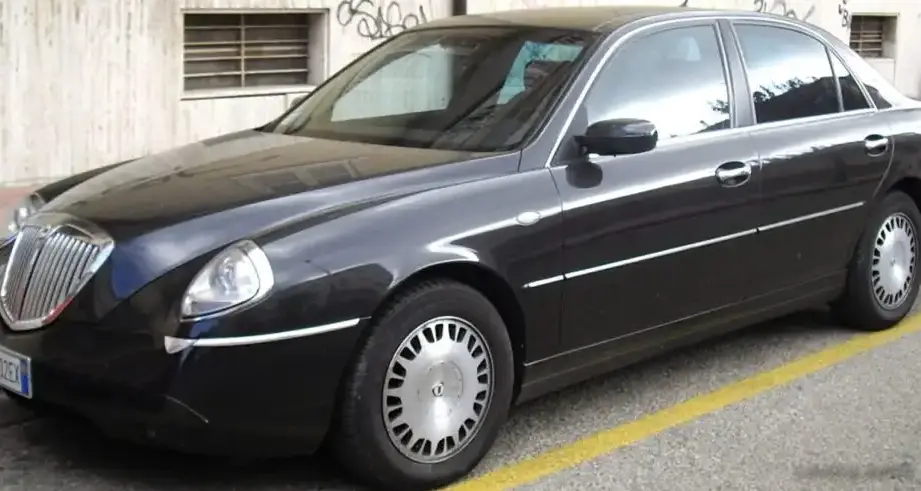
The Lancia Thesis 3.2 i V6 24V, produced from May 2003 to September 2007, represented the pinnacle of Lancia’s flagship sedan during that period. Positioned as a luxurious and technologically advanced vehicle, the Thesis aimed to compete with established German and Scandinavian executive cars. This particular variant, powered by a 3.2-liter V6 engine paired with a five-speed automatic transmission, was the top-of-the-line offering, showcasing Lancia’s engineering capabilities and design flair. It was built on the 841 platform, a front-wheel-drive architecture shared with other Fiat Group vehicles, but refined for a more premium experience.
Technical Specifications
| Brand | Lancia |
| Model | Thesis |
| Generation | Thesis |
| Type (Engine) | 3.2 i V6 24V (230 Hp) |
| Start of production | May, 2003 |
| End of production | September, 2007 |
| Powertrain Architecture | Internal Combustion engine |
| Body type | Sedan |
| Seats | 5 |
| Doors | 4 |
| Fuel consumption (urban) | 22.7 l/100 km (10.4 US mpg, 12.4 UK mpg, 4.4 km/l) |
| Fuel consumption (extra urban) | 10.3 l/100 km (22.8 US mpg, 27.4 UK mpg, 9.7 km/l) |
| Fuel consumption (combined) | 14.9 l/100 km (15.8 US mpg, 19 UK mpg, 6.7 km/l) |
| Fuel Type | Petrol (Gasoline) |
| Acceleration 0 – 100 km/h | 8.8 sec |
| Acceleration 0 – 62 mph | 8.8 sec |
| Acceleration 0 – 60 mph | 8.4 sec |
| Maximum speed | 240 km/h (149.13 mph) |
| Weight-to-power ratio | 8 kg/Hp, 124.3 Hp/tonne |
| Weight-to-torque ratio | 6.4 kg/Nm, 156.2 Nm/tonne |
| Power | 230 Hp @ 6200 rpm |
| Power per litre | 72.3 Hp/l |
| Torque | 289 Nm @ 4800 rpm (213.16 lb.-ft. @ 4800 rpm) |
| Engine layout | Front, Transverse |
| Engine Model/Code | 841 L.000 |
| Engine displacement | 3179 cm3 (193.99 cu. in.) |
| Number of cylinders | 6 |
| Engine configuration | V-engine |
| Cylinder Bore | 93 mm (3.66 in.) |
| Piston Stroke | 78 mm (3.07 in.) |
| Compression ratio | 10.5:1 |
| Number of valves per cylinder | 4 |
| Fuel injection system | Multi-port manifold injection |
| Engine aspiration | Naturally aspirated engine |
| Valvetrain | OHC |
| Engine oil capacity | 5.9 l (6.23 US qt | 5.19 UK qt) |
| Coolant | 12.2 l (12.89 US qt | 10.73 UK qt) |
| Kerb Weight | 1850 kg (4078.55 lbs.) |
| Trunk (boot) space – minimum | 480 l (16.95 cu. ft.) |
| Fuel tank capacity | 75 l (19.81 US gal | 16.5 UK gal) |
| Length | 4890 mm (192.52 in.) |
| Width | 1830 mm (72.05 in.) |
| Height | 1470 mm (57.87 in.) |
| Wheelbase | 2805 mm (110.43 in.) |
| Front track | 1570 mm (61.81 in.) |
| Rear (Back) track | 1540 mm (60.63 in.) |
| Drivetrain Architecture | The Internal combustion engine (ICE) drives the front wheels of the vehicle. |
| Drive wheel | Front wheel drive |
| Number of gears and type of gearbox | 5 gears, automatic transmission |
| Front suspension | Spring Strut |
| Rear suspension | Coil spring |
| Front brakes | Ventilated discs |
| Rear brakes | Ventilated discs |
| Assisting systems | ABS (Anti-lock braking system) |
| Steering type | Steering rack and pinion |
| Power steering | Hydraulic Steering |
| Tires size | 215/60 R 16 |
Powertrain & Engine Architecture
The heart of the Thesis 3.2 i V6 24V is the 841 L.000 engine, a 60-degree V6 displacing 3.2 liters. This engine is naturally aspirated and features multi-port fuel injection. The 24-valve configuration (four valves per cylinder) and a compression ratio of 10.5:1 contribute to its respectable power output. The engine’s design prioritized smooth operation and refinement over outright performance, aligning with the Thesis’s luxury positioning. The five-speed automatic transmission, while providing convenience, was a conventional torque converter type, not a dual-clutch or continuously variable transmission (CVT) found in some contemporary rivals. This transmission was tuned for comfortable shifts rather than aggressive downshifts.
Driving Characteristics
The combination of the 3.2-liter V6 and the five-speed automatic resulted in a driving experience focused on effortless cruising. Acceleration to 60 mph took approximately 8.4 seconds, and the car could reach a top speed of 149 mph. While not particularly sporty, the engine delivered ample torque throughout the rev range, making overtaking maneuvers relatively easy. The automatic transmission, while smooth, could feel somewhat sluggish in comparison to manual transmissions or more modern automatics. Gear ratios were optimized for fuel efficiency and comfort, rather than maximizing performance. The front-wheel-drive configuration contributed to predictable handling, but also limited the car’s dynamic capabilities compared to rear-wheel-drive competitors.
Equipment & Trim Levels
The 3.2 i V6 24V Thesis was the most comprehensively equipped variant. Standard features typically included leather upholstery, automatic climate control, a premium audio system, power-adjustable front seats, and a sunroof. Safety features such as ABS, traction control, and multiple airbags were also standard. Optional extras included navigation system, upgraded leather trim, and a rear entertainment system. The interior design emphasized luxury and comfort, with high-quality materials and a spacious cabin. The dashboard layout was elegant and functional, though some critics found it somewhat dated compared to more modern designs.
Chassis & Braking
The Thesis utilized a front-wheel-drive chassis with independent suspension at all four corners. The front suspension employed a MacPherson strut setup, while the rear featured a multi-link design. This configuration aimed to provide a comfortable ride and predictable handling. Braking duties were handled by ventilated discs on all four wheels, providing adequate stopping power. ABS (Anti-lock Braking System) was standard, enhancing safety during emergency braking situations. The Thesis’s weight of approximately 4,079 pounds meant that the braking system needed to work effectively to provide confident stopping performance.
Market Reception & Comparison
The Lancia Thesis, particularly the 3.2 V6 variant, received mixed reviews. Critics praised its luxurious interior, comfortable ride, and refined engine. However, it was often criticized for its somewhat dated design, front-wheel-drive configuration, and relatively high price compared to competitors. Fuel economy was also a concern, with the 3.2 V6 consuming a significant amount of gasoline. Compared to the lower-displacement 2.0 and 2.4-liter versions, the 3.2 V6 offered significantly more power and refinement, but at the cost of increased fuel consumption and a higher purchase price. The 2.4-liter model was often seen as a more sensible choice for those prioritizing fuel efficiency and value.
Legacy
The Lancia Thesis, while not a commercial success, remains a significant vehicle in Lancia’s history. The 3.2 V6 variant, in particular, is appreciated by enthusiasts for its smooth engine, luxurious interior, and unique character. The 841 L.000 engine, while not known for being particularly prone to major failures, requires regular maintenance to ensure longevity. Finding parts can be challenging due to the car’s limited production numbers and age. Today, the Thesis 3.2 i V6 24V is a relatively rare and sought-after classic, appealing to collectors and enthusiasts who appreciate Italian automotive design and engineering.
