
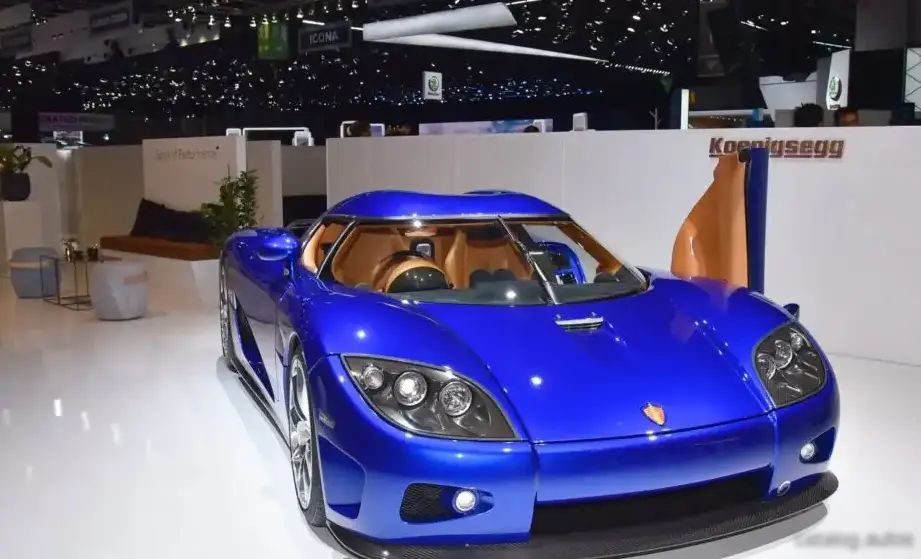
The Koenigsegg CCX 4.8 V8 (888 Hp) Edition, produced from 2008 to 2010, represents a pivotal evolution in the Koenigsegg lineage. Positioned as a more accessible, yet still extraordinarily capable, offering compared to the earlier CCR, the CCX was designed to broaden the brand’s appeal while maintaining its commitment to extreme performance. Built on a strengthened version of the Koenigsegg chassis, the CCX aimed to meet and exceed American safety and emissions standards, opening the door to the lucrative US market. This particular 888 horsepower variant, utilizing a twin-turbocharged V8 engine, became a defining model for the Swedish hypercar manufacturer.
Technical Specifications
| Brand | Koenigsegg |
| Model | CC |
| Generation | CCX |
| Type (Engine) | 4.8 V8 (888 Hp) Edition |
| Start of production | 2008 |
| End of production | 2010 |
| Powertrain Architecture | Internal Combustion engine |
| Body type | Targa |
| Seats | 2 |
| Doors | 2 |
| Fuel consumption (economy) – extra urban | 13 l/100 km (18.1 US mpg, 21.7 UK mpg, 7.7 km/l) |
| Fuel consumption (economy) – combined | 17 l/100 km (13.8 US mpg, 16.6 UK mpg, 5.9 km/l) |
| Fuel Type | Petrol (Gasoline) |
| Acceleration 0 – 100 km/h | 3 sec |
| Acceleration 0 – 62 mph | 3 sec |
| Acceleration 0 – 60 mph | 2.9 sec |
| Acceleration 0 – 200 km/h | 9.05 sec |
| Maximum speed | 400 km/h (248.55 mph) |
| Emission standard | Euro 4 |
| Weight-to-power ratio | 1.4 kg/Hp, 693.8 Hp/tonne |
| Weight-to-torque ratio | 1.4 kg/Nm, 734.4 Nm/tonne |
| Power | 888 Hp @ 7000 rpm |
| Power per litre | 185 Hp/l |
| Torque | 940 Nm @ 5800 rpm (693.31 lb.-ft. @ 5800 rpm) |
| Engine layout | Rear, Longitudinal |
| Engine displacement | 4800 cm3 (292.91 cu. in.) |
| Number of cylinders | 8 |
| Engine configuration | V-engine |
| Compression ratio | 8.6:1 |
| Number of valves per cylinder | 4 |
| Fuel injection system | Multi-port manifold injection |
| Engine aspiration | Twin-Turbo, Intercooler |
| Valvetrain | DOHC |
| Kerb Weight | 1280 kg (2821.92 lbs.) |
| Trunk (boot) space – minimum | 120 l (4.24 cu. ft.) |
| Fuel tank capacity | 70 l (18.49 US gal | 15.4 UK gal) |
| Length | 4293 mm (169.02 in.) |
| Width including mirrors | 1996 mm (78.58 in.) |
| Height | 1114 mm (43.86 in.) |
| Ride height (ground clearance) | 92-95 mm (3.62 – 3.74 in.) |
| Drag coefficient (Cd) | 0.36 |
| Minimum turning circle (turning diameter) | 11 m (36.09 ft.) |
| Drivetrain Architecture | The Internal combustion engine (ICE) drives the rear wheels of the vehicle. |
| Drive wheel | Rear wheel drive |
| Number of gears and type of gearbox | 6 gears, manual transmission |
| Front suspension | Double wishbone |
| Rear suspension | Double wishbone |
| Front brakes | Ventilated discs |
| Rear brakes | Ventilated discs |
| Assisting systems | ABS (Anti-lock braking system) |
| Steering type | Steering rack and pinion |
| Power steering | Electric Steering |
| Tires size | 255/35 R19; 335/30 R20 |
| Wheel rims size | 9.5J x 19; 12.5J x 20 |
Powertrain & Engine Architecture
At the heart of the CCX 4.8 V8 (888 Hp) Edition lies a 4.8-liter, twin-turbocharged V8 engine, designated as the KR8 engine. This engine represented a significant departure from the supercharged setup used in the CCR. The switch to twin-turbocharging was primarily driven by the need to meet stricter emissions regulations and improve drivability. The engine utilizes a dry-sump lubrication system, crucial for maintaining oil pressure during the extreme cornering forces the CCX is capable of. Fuel delivery is managed by a multi-port fuel injection system. The engine boasts a relatively modest compression ratio of 8.6:1, a compromise made to accommodate the increased boost pressures from the twin turbochargers. The engine’s 940 Nm (693.31 lb-ft) of torque is delivered at 5800 rpm, providing a broad and potent powerband. The CCX exclusively came equipped with a 6-speed manual transmission, prioritizing driver engagement and control.
Driving Characteristics
The CCX 4.8 V8 (888 Hp) Edition delivers a visceral and uncompromising driving experience. Acceleration is, unsurprisingly, breathtaking. The 0-60 mph sprint is dispatched in around 2.9 seconds, and the car continues to pull relentlessly to its top speed of 400 km/h (248.55 mph). The manual transmission, while demanding, allows for precise control over the immense power. Compared to potential future automatic variants, the manual gearbox provides a more direct connection to the engine. The relatively lightweight construction (1280 kg / 2821.92 lbs) contributes to the car’s agility and responsiveness. The suspension, tuned for both road and track use, provides a firm but controlled ride. While not designed for everyday commuting, the CCX is surprisingly tractable at lower speeds, thanks to the engine’s flexible power delivery.
Equipment & Trim Levels
The CCX was offered with a relatively limited range of options, reflecting Koenigsegg’s focus on bespoke craftsmanship. Standard features included a carbon fiber body, leather interior, air conditioning, and a basic audio system. Customers could specify custom paint colors, interior trim materials, and various carbon fiber accents. Optional extras included a full leather interior, upgraded audio system, and a telemetry system for track use. The interior, while minimalist, is beautifully crafted with high-quality materials. The Targa top, a defining feature of the CCX, is removable for open-air driving.
Chassis & Braking
The CCX utilizes a lightweight chassis constructed from aluminum and carbon fiber. This chassis provides exceptional rigidity and contributes to the car’s low weight. The suspension features double wishbones at both the front and rear, with adjustable dampers and springs. Braking is provided by ventilated discs at all four corners, coupled with an ABS system. The braking system is more than adequate for the car’s performance, providing strong and consistent stopping power. The steering is a rack and pinion system with electric power assistance, offering precise and responsive control.
Market Reception & Comparison
The Koenigsegg CCX was widely praised by automotive journalists for its incredible performance, stunning design, and uncompromising engineering. Critics noted the car’s ability to deliver a truly exhilarating driving experience. Compared to the earlier CCR, the CCX was seen as a more refined and accessible machine, thanks to the switch to twin-turbocharging. Fuel economy, while not a primary concern for CCX buyers, is rated at 17 l/100 km (13.8 US mpg) combined, which is relatively reasonable considering the car’s performance. Reliability, while not extensively documented, appears to be good, with many CCXs still being actively driven and maintained today.
Legacy
The Koenigsegg CCX 4.8 V8 (888 Hp) Edition holds a significant place in the history of Koenigsegg. It was the model that established the brand as a serious contender in the hypercar market and paved the way for future models like the Agera and Regera. Today, the CCX is a highly sought-after collector’s car, with values continuing to appreciate. The KR8 engine, while superseded by newer designs, remains a testament to Koenigsegg’s engineering prowess. The CCX’s combination of raw performance, stunning design, and exclusivity ensures its enduring appeal among automotive enthusiasts.
