
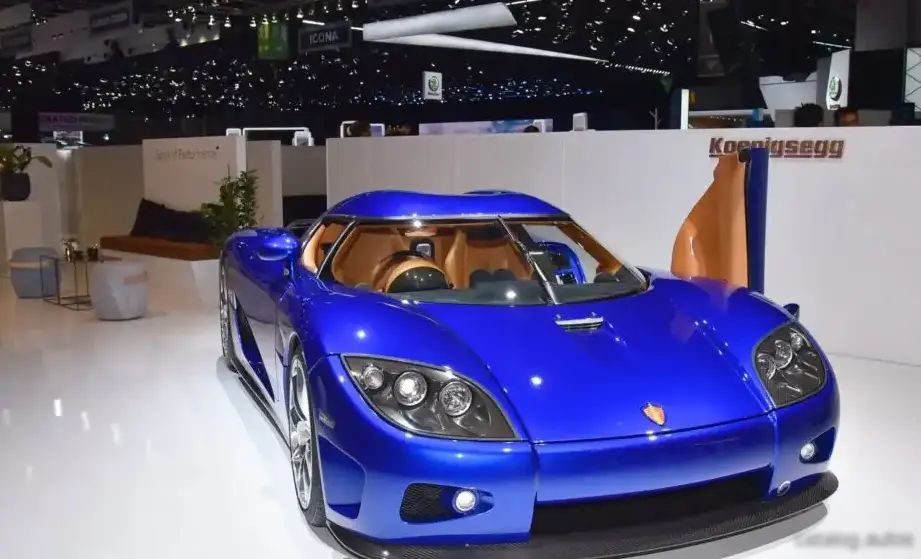
The Koenigsegg CCX R 4.7 V8 (1032 Hp) Ethanol was a limited-production hypercar manufactured by the Swedish automaker Koenigsegg between 2008 and 2010. Positioned as a more track-focused evolution of the CCX, the “R” variant represented the pinnacle of Koenigsegg’s early engineering prowess, designed for extreme performance and capable of challenging established supercar benchmarks. It was built on the CCX platform, a significant step forward for Koenigsegg in terms of production quality and overall refinement, moving away from the more bespoke, low-volume builds of earlier models. The CCX R was specifically engineered to run on E85 ethanol fuel, unlocking its substantial power output.
Technical Specifications
| Brand | Koenigsegg |
| Model | CC |
| Generation | CCX |
| Type (Engine) | R 4.7 V8 (1032 Hp) Ethanol |
| Start of production | 2008 |
| End of production | 2010 |
| Powertrain Architecture | Internal Combustion engine |
| Body type | Targa |
| Seats | 2 |
| Doors | 2 |
| Fuel consumption (economy) – extra urban | 18 l/100 km (13.1 US mpg, 15.7 UK mpg, 5.6 km/l) |
| Fuel consumption (economy) – combined | 22 l/100 km (10.7 US mpg, 12.8 UK mpg, 4.5 km/l) |
| Fuel Type | Petrol / Ethanol – E85 |
| Acceleration 0 – 100 km/h | 3.1 sec |
| Acceleration 0 – 62 mph | 3.1 sec |
| Acceleration 0 – 60 mph | 2.9 sec |
| Acceleration 0 – 200 km/h | 8.9 sec |
| Maximum speed | 400 km/h (248.55 mph) |
| Weight-to-power ratio | 1.2 kg/Hp, 806.3 Hp/tonne |
| Weight-to-torque ratio | 1.2 kg/Nm, 828.1 Nm/tonne |
| Power | 1032 Hp @ 7000 rpm |
| Power per litre | 219.6 Hp/l |
| Torque | 1060 Nm @ 5600 rpm (781.82 lb.-ft. @ 5600 rpm) |
| Engine layout | Rear, Longitudinal |
| Engine displacement | 4700 cm3 (286.81 cu. in.) |
| Number of cylinders | 8 |
| Engine configuration | V-engine |
| Compression ratio | 8.8:1 |
| Number of valves per cylinder | 4 |
| Fuel injection system | Multi-port manifold injection |
| Engine aspiration | Twin-Turbo, Intercooler |
| Valvetrain | DOHC |
| Kerb Weight | 1280 kg (2821.92 lbs) |
| Trunk (boot) space – minimum | 120 l (4.24 cu. ft.) |
| Fuel tank capacity | 70 l (18.49 US gal | 15.4 UK gal) |
| Length | 4293 mm (169.02 in) |
| Width including mirrors | 1996 mm (78.58 in) |
| Height | 1114 mm (43.86 in) |
| Ride height (ground clearance) | 100 mm (3.94 in) |
| Drag coefficient (Cd) | 0.33 |
| Minimum turning circle (turning diameter) | 11 m (36.09 ft) |
| Drivetrain Architecture | The Internal combustion engine (ICE) drives the rear wheels of the vehicle. |
| Drive wheel | Rear wheel drive |
| Number of gears and type of gearbox | 6 gears, manual transmission |
| Front suspension | Double wishbone |
| Rear suspension | Double wishbone |
| Front brakes | Ventilated discs |
| Rear brakes | Ventilated discs |
| Assisting systems | ABS (Anti-lock braking system) |
| Steering type | Steering rack and pinion |
| Power steering | Electric Steering |
| Tires size | 255/35 R19; 335/30 R20 |
| Wheel rims size | 9.5J x 19; 12.5J x 20 |
Introduction
The Koenigsegg CCX R represented a significant evolution in the CCX lineage, building upon the already impressive performance of the standard CCX. Introduced in 2008, it was designed as a more focused, track-oriented version, optimized for use with E85 ethanol fuel. This allowed Koenigsegg to extract an even higher level of power from the 4.7-liter V8 engine. The CCX R was produced in very limited numbers, further enhancing its exclusivity and collectibility. The CCX platform itself was a departure for Koenigsegg, utilizing more conventional manufacturing techniques and materials compared to earlier, highly bespoke models, resulting in improved build quality and reliability. The “R” designation signified a further refinement of the CCX, with enhancements to aerodynamics, suspension, and engine management.
Powertrain & Engine Architecture
At the heart of the CCX R lies Koenigsegg’s 4.7-liter twin-supercharged V8 engine. The engine, designated as a Koenigsegg internal combustion engine, is longitudinally mounted and positioned behind the driver. The key to the CCX R’s immense power output is its ability to run on E85 ethanol. This higher-octane fuel allows for increased boost pressures from the twin superchargers, resulting in a power increase to 1032 horsepower at 7000 rpm and 1060 Nm (781.82 lb-ft) of torque at 5600 rpm. The engine utilizes a multi-port fuel injection system and a double overhead camshaft (DOHC) valvetrain with four valves per cylinder. The engine block is constructed from aluminum, contributing to a relatively lightweight powertrain. The CCX R exclusively came equipped with a 6-speed manual transmission, prioritizing driver engagement and control.
Driving Characteristics
The CCX R’s driving experience is defined by its raw power and responsiveness. The 6-speed manual transmission provides direct control over the engine’s immense torque, allowing for blistering acceleration. The car is capable of reaching 100 km/h (62 mph) in just 3.1 seconds and 0-60 mph in a calculated 2.9 seconds, with a top speed of 400 km/h (248.55 mph). The relatively lightweight construction (1280 kg / 2821.92 lbs) contributes to its agile handling and impressive cornering ability. Compared to a standard CCX, the “R” variant offered a more aggressive throttle response and a more focused driving experience, sacrificing some of the everyday usability for enhanced track performance. The manual transmission, while demanding, provided a more visceral connection to the car than an automatic would have.
Equipment & Trim Levels
Given its limited production run and focus on performance, the CCX R was not offered with extensive customization options. The interior was minimalist and driver-focused, featuring lightweight bucket seats upholstered in leather and Alcantara. Standard equipment included air conditioning, a basic audio system, and power windows. Optional extras were limited to bespoke interior trim choices and paint colors. The emphasis was on reducing weight and maximizing performance, rather than luxury or comfort. The Targa top, a defining feature of the CCX, was removable, allowing for an open-air driving experience.
Chassis & Braking
The CCX R utilized a lightweight chassis constructed from aluminum and carbon fiber, contributing to its low curb weight. The suspension system employed double wishbones at both the front and rear, providing excellent handling and stability. Ventilated disc brakes were fitted to all four wheels, providing ample stopping power. An Anti-lock Braking System (ABS) was standard. The steering system was a rack and pinion setup with electric power steering, offering precise and responsive control. The car rode on staggered tires – 255/35 R19 at the front and 335/30 R20 at the rear – mounted on 9.5J x 19 and 12.5J x 20 inch wheels, respectively.
Market Reception & Comparison
The Koenigsegg CCX R was widely praised by automotive journalists for its incredible performance and engineering. Critics lauded its powerful engine, responsive handling, and overall driving experience. However, its high price and limited availability meant it was accessible to only a select few. Compared to other hypercars of the era, such as the Bugatti Veyron and the Pagani Zonda, the CCX R offered a more raw and visceral driving experience, prioritizing driver engagement over outright luxury. Its fuel economy, while not a primary concern for buyers in this segment, was relatively poor at 22 l/100 km (10.7 US mpg) combined.
Legacy
The Koenigsegg CCX R remains a highly sought-after collector’s item. Its limited production run and exceptional performance have ensured its place in automotive history. The powertrain, while demanding in terms of maintenance, has proven to be relatively reliable when properly cared for. The CCX R represents a pivotal moment in Koenigsegg’s evolution, demonstrating the company’s ability to produce world-class hypercars that can compete with the best in the world. Today, examples of the CCX R command significant prices on the used car market, reflecting their rarity and desirability.
