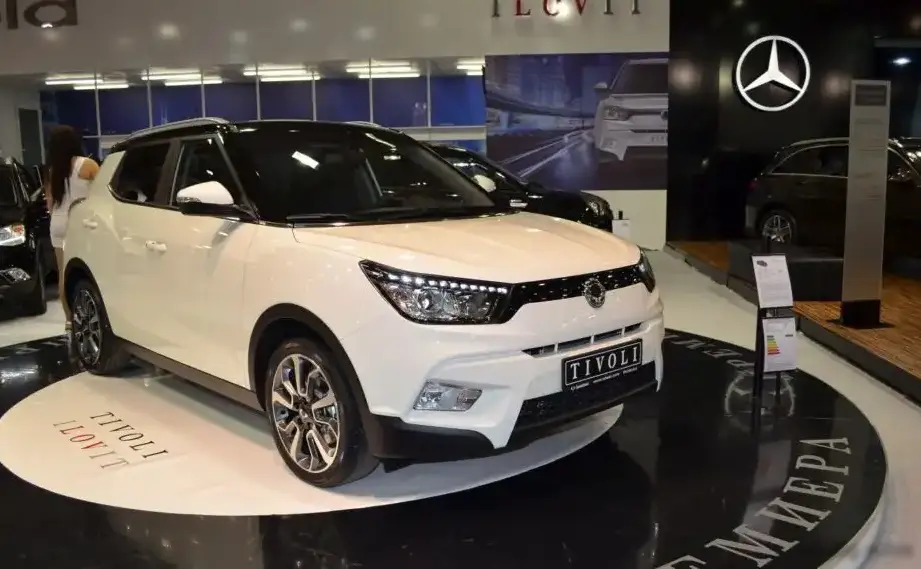
The SsangYong Tivoli (facelift 2019) 1.2 T-GDi, producing 128 horsepower, represents a key iteration of SsangYong’s compact SUV offering. Introduced in May 2020 and continuing through 2023, this variant played a significant role in the Tivoli’s second generation (codenamed XLV200), aiming to broaden the model’s appeal with a more fuel-efficient and accessible powertrain option. Positioned as a mid-range trim, it slotted between the base model and the more powerful petrol and diesel alternatives. The Tivoli, in general, was SsangYong’s attempt to gain a stronger foothold in the highly competitive European and Asian crossover market, offering a blend of practicality, affordability, and a distinctive design.
Technical Specifications
| Brand | SsangYong |
| Model | Tivoli |
| Generation | Tivoli (facelift 2019) |
| Type (Engine) | 1.2 T-GDi (128 Hp) |
| Start of production | May, 2020 |
| End of production | 2023 |
| Powertrain Architecture | Internal Combustion engine |
| Body type | SUV, Crossover |
| Seats | 5 |
| Doors | 5 |
| Fuel consumption at Low speed (WLTP) | 8.3 l/100 km (28.3 US mpg, 34 UK mpg, 12 km/l) |
| Fuel consumption at Medium speed (WLTP) | 6.4 l/100 km (36.8 US mpg, 44.1 UK mpg, 15.6 km/l) |
| Fuel consumption at high speed (WLTP) | 6 l/100 km (39.2 US mpg, 47.1 UK mpg, 16.7 km/l) |
| Fuel consumption at very high speed (WLTP) | 7.7 l/100 km (30.5 US mpg, 36.7 UK mpg, 13 km/l) |
| Combined fuel consumption (WLTP) | 7 l/100 km (33.6 US mpg, 40.4 UK mpg, 14.3 km/l) |
| CO2 emissions (WLTP) | 158 g/km |
| Fuel Type | Petrol (Gasoline) |
| Maximum speed | 180 km/h (111.85 mph) |
| Emission standard | Euro 6d |
| Weight-to-power ratio | 10.7 kg/Hp, 93.5 Hp/tonne |
| Weight-to-torque ratio | 6 kg/Nm, 168 Nm/tonne |
| Power | 128 Hp @ 5000 rpm |
| Power per litre | 106.9 Hp/l |
| Torque | 230 Nm @ 1750-3500 rpm (169.64 lb.-ft. @ 1750-3500 rpm) |
| Engine layout | Front, Transverse |
| Engine Model/Code | G12DTF |
| Engine displacement | 1197 cm3 (73.05 cu. in.) |
| Number of cylinders | 3 |
| Engine configuration | Inline |
| Number of valves per cylinder | 4 |
| Fuel injection system | Direct injection |
| Engine aspiration | Turbocharger, Intercooler |
| Engine oil capacity | 4 l (4.23 US qt | 3.52 UK qt) |
| Engine systems | Start & Stop System, Particulate filter |
| Kerb Weight | 1369 kg (3018.13 lbs.) |
| Max. weight | 1745 kg (3847.07 lbs.) |
| Max load | 376 kg (828.94 lbs.) |
| Trunk (boot) space – minimum | 427 l (15.08 cu. ft.) |
| Trunk (boot) space – maximum | 1118 l (39.48 cu. ft.) |
| Fuel tank capacity | 50 l (13.21 US gal | 11 UK gal) |
| Permitted trailer load with brakes (12%) | 1000 kg (2204.62 lbs.) |
| Permitted trailer load without brakes | 500 kg (1102.31 lbs.) |
| Permitted towbar download | 60 kg (132.28 lbs.) |
| Length | 4225 mm (166.34 in.) |
| Width | 1810 mm (71.26 in.) |
| Height | 1613-1621 mm (63.5 – 63.82 in.) |
| Wheelbase | 2600 mm (102.36 in.) |
| Front track | 1555 mm (61.22 in.) |
| Rear (Back) track | 1555 mm (61.22 in.) |
| Front overhang | 880 mm (34.65 in.) |
| Rear overhang | 745 mm (29.33 in.) |
| Minimum turning circle (turning diameter) | 10.6 m (34.78 ft.) |
| Drivetrain Architecture | The Internal combustion engine (ICE) drives the front wheels of the vehicle. |
| Drive wheel | Front wheel drive |
| Number of gears and type of gearbox | 6 gears, manual transmission |
| Front suspension | Independent type McPherson |
| Rear suspension | Torsion |
| Front brakes | Ventilated discs |
| Rear brakes | Disc |
| Assisting systems | ABS (Anti-lock braking system) |
| Steering type | Steering rack and pinion |
| Power steering | Electric Steering |
| Tires size | 205/65 R16 |
| Wheel rims size | 16 |
INTRODUCTION
The SsangYong Tivoli 1.2 T-GDi (facelift 2019) is a front-wheel-drive, five-door compact SUV that arrived as part of the Tivoli’s mid-life refresh. The facelift brought updated styling, improved safety features, and this new 1.2-liter turbocharged petrol engine option. This engine, designated G12DTF, was intended to offer a balance between performance and fuel economy, appealing to buyers seeking a more efficient alternative to the larger displacement engines available in the Tivoli range. The Tivoli aimed to compete with established players like the Nissan Juke, Renault Captur, and Kia Stonic, offering a distinctive Korean design and a competitive price point.
Powertrain & Engine Architecture
At the heart of the Tivoli 1.2 T-GDi lies the G12DTF engine, a 1.2-liter inline-three cylinder petrol engine. This engine utilizes direct fuel injection and is coupled with a turbocharger and intercooler to boost power and efficiency. The engine’s architecture is relatively simple, contributing to its compact size and reduced weight. The direct injection system precisely meters fuel into the combustion chamber, optimizing combustion and reducing emissions. The turbocharger forces more air into the engine, increasing power output. The engine’s valvetrain features four valves per cylinder, enhancing breathing and contributing to improved performance. The 6-speed manual transmission was standard, providing a direct connection between the engine and the front wheels. The transmission’s gear ratios were tuned to prioritize fuel efficiency while still providing adequate acceleration.
Driving Characteristics
The 128 hp and 230 Nm (169.64 lb-ft) of torque delivered by the 1.2 T-GDi engine provided adequate, though not exhilarating, performance. Acceleration was reasonable for everyday driving, with the engine feeling most responsive in the mid-range. Compared to the more powerful 1.6-liter petrol or 1.6-liter diesel options, the 1.2 T-GDi felt less urgent, particularly when fully loaded or tackling steep inclines. The manual transmission offered a satisfyingly direct feel, but the gear ratios were geared towards economy, meaning frequent downshifts were often required for overtaking maneuvers. The engine’s turbocharger did exhibit some lag at low RPMs, but this was generally well-managed. Overall, the driving experience was comfortable and predictable, prioritizing ease of use over outright performance.
Equipment & Trim Levels
The 1.2 T-GDi trim typically included standard features such as air conditioning, a touchscreen infotainment system with Bluetooth connectivity, alloy wheels, and a suite of safety features including ABS, ESC (Electronic Stability Control), and multiple airbags. Higher trim levels added features like a rear parking camera, automatic climate control, leather upholstery, and a more advanced infotainment system with navigation. Interior upholstery was typically cloth on the base trims, with leather options available on higher-spec models. The dashboard layout was functional and modern, with a focus on user-friendliness. Optional extras included a panoramic sunroof, upgraded sound system, and various styling enhancements.
Chassis & Braking
The Tivoli 1.2 T-GDi utilized a McPherson strut front suspension and a torsion beam rear suspension. This setup provided a comfortable ride quality, absorbing bumps and imperfections in the road surface effectively. The front brakes were ventilated discs, providing ample stopping power, while the rear brakes were solid discs. ABS (Anti-lock Braking System) was standard, enhancing safety during emergency braking situations. The steering was electrically assisted, providing a light and responsive feel. Stabilizer bars were fitted to both the front and rear axles to reduce body roll during cornering.
Market Reception & Comparison
The Tivoli 1.2 T-GDi was generally well-received by critics as a practical and affordable compact SUV. Its fuel economy was a key selling point, particularly compared to the larger-engined variants. However, some reviewers noted that the engine lacked the punch of its competitors and that the interior materials were not as premium as those found in some rival models. Compared to the 1.6-liter petrol Tivoli, the 1.2 T-GDi offered better fuel economy but less power. The 1.6-liter diesel provided superior torque and fuel efficiency, but at a higher price point. The 1.2 T-GDi appealed to buyers prioritizing fuel economy and affordability over outright performance.
Legacy
The SsangYong Tivoli 1.2 T-GDi, while not without its shortcomings, proved to be a popular choice for buyers seeking a value-for-money compact SUV. The G12DTF engine has demonstrated reasonable reliability, although regular maintenance is crucial. On the used car market, these models represent a relatively affordable entry point into the compact SUV segment. The Tivoli, as a whole, helped to elevate SsangYong’s brand image and establish it as a credible competitor in the European and Asian markets. While SsangYong has undergone ownership changes since the production of this model, the Tivoli continues to be a significant vehicle in the company’s history.