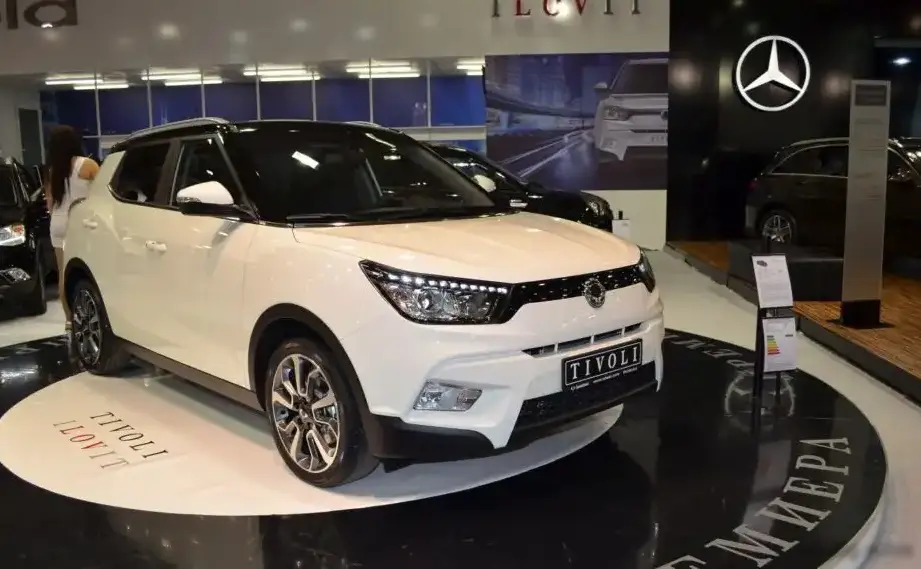
The SsangYong Tivoli (facelift, introduced in October 2019) 1.5 T-GDi represents a significant iteration of SsangYong’s popular subcompact crossover SUV. Positioned as a mid-range offering within the Tivoli lineup, this variant aimed to balance fuel efficiency with a more engaging driving experience compared to the base engine options. The facelift brought updated styling, improved interior materials, and enhanced safety features, solidifying the Tivoli’s position in the competitive European and Asian markets. Production continued until 2023, with this 1.5 T-GDi engine becoming a mainstay of the model range. The Tivoli, in general, was SsangYong’s attempt to broaden its appeal beyond its traditional, more rugged SUV offerings, targeting a younger, more urban demographic.
Technical Specifications
| Brand | SsangYong |
| Model | Tivoli |
| Generation | Tivoli (facelift 2019) |
| Type (Engine) | 1.5 T-GDi (163 Hp) |
| Start of production | October, 2019 |
| End of production | 2023 |
| Powertrain Architecture | Internal Combustion engine |
| Body type | SUV, Crossover |
| Seats | 5 |
| Doors | 5 |
| Fuel consumption at Low speed (WLTP) | 8.6 l/100 km (27.4 US mpg, 32.8 UK mpg, 11.6 km/l) |
| Fuel consumption at Medium speed (WLTP) | 6.7 l/100 km (35.1 US mpg, 42.2 UK mpg, 14.9 km/l) |
| Fuel consumption at high speed (WLTP) | 6.2 l/100 km (37.9 US mpg, 45.6 UK mpg, 16.1 km/l) |
| Fuel consumption at very high speed (WLTP) | 7.8 l/100 km (30.2 US mpg, 36.2 UK mpg, 12.8 km/l) |
| Combined fuel consumption (WLTP) | 7.2 l/100 km (32.7 US mpg, 39.2 UK mpg, 13.9 km/l) |
| CO2 emissions (WLTP) | 164 g/km |
| Fuel Type | Petrol (Gasoline) |
| Maximum speed | 180 km/h (111.85 mph) |
| Emission standard | Euro 6d |
| Weight-to-power ratio | 8 kg/Hp, 125.4 Hp/tonne |
| Weight-to-torque ratio | 4.6 kg/Nm, 215.4 Nm/tonne |
| Power | 163 Hp @ 5500 rpm |
| Power per litre | 108.9 Hp/l |
| Torque | 280 Nm @ 1500-4000 rpm (206.52 lb.-ft. @ 1500-4000 rpm) |
| Engine layout | Front, Transverse |
| Engine Model/Code | G15DTF |
| Engine displacement | 1497 cm3 (91.35 cu. in.) |
| Number of cylinders | 4 |
| Engine configuration | Inline |
| Cylinder Bore | 76 mm (2.99 in.) |
| Piston Stroke | 82.5 mm (3.25 in.) |
| Compression ratio | 9.5:1 |
| Number of valves per cylinder | 4 |
| Fuel injection system | Direct injection |
| Engine aspiration | Turbocharger, Intercooler |
| Engine oil capacity | 4.5 l (4.76 US qt | 3.96 UK qt) |
| Coolant | 7 l (7.4 US qt | 6.16 UK qt) |
| Kerb Weight | 1300-1387 kg (2866.01 – 3057.81 lbs.) |
| Max. weight | 1850 kg (4078.55 lbs.) |
| Max load | 463-550 kg (1020.74 – 1212.54 lbs.) |
| Trunk (boot) space – minimum | 311 l (10.98 cu. ft.) |
| Trunk (boot) space – maximum | 1002 l (35.39 cu. ft.) |
| Fuel tank capacity | 50 l (13.21 US gal | 11 UK gal) |
| Permitted trailer load with brakes (12%) | 1000 kg (2204.62 lbs.) |
| Permitted trailer load without brakes | 500 kg (1102.31 lbs.) |
| Permitted towbar download | 60 kg (132.28 lbs.) |
| Length | 4225 mm (166.34 in.) |
| Width | 1810 mm (71.26 in.) |
| Height | 1621 mm (63.82 in.) |
| Wheelbase | 2600 mm (102.36 in.) |
| Front track | 1555 mm (61.22 in.) |
| Rear (Back) track | 1555 mm (61.22 in.) |
| Front overhang | 880 mm (34.65 in.) |
| Rear overhang | 745 mm (29.33 in.) |
| Ride height (ground clearance) | 178 mm (7.01 in.) |
| Minimum turning circle (turning diameter) | 10.6 m (34.78 ft.) |
| Approach angle | 17.5° |
| Departure angle | 27.5° |
| Ramp-over (brakeover) angle | 17° |
| Drivetrain Architecture | The Internal combustion engine (ICE) drives the front wheels of the vehicle. |
| Drive wheel | Front wheel drive |
| Number of gears and type of gearbox | 6 gears, manual transmission |
| Front suspension | Independent type McPherson |
| Rear suspension | Torsion |
| Front brakes | Ventilated discs |
| Rear brakes | Disc |
| Assisting systems | ABS (Anti-lock braking system) |
| Steering type | Steering rack and pinion |
| Power steering | Electric Steering |
| Tires size | 205/65 R16 |
| Wheel rims size | 16 |
Powertrain & Engine Architecture
The heart of the Tivoli 1.5 T-GDi is the G15DTF engine, a 1.5-liter turbocharged inline-four cylinder gasoline engine. This engine is part of SsangYong’s newer engine family, designed for improved efficiency and performance. It utilizes direct fuel injection, a technology that precisely meters fuel into the combustion chamber, enhancing both power and fuel economy. The engine also features an intercooled turbocharger, which forces more air into the cylinders, boosting power output. The G15DTF produces 163 horsepower at 5500 rpm and 280 Nm (206.52 lb-ft) of torque between 1500 and 4000 rpm. This broad torque curve provides good responsiveness in everyday driving situations. The engine is paired with a 6-speed manual transmission, delivering power to the front wheels. The engine’s architecture prioritizes a balance between performance and fuel efficiency, making it suitable for urban and highway driving.
Driving Characteristics
The 1.5 T-GDi Tivoli offers a noticeable step up in performance compared to the lower-powered engine options available in the range. The turbocharger provides a good amount of low-end torque, making it easy to accelerate from a standstill and navigate city traffic. While not a sports car, the 163 hp engine provides sufficient power for confident highway merging and overtaking. The 6-speed manual transmission allows for precise gear selection, and the gear ratios are well-matched to the engine’s powerband. Compared to a hypothetical automatic version (not offered in the US market), the manual transmission provides a more engaging driving experience and allows the driver to fully utilize the engine’s power. The Tivoli’s suspension is tuned for comfort, providing a relatively smooth ride over most road surfaces. However, it’s not particularly sporty, and there is some body roll in corners.
Equipment & Trim Levels
The 1.5 T-GDi trim typically included a good level of standard equipment. Features commonly included air conditioning, a touchscreen infotainment system with Apple CarPlay and Android Auto compatibility, Bluetooth connectivity, and a rearview camera. Higher trim levels added features such as leather upholstery, heated front seats, a sunroof, and advanced driver-assistance systems (ADAS) like lane departure warning and automatic emergency braking. Interior materials were generally of good quality for the price point, with a focus on durability and practicality. The dashboard layout was clean and functional, with easy-to-use controls.
Chassis & Braking
The Tivoli utilizes a front-wheel-drive platform with an independent McPherson strut suspension in the front and a torsion beam suspension in the rear. This setup provides a good balance between ride comfort and handling. The braking system consists of ventilated discs on the front wheels and solid discs on the rear wheels. Anti-lock Braking System (ABS) is standard, providing enhanced braking performance in emergency situations. The steering is electrically assisted, providing light and precise steering feel.
Market Reception & Comparison
The SsangYong Tivoli 1.5 T-GDi was generally well-received by automotive critics. It was praised for its stylish design, spacious interior, and good value for money. The 1.5 T-GDi engine was considered a significant improvement over the base engine options, providing a more enjoyable driving experience. Fuel economy was competitive within its class, averaging around 32.7 US mpg in combined driving. Compared to rivals like the Nissan Juke or Kia Soul, the Tivoli offered a more generous warranty and a more rugged aesthetic. However, some critics noted that the Tivoli’s interior materials were not quite as refined as those found in some of its competitors.
Legacy
The SsangYong Tivoli 1.5 T-GDi has proven to be a reliable and durable vehicle. The G15DTF engine, while not without its minor quirks, has generally been considered a robust and dependable unit. On the used car market, the Tivoli 1.5 T-GDi represents a good value proposition, offering a well-equipped and relatively fuel-efficient crossover SUV at an affordable price. Its relatively simple mechanical design makes it easier and less expensive to maintain compared to some of its more technologically advanced rivals. The Tivoli helped to modernize SsangYong’s image and broaden its appeal to a wider range of customers, paving the way for future models.