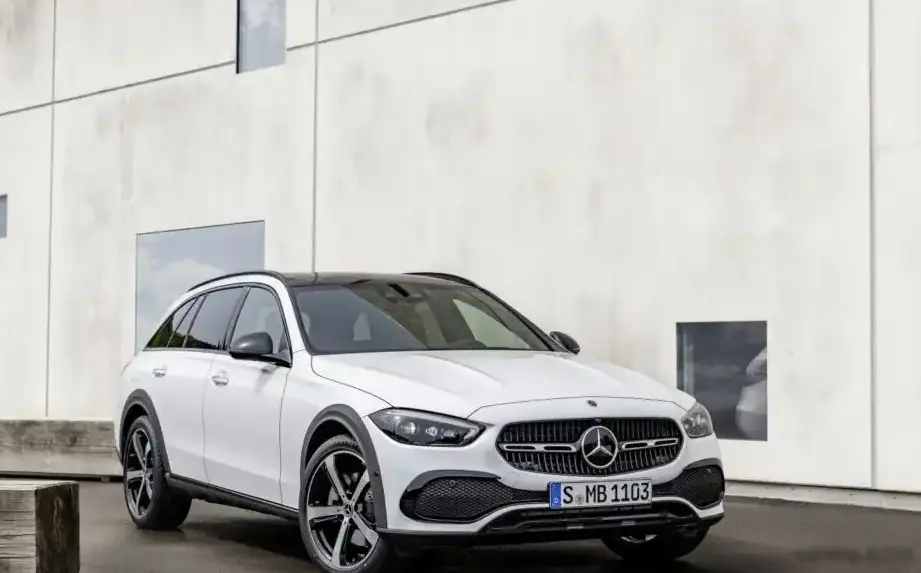
The Mercedes-Benz C-Class T-modell (S203) C 240 V6 4MATIC, produced from July 2002 to March 2004, represented a compelling blend of practicality and performance within the compact executive estate car segment. Positioned as a mid-range offering in the S203 series, it catered to buyers seeking the versatility of a wagon with the refinement and all-weather capability of Mercedes-Benz’s 4MATIC all-wheel-drive system. This variant occupied a space between the more economical four-cylinder models and the higher-performance C32 AMG, offering a comfortable and capable driving experience. It was primarily sold in European markets, where the demand for station wagons (estate cars) remained strong.
Technical Specifications
| Brand | Mercedes-Benz |
| Model | C-class |
| Generation | C-class T-modell (S203) |
| Type (Engine) | C 240 V6 (170 Hp) 4MATIC |
| Start of production | July, 2002 |
| End of production | March, 2004 |
| Powertrain Architecture | Internal Combustion engine |
| Body type | Station wagon (estate) |
| Seats | 5 |
| Doors | 5 |
| Fuel consumption (economy) – urban (NEDC) | 16.1 l/100 km (14.6 US mpg, 17.5 UK mpg, 6.2 km/l) |
| Fuel consumption (economy) – extra urban (NEDC) | 8.5 l/100 km (27.7 US mpg, 33.2 UK mpg, 11.8 km/l) |
| Fuel consumption (economy) – combined (NEDC) | 11.6 l/100 km (20.3 US mpg, 24.4 UK mpg, 8.6 km/l) |
| CO2 emissions (NEDC) | 279 g/km |
| Fuel Type | Petrol (Gasoline) |
| Acceleration 0 – 100 km/h | 10.4 sec |
| Acceleration 0 – 62 mph | 10.4 sec |
| Acceleration 0 – 60 mph | 9.9 sec |
| Maximum speed | 219 km/h (136.08 mph) |
| Emission standard | Euro 4 |
| Weight-to-power ratio | 9.5 kg/Hp, 105.3 Hp/tonne |
| Weight-to-torque ratio | 6.7 kg/Nm, 148.6 Nm/tonne |
| Power | 170 Hp @ 5500 rpm |
| Power per litre | 65.5 Hp/l |
| Torque | 240 Nm @ 4500 rpm (177.01 lb.-ft. @ 4500 rpm) |
| Engine layout | Front, Longitudinal |
| Engine Model/Code | M 112.916 |
| Engine displacement | 2597 cm3 (158.48 cu. in.) |
| Number of cylinders | 6 |
| Engine configuration | V-engine |
| Cylinder Bore | 89.9 mm (3.54 in.) |
| Piston Stroke | 68.2 mm (2.69 in.) |
| Compression ratio | 10.5:1 |
| Number of valves per cylinder | 3 |
| Fuel injection system | Multi-port manifold injection |
| Engine aspiration | Naturally aspirated engine |
| Valvetrain | SOHC |
| Engine oil capacity | 8 l (8.45 US qt | 7.04 UK qt) |
| Coolant | 10 l (10.57 US qt | 8.8 UK qt) |
| Kerb Weight | 1615 kg (3560.47 lbs.) |
| Max. weight | 2215 kg (4883.24 lbs.) |
| Max load | 600 kg (1322.77 lbs.) |
| Trunk (boot) space – minimum | 470 l (16.6 cu. ft.) |
| Trunk (boot) space – maximum | 1384 l (48.88 cu. ft.) |
| Fuel tank capacity | 62 l (16.38 US gal | 13.64 UK gal) |
| Max. roof load | 100 kg (220.46 lbs.) |
| Permitted trailer load with brakes (12%) | 1500 kg (3306.93 lbs.) |
| Permitted trailer load without brakes | 750 kg (1653.47 lbs.) |
| Length | 4541 mm (178.78 in.) |
| Width | 1728 mm (68.03 in.) |
| Width including mirrors | 1980 mm (77.95 in.) |
| Height | 1462 mm (57.56 in.) |
| Wheelbase | 2715 mm (106.89 in.) |
| Front track | 1493 mm (58.78 in.) |
| Rear (Back) track | 1464 mm (57.64 in.) |
| Front overhang | 755 mm (29.72 in.) |
| Rear overhang | 1071 mm (42.17 in.) |
| Drag coefficient (Cd) | 0.31 |
| Minimum turning circle (turning diameter) | 10.76 m (35.3 ft.) |
| Drivetrain Architecture | The Internal combustion engine (ICE) drives permanently the four wheels of the vehicle. |
| Drive wheel | All wheel drive (4×4) |
| Number of gears and type of gearbox | 5 gears, automatic transmission |
| Front suspension | Independent type McPherson, Transverse stabilizer |
| Rear suspension | Independent multi-link suspension, Transverse stabilizer |
| Front brakes | Ventilated discs |
| Rear brakes | Disc |
| Assisting systems | ABS (Anti-lock braking system) |
| Steering type | Steering rack and pinion |
| Power steering | Hydraulic Steering |
| Tires size | 205/55 R 16 91 V |
| Wheel rims size | 7 J x 16 H 2 |
INTRODUCTION
The S203 C-Class T-modell, introduced in 2001, brought a modern estate car option to the Mercedes-Benz lineup. The C 240 V6 4MATIC, launched in 2002, was a key variant, offering a step up in performance and all-weather capability compared to the base models. It utilized the M112 V6 engine, a significant departure from the previous inline-six configurations, and paired it with a five-speed automatic transmission and Mercedes’ 4MATIC all-wheel-drive system. This combination aimed to provide a refined and practical vehicle for families and individuals needing both space and security in varying road conditions.
Powertrain & Engine Architecture
The heart of the C 240 V6 4MATIC is the M112.916 2.6-liter V6 engine. This engine, part of Mercedes’ modular V6 and V8 family, featured all-aluminum construction, three valves per cylinder (two intake, one exhaust), and a double overhead camshaft (DOHC) design. Fuel delivery was handled by a multi-port fuel injection system. The engine produced 170 horsepower at 5500 rpm and 240 Nm (177 lb-ft) of torque at 4500 rpm. The five-speed automatic transmission (typically the 722.6) was chosen for its smooth operation and suitability for the engine’s torque curve. The 4MATIC system is a full-time all-wheel-drive system, utilizing a center differential to distribute power between the front and rear axles, providing enhanced traction and stability.
Driving Characteristics
The C 240 V6 4MATIC offered a comfortable and composed driving experience. While not overtly sporty, the V6 engine provided adequate power for everyday driving and overtaking maneuvers. The automatic transmission, while smooth, wasn’t particularly quick to downshift, resulting in a slightly less responsive feel compared to the manual transmission options available in other C-Class models. The 4MATIC system instilled confidence in slippery conditions, providing noticeable improvements in grip and stability. The weight distribution, however, was slightly front-biased, which could be felt during more spirited driving. Gear ratios were tuned for fuel efficiency and comfort rather than outright performance.
Equipment & Trim Levels
The C 240 V6 4MATIC typically came standard with features such as automatic climate control, power windows and locks, a multi-function steering wheel, and a basic audio system. Upholstery was generally cloth, although leather was available as an option. Optional extras included a sunroof, upgraded audio systems, navigation, heated seats, and parking sensors. The interior design was typical of Mercedes-Benz at the time – functional, well-built, and focused on comfort. Trim levels varied slightly depending on the market, but generally, the C 240 4MATIC sat in the mid-range of the S203 lineup.
Chassis & Braking
The S203 C-Class utilized an independent suspension system all around. The front suspension featured McPherson struts with a transverse stabilizer bar, while the rear employed a multi-link setup, also with a stabilizer bar. This configuration provided a good balance between ride comfort and handling. Braking duties were handled by ventilated discs at the front and solid discs at the rear. Anti-lock braking system (ABS) was standard. The suspension tuning was geared towards comfort, resulting in a relatively soft ride, but body roll was noticeable during aggressive cornering.
Market Reception & Comparison
The C 240 V6 4MATIC was generally well-received by automotive critics. It was praised for its comfortable ride, refined engine, and the added security of all-wheel drive. However, some reviewers noted that the automatic transmission could feel sluggish at times, and the car wasn’t as engaging to drive as some of its rivals. Compared to the C180 Kompressor or C200K, the C 240 offered significantly more power and a smoother driving experience. Against the C32 AMG, it lacked the outright performance but offered a more affordable price point and better fuel economy. The C 240 V6 4MATIC offered a good balance between performance, practicality, and luxury.
Legacy
The M112 V6 engine, used in the C 240 4MATIC, proved to be a reliable powerplant when properly maintained. Common issues included occasional oil leaks and sensor failures, but these were generally not major concerns. The 722.6 automatic transmission is also known for its durability. Today, the S203 C-Class T-modell C 240 V6 4MATIC represents an affordable entry point into Mercedes-Benz ownership. Well-maintained examples are still relatively common on the used car market, and they continue to offer a practical and comfortable driving experience. Its blend of space, refinement, and all-wheel-drive capability makes it a desirable option for those seeking a versatile and reliable estate car.