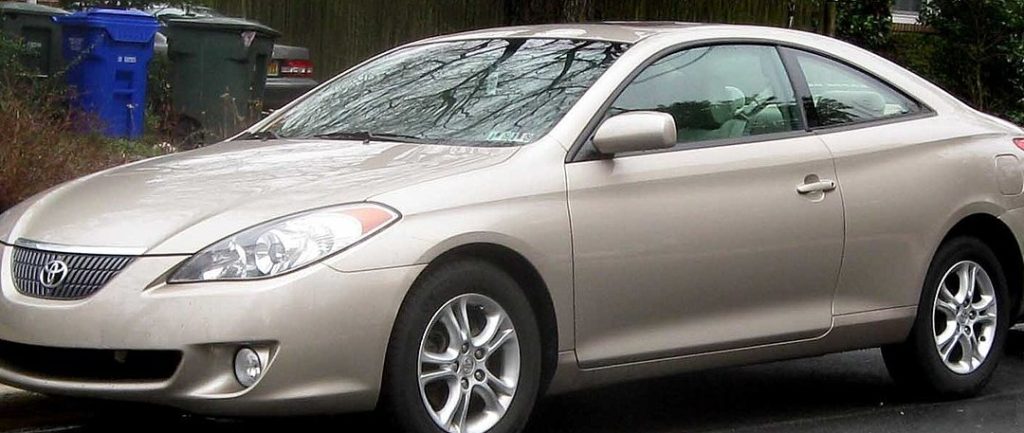
The Toyota Camry Solara II 3.3 V6 Automatic, produced between 2003 and 2006, represented a more sporting iteration of Toyota’s popular Camry lineage. Positioned as the top-tier engine option for the Solara coupe, this variant aimed to attract buyers seeking a blend of comfort, style, and respectable performance. It was built upon the XV20 platform, sharing its underpinnings with the Camry sedan but distinguished by its two-door coupe body style and more aggressive styling cues. The 3.3L V6 automatic was the premium offering in the Solara lineup, sitting above the base 2.4L four-cylinder models.
Technical Specifications
| Brand | Toyota |
| Model | Camry |
| Generation | Camry Solara II |
| Type (Engine) | 3.3 V6 (225 Hp) Automatic |
| Start of production | 2003 |
| End of production | 2006 |
| Powertrain Architecture | Internal Combustion engine |
| Body type | Coupe |
| Seats | 5 |
| Doors | 2 |
| Fuel consumption (urban) | 11.7 l/100 km (20.1 US mpg) |
| Fuel consumption (extra urban) | 8.1 l/100 km (29 US mpg) |
| Fuel Type | Petrol (Gasoline) |
| Weight-to-power ratio | 6.5 kg/Hp |
| Weight-to-torque ratio | 4.5 kg/Nm |
| Power | 225 Hp @ 5600 rpm |
| Power per litre | 68 Hp/l |
| Torque | 325 Nm @ 3600 rpm (239.71 lb.-ft. @ 3600 rpm) |
| Engine layout | Front, Transverse |
| Engine Model/Code | 3MZ-FE |
| Engine displacement | 3311 cm3 (202.05 cu. in.) |
| Number of cylinders | 6 |
| Engine configuration | V-engine |
| Cylinder Bore | 92 mm (3.62 in.) |
| Piston Stroke | 83 mm (3.27 in.) |
| Compression ratio | 10.8:1 |
| Number of valves per cylinder | 4 |
| Fuel injection system | Multi-port manifold injection |
| Engine aspiration | Naturally aspirated engine |
| Valvetrain | DOHC |
| Engine oil capacity | 4.7 l (4.97 US qt | 4.14 UK qt) |
| Coolant capacity | 9.2 l (9.72 US qt | 8.09 UK qt) |
| Kerb Weight | 1470 kg (3240.8 lbs.) |
| Trunk (boot) space | 391 l (13.81 cu. ft.) |
| Fuel tank capacity | 70 l (18.49 US gal | 15.4 UK gal) |
| Length | 4890 mm (192.52 in.) |
| Width | 1816 mm (71.5 in.) |
| Height | 1425 mm (56.1 in.) |
| Wheelbase | 2720 mm (107.09 in.) |
| Front track | 1547 mm (60.91 in.) |
| Rear track | 1534 mm (60.39 in.) |
| Ride height (ground clearance) | 140 mm (5.51 in.) |
| Drag coefficient (Cd) | 0.29 |
| Minimum turning circle | 11.6 m (38.06 ft.) |
| Drivetrain Architecture | Front wheel drive |
| Number of gears | 5 |
| Gearbox type | Automatic transmission ECT-i |
| Front suspension | Independent, type McPherson with coil spring and anti-roll bar |
| Rear suspension | Independent multi-link spring suspension with stabilizer |
| Front brakes | Ventilated discs |
| Rear brakes | Disc |
| Assisting systems | ABS (Anti-lock braking system) |
| Steering type | Steering rack and pinion |
| Power steering | Hydraulic Steering |
| Tires size | 215/55 R17 |
| Wheel rims size | 17 |
Powertrain & Engine Architecture
The heart of the Solara II 3.3 V6 was Toyota’s 3MZ-FE engine, a 3.3-liter, naturally aspirated V6. This engine featured a 60-degree V-angle and utilized a double overhead camshaft (DOHC) valvetrain with four valves per cylinder. The 3MZ-FE employed multi-port fuel injection, delivering fuel directly to each intake port for optimized combustion. The engine was known for its relatively smooth operation and decent power output for its time. Paired with this engine was a five-speed automatic transmission, designated ECT-i (Electronically Controlled Transmission – intelligent). This transmission offered selectable driving modes, allowing drivers to prioritize fuel economy or performance. The ECT-i transmission was designed to provide smooth shifts and adapt to driving conditions.
Driving Characteristics
The 225 horsepower and 239 lb-ft of torque provided by the 3.3L V6 and automatic transmission combination delivered adequate, though not exhilarating, performance. Acceleration from 0 to 60 mph was typically in the 7-8 second range. The automatic transmission, while smooth, did exhibit some of the characteristics common to older automatic gearboxes – a slight delay in response and a tendency to hunt for gears on inclines. Compared to the available manual transmission, the automatic traded some responsiveness for ease of use. The Solara’s front-wheel-drive configuration contributed to predictable handling, but it lacked the dynamic finesse of rear-wheel-drive competitors. The gear ratios were tuned for a balance between acceleration and highway cruising, making it a comfortable grand tourer.
Equipment & Trim Levels
The Solara II 3.3 V6 Automatic typically came well-equipped, reflecting its position as the premium trim level. Standard features included air conditioning, power windows and locks, a CD player, and cruise control. Higher trim levels, such as the SLE, added features like leather upholstery, heated seats, a sunroof, and upgraded audio systems. Optional extras included a navigation system, premium sound systems, and various cosmetic enhancements. Interior materials were generally of good quality, providing a comfortable and refined cabin environment.
Chassis & Braking
The Solara II utilized an independent McPherson strut suspension in the front and an independent multi-link suspension in the rear. This setup provided a comfortable ride quality, absorbing bumps and irregularities in the road surface effectively. Stabilizer bars were fitted to both the front and rear axles to reduce body roll during cornering. Braking duties were handled by ventilated disc brakes at the front and solid disc brakes at the rear. Anti-lock braking system (ABS) was standard, enhancing safety and control during emergency braking situations. The suspension tuning prioritized comfort over outright sportiness, resulting in a stable and predictable driving experience.
Market Reception & Comparison
The Camry Solara II 3.3 V6 Automatic was generally well-received by automotive critics. It was praised for its comfortable ride, spacious interior, and reliable powertrain. However, some reviewers noted that its performance was not as engaging as some of its competitors, such as the Ford Mustang or Honda Accord Coupe. Fuel economy was respectable for a V6-powered vehicle, averaging around 20 mpg in the city and 29 mpg on the highway. Compared to the base 2.4L four-cylinder Solara, the 3.3L V6 offered a significant boost in power and torque, but at the cost of slightly lower fuel economy. The V6 also commanded a higher price point.
Legacy
The Toyota 3MZ-FE engine, found in the Solara II 3.3 V6, is known for its durability and reliability. With proper maintenance, these engines can accumulate high mileage without major issues. The automatic transmission, while not as sophisticated as modern units, is also generally reliable. Today, the Solara II 3.3 V6 Automatic represents an affordable and relatively dependable used car option. Parts availability is good, and maintenance costs are reasonable. While it may not offer the latest technology or the most thrilling driving experience, it remains a comfortable and practical coupe for those seeking a reliable and stylish vehicle.