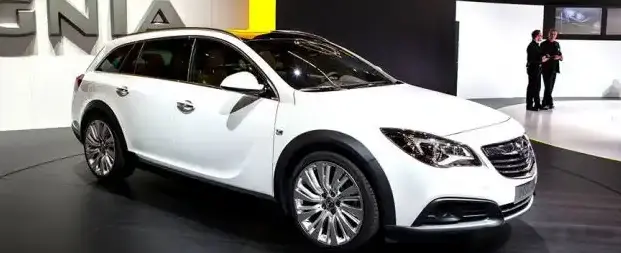
The Opel Insignia Hatchback, specifically the facelifted A-generation produced from July 2013 to January 2017, represented a significant offering in the European mid-size car segment. This variant, equipped with a 1.6-liter turbocharged Ecotec engine producing 170 horsepower and paired with a six-speed automatic transmission, occupied a middle ground within the Insignia lineup, balancing performance with fuel efficiency and comfort. It aimed to appeal to buyers seeking a spacious, well-equipped hatchback with a more refined driving experience than the base models, but without the higher price tag of the flagship trims.
Technical Specifications
| Brand | Opel |
| Model | Insignia |
| Generation | Insignia Hatchback (A, facelift 2013) |
| Type (Engine) | 1.6 (170 Hp) Turbo Ecotec Automatic |
| Start of production | July, 2013 |
| End of production | January, 2017 |
| Powertrain Architecture | Internal Combustion engine |
| Body type | Hatchback |
| Seats | 5 |
| Doors | 5 |
| Fuel consumption (urban) | 9.1 l/100 km (25.8 US mpg, 31 UK mpg, 11 km/l) |
| Fuel consumption (extra urban) | 5.2 l/100 km (45.2 US mpg, 54.3 UK mpg, 19.2 km/l) |
| Fuel consumption (combined) | 6.6 l/100 km (35.6 US mpg, 42.8 UK mpg, 15.2 km/l) |
| CO2 emissions | 155 g/km |
| Fuel Type | Petrol (Gasoline) |
| Acceleration 0 – 100 km/h | 9.9 sec |
| Acceleration 0 – 62 mph | 9.9 sec |
| Acceleration 0 – 60 mph | 9.4 sec |
| Maximum speed | 210 km/h (130.49 mph) |
| Emission standard | Euro 5 |
| Power | 170 Hp @ 4250 rpm |
| Power per litre | 106.4 Hp/l |
| Torque | 260 Nm @ 1650-4250 rpm (191.77 lb.-ft. @ 1650-4250 rpm) |
| Engine layout | Front, Transverse |
| Engine Model/Code | A16XHT, B16SHL |
| Engine displacement | 1598 cm3 (97.52 cu. in.) |
| Number of cylinders | 4 |
| Engine configuration | Inline |
| Cylinder Bore | 79 mm (3.11 in.) |
| Piston Stroke | 81.5 mm (3.21 in.) |
| Number of valves per cylinder | 4 |
| Fuel injection system | Multi-port manifold injection |
| Engine aspiration | Turbocharger, Intercooler |
| Engine oil capacity | 5.5 l (5.81 US qt | 4.84 UK qt) |
| Coolant | 5.8 l (6.13 US qt | 5.1 UK qt) |
| Trunk (boot) space – minimum | 530 l (18.72 cu. ft.) |
| Trunk (boot) space – maximum | 1470 l (51.91 cu. ft.) |
| Fuel tank capacity | 70 l (18.49 US gal | 15.4 UK gal) |
| Length | 4842 mm (190.63 in.) |
| Width | 1856 mm (73.07 in.) |
| Width including mirrors | 2084 mm (82.05 in.) |
| Height | 1498 mm (58.98 in.) |
| Wheelbase | 2737 mm (107.76 in.) |
| Front track | 1587 mm (62.48 in.) |
| Rear (Back) track | 1590 mm (62.6 in.) |
| Minimum turning circle | 11.4 m (37.4 ft.) |
| Drivetrain Architecture | Front wheel drive |
| Number of gears | 6 |
| Gearbox type | Automatic transmission |
INTRODUCTION
The Opel Insignia A, launched in 2008, was a pivotal model for the brand, representing a move upmarket and a challenge to established players like the Ford Mondeo and Volkswagen Passat. The 2013 facelift brought styling revisions, improved interior materials, and updated technology. The 1.6 Turbo Ecotec Automatic variant, introduced with the facelift, offered a compelling blend of performance and economy. It was positioned as a step up from the base 1.4-liter engine, providing more power for highway cruising and overtaking, while the automatic transmission appealed to drivers prioritizing convenience. This trim level aimed for buyers who wanted a comfortable and capable family car without the expense of the higher-powered 2.0-liter models.
Powertrain & Engine Architecture
The heart of this Insignia variant is the A16XHT (or B16SHL, depending on the specific production date) 1.6-liter inline-four cylinder engine. This engine is part of Opel’s Ecotec family, known for its focus on efficiency and refinement. It features a single overhead camshaft (SOHC) valvetrain with four valves per cylinder. The engine utilizes multi-port fuel injection, delivering fuel directly into the intake ports. Crucially, it’s equipped with a turbocharger and intercooler, which significantly boost power output. The turbocharger provides increased air intake, allowing for a higher compression ratio and more efficient combustion. The six-speed automatic transmission, sourced from Aisin, was chosen for its smooth shifting and responsiveness. It features adaptive shift patterns, adjusting to the driver’s style and road conditions. The transmission doesn’t offer manual shift modes, focusing on ease of use.
Driving Characteristics
The 170 horsepower and 192 lb-ft of torque delivered by the 1.6 Turbo Ecotec engine provide adequate performance for everyday driving. Acceleration from 0-60 mph takes around 9.4 seconds, and the car feels reasonably responsive in most situations. However, compared to the more powerful 2.0-liter turbocharged variants, this engine feels less eager, particularly when fully loaded or tackling steep inclines. The automatic transmission contributes to a relaxed driving experience, with smooth gear changes. The gear ratios are tuned for fuel efficiency, meaning the engine can feel slightly strained when demanding rapid acceleration. The steering is light and precise, making the Insignia easy to maneuver in urban environments. The suspension provides a comfortable ride, absorbing bumps and imperfections in the road surface effectively.
Equipment & Trim Levels
The 1.6 Turbo Ecotec Automatic typically came equipped with a generous level of standard features. These included air conditioning, a CD/MP3 stereo system, electric windows and mirrors, and alloy wheels. Higher trim levels, such as SE or Elite, added features like leather upholstery, heated front seats, a touchscreen infotainment system with navigation, and parking sensors. Optional extras included a panoramic sunroof, adaptive cruise control, and a premium sound system. Interior upholstery was typically cloth on the base trims, with leather available as an upgrade. The dashboard layout was functional and well-designed, with clear instrumentation and intuitive controls.
Chassis & Braking
The Insignia A utilized a front-wheel-drive platform with MacPherson strut suspension at the front and a multi-link suspension at the rear. This setup provides a good balance between ride comfort and handling. The front brakes were typically ventilated discs, while the rear brakes were solid discs on most variants, though some base models featured drum brakes. Anti-lock Braking System (ABS) was standard, along with Electronic Stability Control (ESC). The steering system employed a rack-and-pinion setup with electric power assistance. Stabilizer bars were fitted to both the front and rear axles to reduce body roll during cornering.
Market Reception & Comparison
The 1.6 Turbo Ecotec Automatic Insignia received generally positive reviews. Critics praised its comfortable ride, spacious interior, and good fuel economy. However, some noted that the engine lacked the outright performance of its rivals and that the automatic transmission could occasionally feel hesitant. Compared to the 2.0-liter Turbo models, the 1.6 offered a more affordable entry point into the Insignia range, but at the cost of some performance. The 1.9 CDTi diesel variants were also popular, offering even better fuel economy but with a different driving experience. In terms of reliability, the 1.6 Turbo Ecotec engine proved to be generally dependable, although some owners reported issues with the turbocharger and fuel injectors.
Legacy
The Opel Insignia A, including the 1.6 Turbo Ecotec Automatic variant, remains a popular used car choice. Its combination of practicality, comfort, and affordability makes it an attractive option for families and commuters. The 1.6-liter engine, while not the most powerful in the lineup, has proven to be relatively reliable, and parts availability is generally good. However, potential buyers should be aware of the potential for turbocharger and fuel injector issues. The Insignia A helped to establish Opel as a serious contender in the mid-size car segment, and its success paved the way for the second-generation model.