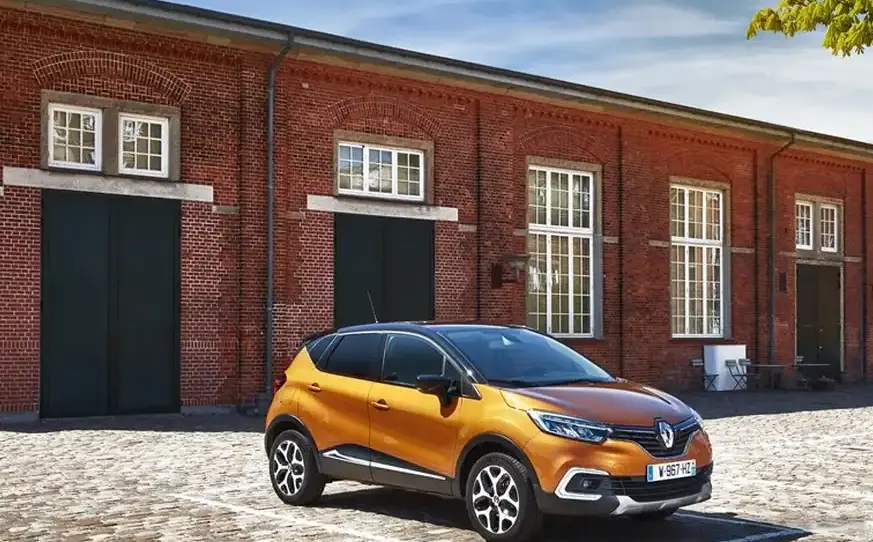
The Renault Captur II (facelift 2024) 1.3 TCe (158 Hp) Mild Hybrid EDC represents a significant update to Renault’s popular subcompact crossover. Introduced in April 2024, this variant builds upon the second-generation Captur, incorporating mild hybrid technology to enhance fuel efficiency and reduce emissions. Positioned as a mid-range offering within the Captur lineup, it slots between the base engine options and the more powerful, though currently unavailable, performance-oriented trims. The facelift brings styling revisions, updated technology, and this new powertrain option, aiming to maintain the Captur’s appeal in a competitive segment.
Technical Specifications
| Brand | Renault |
| Model | Captur |
| Generation | Captur II (facelift 2024) |
| Type (Engine) | 1.3 TCe (158 Hp) Mild Hybrid EDC |
| Start of production | April, 2024 |
| Powertrain Architecture | MHEV (Mild Hybrid Electric Vehicle) |
| Body type | Crossover |
| Seats | 5 |
| Doors | 5 |
| Combined fuel consumption (WLTP) | 5.8-5.9 l/100 km (40.6 – 39.9 US mpg, 48.7 – 47.9 UK mpg, 17.2 – 16.9 km/l) |
| CO2 emissions (WLTP) | 133 g/km |
| Fuel Type | Petrol (Gasoline) |
| Acceleration 0 – 100 km/h | 8.5 sec |
| Acceleration 0 – 62 mph | 8.5 sec |
| Acceleration 0 – 60 mph | 8.1 sec |
| Emission standard | Euro 6d |
| Battery voltage | 12 V |
| Battery technology | Lithium-ion (Li-Ion) |
| Battery location | Below the floor, under the front seats |
| Power | 158 Hp |
| Power per litre | 118.8 Hp/l |
| Torque | 270 Nm @ 1750 rpm (199.14 lb.-ft. @ 1750 rpm) |
| Engine layout | Front, Transverse |
| Engine Model/Code | H5H 490 |
| Engine displacement | 1330 cm3 (81.16 cu. in.) |
| Number of cylinders | 4 |
| Engine configuration | Inline |
| Number of valves per cylinder | 4 |
| Fuel injection system | Direct injection |
| Engine aspiration | Turbocharger, Intercooler |
| Engine oil capacity | 5.4 l (5.71 US qt | 4.75 UK qt) |
| Coolant | 7.5 l (7.93 US qt | 6.6 UK qt) |
| Trunk (boot) space – minimum | 422 l (14.9 cu. ft.) |
| Trunk (boot) space – maximum | 1596 l (56.36 cu. ft.) |
| Length | 4239 mm (166.89 in.) |
| Width with mirrors folded | 1797 mm (70.75 in.) |
| Width including mirrors | 2003 mm (78.86 in.) |
| Height | 1575 mm (62.01 in.) |
| Wheelbase | 2639 mm (103.9 in.) |
| Front track | 1562 mm (61.5 in.) |
| Rear (Back) track | 1547 mm (60.91 in.) |
| Front overhang | 883 mm (34.76 in.) |
| Rear overhang | 717 mm (28.23 in.) |
| Ride height (ground clearance) | 169 mm (6.65 in.) |
| Drivetrain Architecture | Front wheel drive, MHEV |
| Number of gears and type of gearbox | 7 gears, automatic transmission EDC |
| Front suspension | Independent type McPherson |
| Rear suspension | Elastic beam |
| Front brakes | Ventilated discs |
| Rear brakes | Drum |
| Assisting systems | ABS (Anti-lock braking system) |
| Steering type | Steering rack and pinion |
| Power steering | Electric Steering |
| Tires size | 215/60 R17 |
| Wheel rims size | 17 |
Powertrain & Engine Architecture
At the heart of the Captur II (facelift 2024) 1.3 TCe Mild Hybrid EDC lies the Renault H5H 490 engine, a 1.3-liter turbocharged inline-four cylinder gasoline engine. This engine benefits from direct fuel injection and an intercooler, contributing to its 158 horsepower output and 270 Nm (199.14 lb.-ft.) of torque at 1750 rpm. The “Mild Hybrid” designation indicates the inclusion of a 48-volt starter-generator system. This system assists the engine during acceleration, allowing for a brief period of electric boost, and enables a more efficient start-stop system. The EDC (Efficient Dual Clutch) 7-speed automatic transmission is standard, providing smooth and relatively quick gear changes. This transmission is known for its efficiency and responsiveness compared to traditional torque-converter automatics.
Driving Characteristics
The 1.3 TCe Mild Hybrid EDC powertrain delivers a balanced driving experience. While not overtly sporty, the 158 hp output provides adequate acceleration, achieving 0-60 mph in approximately 8.1 seconds. The mild hybrid system contributes to improved responsiveness from a standstill and during overtaking maneuvers. The EDC transmission is well-tuned for everyday driving, offering seamless shifts and contributing to the overall refinement. Compared to lower-powered Captur variants, this version offers a noticeable performance upgrade. However, it doesn’t match the punch of potential future, higher-output trims. The gear ratios are optimized for fuel efficiency, but also provide sufficient power for highway cruising.
Equipment & Trim Levels
The 1.3 TCe Mild Hybrid EDC trim typically includes a generous level of standard equipment. This generally encompasses features such as a 7-inch touchscreen infotainment system with Apple CarPlay and Android Auto compatibility, manual air conditioning, rear parking sensors, and a suite of safety systems including automatic emergency braking and lane departure warning. Interior upholstery is typically cloth, with options for upgraded materials available. Higher trim levels within the Captur range offer additional features like a larger touchscreen, digital instrument cluster, automatic climate control, and advanced driver-assistance systems. Optional extras for this trim often include a panoramic sunroof, upgraded audio system, and various styling packages.
Chassis & Braking
The Captur II utilizes a front-wheel-drive platform with an independent McPherson strut suspension at the front and an elastic beam suspension at the rear. This setup provides a comfortable ride quality, well-suited for urban driving conditions. The front brakes are ventilated discs, offering good stopping power, while the rear brakes are drums, a cost-saving measure common in this segment. The steering is electrically assisted, providing a light and easy driving experience. Stabilizer bars are fitted to both the front and rear axles to reduce body roll during cornering. The suspension tuning is geared towards comfort rather than outright handling prowess.
Market Reception & Comparison
The Renault Captur has consistently been a popular choice in the European subcompact crossover market. The introduction of the 1.3 TCe Mild Hybrid EDC powertrain was generally well-received by critics, who praised its improved fuel efficiency and smooth operation. Compared to the base petrol engines, the mild hybrid version offers a significant improvement in fuel economy, achieving around 5.8-5.9 l/100 km (40.6 – 39.9 US mpg). Reliability reports are still emerging for this specific powertrain combination, but Renault has a generally positive reputation for reliability. Compared to diesel variants (where available), the 1.3 TCe offers a more refined driving experience and lower NOx emissions, though potentially slightly higher CO2 emissions depending on driving style.
Legacy
The Renault Captur II (facelift 2024) 1.3 TCe Mild Hybrid EDC represents a step towards electrification for the Captur model line. While not a full hybrid or electric vehicle, the mild hybrid system demonstrates Renault’s commitment to reducing emissions and improving fuel efficiency. The long-term reliability of the H5H 490 engine and EDC transmission remains to be fully assessed, but early indications suggest a robust and dependable powertrain. As the automotive industry continues to shift towards electrification, this variant is likely to become a popular choice in the used car market, offering a balance of affordability, efficiency, and practicality.