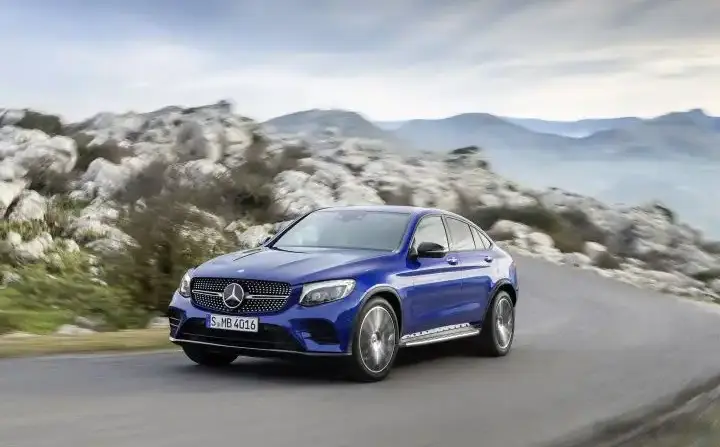
The Mercedes-Benz GLC 220d 4MATIC G-TRONIC Coupe (C253) was a diesel-powered variant of the first-generation GLC Coupe, produced from September 2016 to April 2019. Positioned as a mid-range offering within the GLC Coupe lineup, it aimed to balance fuel efficiency with respectable performance and the practicality of all-wheel drive. This model represented Mercedes-Benz’s entry into the increasingly popular compact luxury crossover coupe segment, offering a more sporting aesthetic compared to the traditional GLC SUV while maintaining a premium interior and advanced technology.
Technical Specifications
| Brand | Mercedes-Benz |
| Model | GLC |
| Generation | GLC Coupe (C253) |
| Type | GLC 220d (170 Hp) 4MATIC G-TRONIC |
| Start of production | September, 2016 |
| End of production | April, 2019 |
| Powertrain Architecture | Internal Combustion engine |
| Body type | Coupe, SUV |
| Seats | 4 |
| Doors | 4 |
| Fuel consumption (urban) | 6.2-5.7 l/100 km (37.9 – 41.3 US mpg, 45.6 – 49.6 UK mpg, 16.1 – 17.5 km/l) |
| Fuel consumption (extra urban) | 5.0-4.7 l/100 km (47 – 50 US mpg, 56.5 – 60.1 UK mpg, 20 – 21.3 km/l) |
| Fuel consumption (combined) | 5.4-5.0 l/100 km (43.6 – 47 US mpg, 52.3 – 56.5 UK mpg, 18.5 – 20 km/l) |
| CO2 emissions | 143-131 g/km |
| Fuel Type | Diesel |
| Acceleration 0 – 100 km/h | 8.3 sec |
| Acceleration 0 – 62 mph | 8.3 sec |
| Acceleration 0 – 60 mph | 7.9 sec |
| Maximum speed | 210 km/h (130.49 mph) |
| Emission standard | Euro 6 |
| Weight-to-power ratio | 10.4 kg/Hp, 96 Hp/tonne |
| Weight-to-torque ratio | 4.4 kg/Nm, 226 Nm/tonne |
| Power | 170 Hp @ 3000-4200 rpm |
| Power per litre | 79.3 Hp/l |
| Torque | 400 Nm @ 1400-2800 rpm (295.02 lb.-ft. @ 1400-2800 rpm) |
| Engine layout | Front, Longitudinal |
| Engine Model/Code | OM 651.921 |
| Engine displacement | 2143 cm3 (130.77 cu. in.) |
| Number of cylinders | 4 |
| Engine configuration | Inline |
| Compression ratio | 16.2:1 |
| Number of valves per cylinder | 4 |
| Fuel injection system | Diesel Commonrail |
| Engine aspiration | BiTurbo, Intercooler |
| Engine oil capacity | 6 l (6.34 US qt | 5.28 UK qt) |
| Coolant | 10 l (10.57 US qt | 8.8 UK qt) |
| Kerb Weight | 1770 kg (3902.18 lbs.) |
| Max. weight | 2520 kg (5555.65 lbs.) |
| Max load | 750 kg (1653.47 lbs.) |
| Trunk (boot) space – minimum | 500 l (17.66 cu. ft.) |
| Trunk (boot) space – maximum | 1400 l (49.44 cu. ft.) |
| Fuel tank capacity | 50 l (13.21 US gal | 11 UK gal) |
| Max. roof load | 75 kg (165.35 lbs.) |
| Permitted trailer load with brakes (12%) | 2200 kg (4850.17 lbs.) |
| Permitted trailer load without brakes | 750 kg (1653.47 lbs.) |
| Length | 4732 mm (186.3 in.) |
| Width | 1890 mm (74.41 in.) |
| Width including mirrors | 2096 mm (82.52 in.) |
| Height | 1602 mm (63.07 in.) |
| Wheelbase | 2873 mm (113.11 in.) |
| Front track | 1620 mm (63.78 in.) |
| Rear (Back) track | 1619 mm (63.74 in.) |
| Front overhang | 831 mm (32.72 in.) |
| Rear overhang | 1028 mm (40.47 in.) |
| Drag coefficient (Cd) | 0.31 |
| Minimum turning circle (turning diameter) | 11.80 m (38.71 ft.) |
| Drive wheel | All wheel drive (4×4) |
| Number of gears and type of gearbox | 9 gears, automatic transmission G-TRONIC |
| Front suspension | Independent multi-link suspension |
| Rear suspension | Independent multi-link suspension |
| Front brakes | Ventilated discs |
| Rear brakes | Ventilated discs |
| Assisting systems | ABS (Anti-lock braking system) |
| Steering type | Steering rack and pinion |
| Power steering | Electric Steering |
| Tires size | 235/60 R18 |
| Wheel rims size | 18 |
Powertrain & Engine Architecture
The GLC 220d Coupe was powered by the OM 651.921, a 2.1-liter inline-four cylinder diesel engine. This engine was a mainstay in the Mercedes-Benz lineup for many years, known for its durability and efficiency. It featured a sophisticated common-rail direct injection system, delivering fuel at extremely high pressures for optimized combustion. The engine also employed a bi-turbocharger setup – a small turbocharger for quick response at low engine speeds and a larger turbocharger for increased power at higher RPMs. An intercooler further enhanced performance by cooling the compressed intake air. The engine produced 170 horsepower at 3000-4200 rpm and a substantial 400 Nm (295 lb-ft) of torque between 1400-2800 rpm. This torque output was a key characteristic, providing strong pulling power for everyday driving and towing. The engine was paired with Mercedes-Benz’s 9G-TRONIC nine-speed automatic transmission. This transmission was designed for smooth shifts and optimized fuel economy, with closely spaced gear ratios to keep the engine operating in its most efficient range.
Driving Characteristics
The 170 hp and 400 Nm of torque, combined with the 9G-TRONIC transmission, provided a comfortable and capable driving experience. While not a performance-oriented variant, the GLC 220d Coupe offered sufficient power for highway cruising and overtaking. The automatic transmission generally shifted smoothly and responsively, although some drivers noted a slight hesitation during kickdown maneuvers. Compared to the more powerful GLC 300 or AMG variants, the 220d prioritized fuel economy over outright acceleration. The 9G-TRONIC’s tall gearing contributed to lower engine speeds at highway speeds, reducing noise and improving fuel efficiency. The 4MATIC all-wheel-drive system provided enhanced traction in adverse weather conditions, making it a practical choice for regions with snow or rain. The gear ratios were tuned for efficiency, meaning the car wasn’t particularly quick off the line, but maintained good pace once up to speed.
Equipment & Trim Levels
The GLC 220d 4MATIC Coupe typically came standard with features such as automatic climate control, a 7-inch infotainment display with a rotary controller, Bluetooth connectivity, and a suite of safety features including collision prevention assist and attention assist. Interior upholstery was typically MB-Tex artificial leather, with options for genuine leather upgrades. Common optional extras included a larger infotainment screen, navigation system, panoramic sunroof, heated seats, and a premium sound system. Trim levels varied slightly depending on the market, but generally offered packages that bundled popular options together. The overall interior design emphasized luxury and refinement, with high-quality materials and a modern aesthetic.
Chassis & Braking
The GLC Coupe utilized an independent multi-link suspension system at both the front and rear axles, providing a comfortable ride and good handling characteristics. The suspension was tuned to balance comfort and stability, offering a relatively compliant ride over uneven surfaces. The front brakes featured ventilated discs, while the rear brakes were also ventilated discs, providing adequate stopping power for the vehicle’s weight. The 4MATIC all-wheel-drive system distributed torque between the front and rear axles as needed, enhancing traction and stability. The steering was electrically assisted, providing a light and precise feel.
Market Reception & Comparison
The GLC 220d Coupe was generally well-received by automotive critics as a practical and efficient luxury crossover. Reviewers praised its comfortable ride, refined interior, and fuel-efficient engine. However, some criticized its relatively modest performance compared to higher-powered variants. Compared to the GLC 300, the 220d offered significantly better fuel economy but lacked the same level of acceleration. The 220d also represented a more affordable entry point into the GLC Coupe range, making it an attractive option for buyers prioritizing value and efficiency. Reliability reports generally indicated good long-term durability for the OM 651 engine and 9G-TRONIC transmission, although routine maintenance was essential.
Legacy
The Mercedes-Benz GLC 220d 4MATIC Coupe (C253) remains a relatively common sight on the used car market. The OM 651 diesel engine is known for its longevity, provided it has been properly maintained. The 9G-TRONIC transmission has also proven to be generally reliable. However, potential buyers should be aware of the potential for diesel particulate filter (DPF) issues, particularly if the vehicle has primarily been used for short trips. Overall, the GLC 220d Coupe represents a well-rounded and practical luxury crossover that continues to offer a compelling combination of comfort, efficiency, and all-weather capability.