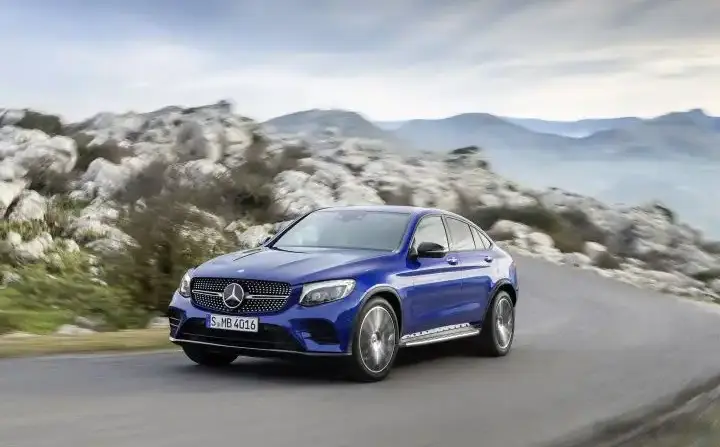
The Mercedes-Benz GLC 250d 4MATIC Coupe (C253) was a diesel-powered variant of the first-generation GLC Coupe, produced between September 2016 and April 2019. Positioned as a mid-range offering within the GLC Coupe lineup, it blended the practicality of a compact SUV with the sleeker styling of a coupe. This model aimed to appeal to buyers seeking a balance between fuel efficiency, performance, and the prestige associated with the Mercedes-Benz brand. It was primarily marketed in Europe and other regions where diesel engines remained popular, offering a compelling alternative to gasoline-powered options and larger SUV models.
Technical Specifications
| Brand | Mercedes-Benz |
| Model | GLC |
| Generation | GLC Coupe (C253) |
| Type | GLC 250d (204 Hp) 4MATIC G-TRONIC |
| Start of production | September, 2016 |
| End of production | April, 2019 |
| Powertrain Architecture | Internal Combustion engine |
| Body type | Coupe, SUV |
| Seats | 4 |
| Doors | 4 |
| Fuel consumption (urban) | 6.2-5.7 l/100 km (37.9 – 41.3 US mpg, 45.6 – 49.6 UK mpg, 16.1 – 17.5 km/l) |
| Fuel consumption (extra urban) | 5.0-4.7 l/100 km (47 – 50 US mpg, 56.5 – 60.1 UK mpg, 20 – 21.3 km/l) |
| Fuel consumption (combined) | 5.4-5.0 l/100 km (43.6 – 47 US mpg, 52.3 – 56.5 UK mpg, 18.5 – 20 km/l) |
| CO2 emissions | 143-131 g/km |
| Fuel Type | Diesel |
| Acceleration 0 – 100 km/h | 7.6 sec |
| Acceleration 0 – 62 mph | 7.6 sec |
| Acceleration 0 – 60 mph | 7.2 sec |
| Maximum speed | 222 km/h (137.94 mph) |
| Emission standard | Euro 6 |
| Weight-to-power ratio | 8.7 kg/Hp, 115.3 Hp/tonne |
| Weight-to-torque ratio | 3.5 kg/Nm, 282.5 Nm/tonne |
| Power | 204 Hp @ 3800 rpm |
| Power per litre | 95.2 Hp/l |
| Torque | 500 Nm @ 1600-1800 rpm (368.78 lb.-ft. @ 1600-1800 rpm) |
| Engine layout | Front, Longitudinal |
| Engine Model/Code | OM 651 DE 22 LA/651.921 |
| Engine displacement | 2143 cm3 (130.77 cu. in.) |
| Number of cylinders | 4 |
| Engine configuration | Inline |
| Compression ratio | 16.2:1 |
| Number of valves per cylinder | 4 |
| Fuel injection system | Diesel Commonrail |
| Engine aspiration | BiTurbo, Intercooler |
| Engine oil capacity | 6 l (6.34 US qt | 5.28 UK qt) |
| Coolant | 13 l (13.74 US qt | 11.44 UK qt) |
| Kerb Weight | 1770 kg (3902.18 lbs.) |
| Max. weight | 2520 kg (5555.65 lbs.) |
| Max load | 750 kg (1653.47 lbs.) |
| Trunk (boot) space – minimum | 500 l (17.66 cu. ft.) |
| Trunk (boot) space – maximum | 1400 l (49.44 cu. ft.) |
| Fuel tank capacity | 50 l (13.21 US gal | 11 UK gal) |
| Max. roof load | 75 kg (165.35 lbs.) |
| Permitted trailer load with brakes (12%) | 2250 kg (4960.4 lbs.) |
| Permitted trailer load without brakes | 750 kg (1653.47 lbs.) |
| Length | 4732 mm (186.3 in.) |
| Width | 1890 mm (74.41 in.) |
| Width including mirrors | 2096 mm (82.52 in.) |
| Height | 1602 mm (63.07 in.) |
| Wheelbase | 2873 mm (113.11 in.) |
| Front track | 1620 mm (63.78 in.) |
| Rear (Back) track | 1619 mm (63.74 in.) |
| Front overhang | 831 mm (32.72 in.) |
| Rear overhang | 1028 mm (40.47 in.) |
| Drag coefficient (Cd) | 0.31 |
| Minimum turning circle (turning diameter) | 11.80 m (38.71 ft.) |
| Drive wheel | All wheel drive (4×4) |
| Number of gears and type of gearbox | 9 gears, automatic transmission G-TRONIC |
| Front suspension | Independent multi-link suspension |
| Rear suspension | Independent multi-link suspension |
| Front brakes | Ventilated discs |
| Rear brakes | Ventilated discs |
| Assisting systems | ABS (Anti-lock braking system) |
| Steering type | Steering rack and pinion |
| Power steering | Electric Steering |
| Tires size | 235/60 R18 |
| Wheel rims size | 18 |
Powertrain & Engine Architecture
The GLC 250d Coupe was powered by the OM 651 DE 22 LA, a 2.1-liter inline-four diesel engine. This engine, a mainstay in the Mercedes-Benz lineup, featured common-rail direct injection and a bi-turbocharger setup. The twin turbos, one larger and one smaller, were designed to minimize turbo lag and provide a broad torque curve. The engine produced 204 horsepower at 3800 rpm and a substantial 500 Nm (368 lb-ft) of torque between 1600 and 1800 rpm. This torque output was a key characteristic, providing strong acceleration and effortless cruising. The engine also incorporated a particulate filter to reduce emissions, meeting Euro 6 standards. The engine was longitudinally mounted, driving all four wheels through Mercedes-Benz’s 9G-TRONIC nine-speed automatic transmission. This transmission was known for its smooth shifts and wide gear ratio spread, contributing to both fuel efficiency and performance.
Driving Characteristics
The 9G-TRONIC transmission, paired with the high torque output of the 2.1-liter diesel, resulted in a comfortable and capable driving experience. While not overtly sporty, the GLC 250d Coupe offered brisk acceleration, achieving 0-62 mph (0-100 km/h) in 7.6 seconds. The automatic transmission was well-tuned for everyday driving, providing smooth gear changes and responsive kickdown. Compared to higher-performance GLC Coupe variants, such as the AMG models, the 250d prioritized fuel economy and relaxed cruising. It also differed from the gasoline-powered GLC 300 in terms of power delivery, with the diesel offering more low-end torque. The 4MATIC all-wheel-drive system provided excellent traction in various weather conditions, enhancing stability and confidence.
Equipment & Trim Levels
The GLC 250d Coupe typically came well-equipped as standard. Features included automatic climate control, a touchscreen infotainment system with navigation, Bluetooth connectivity, and a suite of safety features like collision prevention assist and attention assist. Interior upholstery was typically Artico leather, a high-quality synthetic leather. Optional extras included a panoramic sunroof, upgraded sound systems, heated seats, and various driver assistance packages. Trim levels varied slightly depending on the market, but generally offered options for enhanced luxury and technology features. The overall interior design emphasized a modern and sophisticated aesthetic, consistent with Mercedes-Benz’s brand image.
Chassis & Braking
The GLC 250d Coupe featured an independent multi-link suspension at both the front and rear axles. This suspension setup provided a comfortable ride quality while maintaining good handling characteristics. The suspension was tuned to balance comfort and control, making it suitable for both city driving and longer journeys. Braking duties were handled by ventilated discs on all four wheels, providing ample stopping power. The vehicle was equipped with ABS (Anti-lock Braking System) and electronic stability control as standard safety features. Steering was via a rack-and-pinion system with electric power assistance, offering precise and responsive steering feel.
Market Reception & Comparison
The GLC 250d Coupe was generally well-received by automotive critics. It was praised for its fuel efficiency, comfortable ride, and refined interior. However, some reviewers noted that the diesel engine could be somewhat noisy compared to gasoline alternatives. Compared to the GLC 300, the 250d offered better fuel economy but less outright performance. It also represented a more affordable entry point into the GLC Coupe range. Its main competitors included the BMW X4 xDrive20d and the Audi Q5 TDI, both of which offered similar levels of performance and efficiency.
Legacy
The OM 651 engine family, including the version used in the GLC 250d Coupe, has a reputation for durability and reliability. While diesel engines generally require more diligent maintenance than gasoline engines, the OM 651 has proven to be a robust and long-lasting unit. On the used car market, the GLC 250d Coupe remains a popular choice for buyers seeking a practical and efficient luxury SUV. Its combination of comfort, performance, and fuel economy continues to appeal to a wide range of drivers. However, potential buyers should be aware of the potential costs associated with diesel particulate filter maintenance and ensure the vehicle has been properly serviced throughout its life.