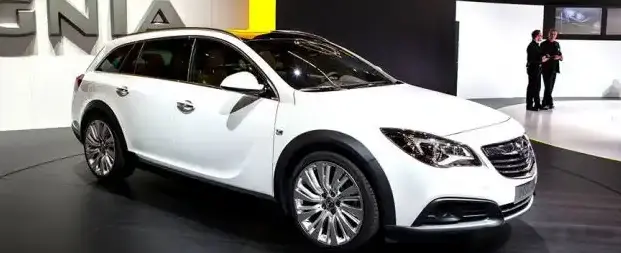
The Opel Insignia Hatchback, specifically the 2.0 (250 Hp) AWD Turbo Ecotec Automatic variant produced from July 2013 to January 2017, represents a significant offering in the mid-size segment. This model falls within the ‘A’ generation of the Insignia, benefitting from a facelift introduced in 2013 that refined both its aesthetics and technology. Positioned as a premium trim level, it catered to drivers seeking a blend of performance, practicality, and all-weather capability. The Insignia, in general, was Opel’s flagship model, intended to elevate the brand’s image and compete with established players like the Ford Mondeo, Volkswagen Passat, and Peugeot 508, primarily in the European market.
Technical Specifications
| Brand | Opel |
| Model | Insignia |
| Generation | Insignia Hatchback (A, facelift 2013) |
| Type (Engine) | 2.0 (250 Hp) AWD Turbo Ecotec Automatic |
| Start of production | July, 2013 |
| End of production | January, 2017 |
| Powertrain Architecture | Internal Combustion engine |
| Body type | Hatchback |
| Seats | 5 |
| Doors | 5 |
| Fuel consumption (urban) | 11.7 l/100 km (20.1 US mpg, 24.1 UK mpg, 8.5 km/l) |
| Fuel consumption (extra urban) | 6.3 l/100 km (37.3 US mpg, 44.8 UK mpg, 15.9 km/l) |
| Fuel consumption (combined) | 8.3 l/100 km (28.3 US mpg, 34 UK mpg, 12 km/l) |
| CO2 emissions | 194 g/km |
| Fuel Type | Petrol (Gasoline) |
| Acceleration 0 – 100 km/h | 7.7 sec |
| Acceleration 0 – 62 mph | 7.7 sec |
| Acceleration 0 – 60 mph | 7.3 sec |
| Maximum speed | 245 km/h (152.24 mph) |
| Emission standard | Euro 5 |
| Power | 250 Hp @ 5300 rpm |
| Power per litre | 125.1 Hp/l |
| Torque | 400 Nm @ 2500-4000 rpm (295.02 lb.-ft. @ 2500-4000 rpm) |
| Engine layout | Front, Transverse |
| Engine Model/Code | A20NHT, B20NHT |
| Engine displacement | 1998 cm3 (121.93 cu. in.) |
| Number of cylinders | 4 |
| Engine configuration | Inline |
| Cylinder Bore | 86 mm (3.39 in.) |
| Piston Stroke | 86 mm (3.39 in.) |
| Number of valves per cylinder | 4 |
| Fuel injection system | Direct injection |
| Engine aspiration | Turbocharger, Intercooler |
| Engine oil capacity | 6 l (6.34 US qt | 5.28 UK qt) |
| Coolant | 8 l (8.45 US qt | 7.04 UK qt) |
| Trunk (boot) space – minimum | 530 l (18.72 cu. ft.) |
| Trunk (boot) space – maximum | 1470 l (51.91 cu. ft.) |
| Fuel tank capacity | 70 l (18.49 US gal | 15.4 UK gal) |
| Length | 4842 mm (190.63 in.) |
| Width | 1856 mm (73.07 in.) |
| Width including mirrors | 2084 mm (82.05 in.) |
| Height | 1498 mm (58.98 in.) |
| Wheelbase | 2737 mm (107.76 in.) |
| Front track | 1587 mm (62.48 in.) |
| Rear (Back) track | 1590 mm (62.6 in.) |
| Minimum turning circle | 11.4 m (37.4 ft.) |
| Drive wheel | All wheel drive (4×4) |
| Number of gears | 6 |
| Gearbox type | automatic transmission |
Powertrain & Engine Architecture
At the heart of the Insignia 2.0 AWD Automatic lies the A20NHT (or B20NHT) 2.0-liter turbocharged inline-four cylinder engine. This engine is a member of Opel’s ‘Ecotec’ family, emphasizing efficiency and performance. It utilizes direct fuel injection, a technology that precisely meters fuel directly into the combustion chamber, improving combustion efficiency and reducing emissions. The engine also features a turbocharger with an intercooler, boosting power output to 250 horsepower at 5300 rpm and 400 Nm (295 lb-ft) of torque available between 2500 and 4000 rpm. The engine’s valvetrain employs four valves per cylinder, contributing to its responsive nature. The six-speed automatic transmission, sourced from Aisin, was chosen for its smoothness and reliability. It’s programmed to balance performance with fuel economy, offering both manual shift control and an adaptive learning function.
Driving Characteristics
The 250 hp AWD automatic Insignia delivers a noticeably brisk driving experience. Acceleration from 0-60 mph takes approximately 7.3 seconds, and it reaches a top speed of 152 mph. The automatic transmission provides smooth gear changes, although it may not be as aggressively tuned as some sportier transmissions. The all-wheel-drive system, utilizing a multi-plate clutch, provides excellent traction in various conditions, enhancing stability and confidence, particularly in inclement weather. Compared to the base 1.6L models, the 2.0L offers a substantial performance upgrade. While not as engaging as a manual transmission, the automatic provides a more relaxed driving experience, making it well-suited for long journeys. The power delivery is linear, with the turbocharger providing a noticeable boost in mid-range acceleration.
Equipment & Trim Levels
The 2.0 AWD Automatic Insignia typically came well-equipped, reflecting its position as a higher-end trim. Standard features often included leather upholstery, heated front seats, dual-zone climate control, a touchscreen infotainment system with navigation, and a premium sound system. Safety features were also comprehensive, including ABS, traction control, stability control, and multiple airbags. Optional extras could include adaptive cruise control, a panoramic sunroof, and advanced parking assist systems. The interior design was generally modern and functional, with a focus on ergonomics and comfort.
Chassis & Braking
The Insignia’s chassis was designed to provide a balance between comfort and handling. It utilizes a MacPherson strut front suspension and a multi-link rear suspension. The AWD models often featured a slightly stiffer suspension setup compared to front-wheel-drive variants to manage the increased weight and power. Braking systems consisted of ventilated front discs and either discs or drums on the rear, depending on the specific configuration. The steering is rack and pinion, providing precise and responsive control. Stabilizer bars were fitted front and rear to reduce body roll during cornering.
Market Reception & Comparison
The Insignia 2.0 AWD Automatic received generally positive reviews from automotive critics. It was praised for its spacious interior, comfortable ride, and strong performance. The all-wheel-drive system was particularly well-regarded for its ability to provide secure handling in challenging conditions. Fuel economy, however, was a common criticism, with the combined cycle consumption of 8.3 l/100 km (28.3 US mpg) being relatively high compared to some competitors. Compared to the 1.6L turbo models, the 2.0L offered a significant performance boost but at the cost of increased fuel consumption and a higher purchase price. The diesel variants, such as the 2.0 CDTI, offered better fuel economy but lacked the outright performance of the petrol 2.0L.
Legacy
The Opel Insignia 2.0 AWD Automatic has proven to be a relatively reliable vehicle in the used car market. The A20NHT engine is generally considered robust, although regular maintenance is crucial. Common issues reported by owners include occasional turbocharger problems and wear and tear on the automatic transmission. However, these issues are not widespread and can often be prevented with proper servicing. Today, the Insignia remains a popular choice for buyers seeking a spacious, comfortable, and well-equipped mid-size hatchback with all-wheel-drive capability. Its blend of performance, practicality, and value continues to make it a competitive option in the used car market.