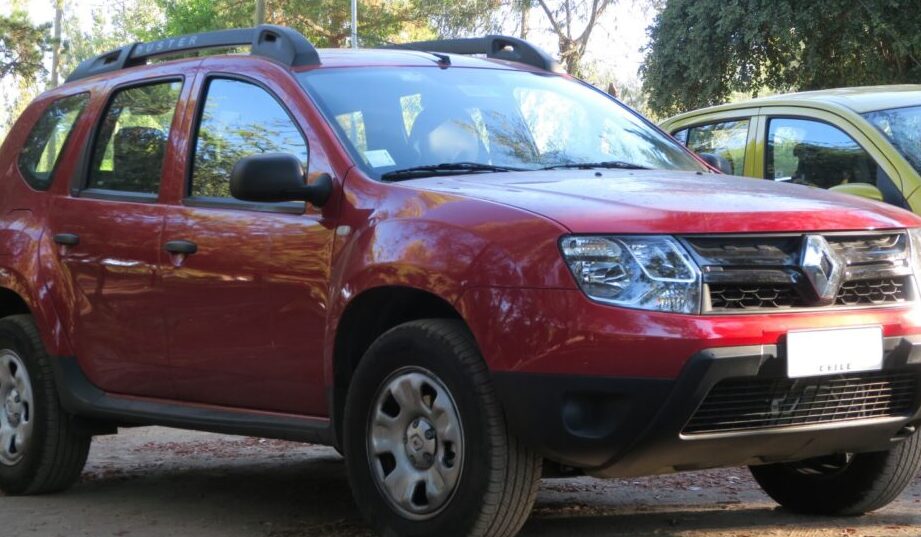
The Renault Duster I 1.5 dCi (90 hp) AWD, produced from 2011 to June 2015, represents a significant entry point into the all-wheel-drive compact SUV market for the Renault brand. Positioned as a budget-friendly and practical vehicle, it was primarily aimed at buyers in Europe and emerging markets seeking a robust and capable vehicle for varied road conditions. This variant occupied the lower end of the Duster I range, offering a balance between affordability and functionality, particularly appealing to those prioritizing fuel efficiency and all-weather capability over outright performance. It was built on the B0 platform, shared with other Renault and Nissan models.
Technical Specifications
| Brand | Renault |
| Model | Duster |
| Generation | Duster I |
| Type (Engine) | 1.5 dCi (90 Hp) AWD |
| Start of production | 2011 |
| End of production | June, 2015 |
| Powertrain Architecture | Internal Combustion engine |
| Body type | SUV |
| Seats | 5 |
| Doors | 5 |
| Fuel consumption (urban) | 5.9 l/100 km (39.9 US mpg, 47.9 UK mpg, 16.9 km/l) |
| Fuel consumption (extra urban) | 5 l/100 km (47 US mpg, 56.5 UK mpg, 20 km/l) |
| Fuel consumption (combined) | 5.3 l/100 km (44.4 US mpg, 53.3 UK mpg, 18.9 km/l) |
| CO2 emissions | 139 g/km |
| Fuel Type | Diesel |
| Acceleration 0 – 100 km/h | 15.6 sec |
| Acceleration 0 – 62 mph | 15.6 sec |
| Acceleration 0 – 60 mph | 14.8 sec |
| Maximum speed | 156 km/h (96.93 mph) |
| Emission standard | Euro 4 |
| Weight-to-power ratio | 15.3 kg/Hp, 65.5 Hp/tonne |
| Weight-to-torque ratio | 6.9 kg/Nm, 145.5 Nm/tonne |
| Power | 90 Hp @ 4000 rpm |
| Power per litre | 61.6 Hp/l |
| Torque | 200 Nm @ 1750 rpm (147.51 lb.-ft. @ 1750 rpm) |
| Engine layout | Front, Transverse |
| Engine Model/Code | K9K |
| Engine displacement | 1461 cm3 (89.16 cu. in.) |
| Number of cylinders | 4 |
| Engine configuration | Inline |
| Cylinder Bore | 76 mm (2.99 in.) |
| Piston Stroke | 80.5 mm (3.17 in.) |
| Compression ratio | 15.2:1 |
| Number of valves per cylinder | 2 |
| Fuel injection system | Diesel Commonrail |
| Engine aspiration | Turbocharger, Intercooler |
| Engine oil capacity | 4.1 l (4.33 US qt | 3.61 UK qt) |
| Coolant | 4.5 l (4.76 US qt | 3.96 UK qt) |
| Kerb Weight | 1375 kg (3031.36 lbs.) |
| Max. weight | 1875 kg (4133.67 lbs.) |
| Max load | 500 kg (1102.31 lbs.) |
| Trunk (boot) space – minimum | 408 l (14.41 cu. ft.) |
| Trunk (boot) space – maximum | 1570 l (55.44 cu. ft.) |
| Fuel tank capacity | 50 l (13.21 US gal | 11 UK gal) |
| Length | 4315 mm (169.88 in.) |
| Width | 1822 mm (71.73 in.) |
| Height | 1690 mm (66.54 in.) |
| Wheelbase | 2673 mm (105.24 in.) |
| Front track | 1560 mm (61.42 in.) |
| Rear (Back) track | 1567 mm (61.69 in.) |
| Front overhang | 822 mm (32.36 in.) |
| Rear overhang | 820 mm (32.28 in.) |
| Ride height (ground clearance) | 210 mm (8.27 in.) |
| Drive wheel | All wheel drive (4×4) |
| Number of gears and type of gearbox | 6 gears, manual transmission |
| Front suspension | Independent, type McPherson with coil spring and anti-roll bar |
| Rear suspension | Independent coil spring |
| Front brakes | Ventilated discs |
| Rear brakes | Drum |
| Assisting systems | ABS (Anti-lock braking system) |
| Tires size | 215/65 R16 |
| Wheel rims size | 16 |
Powertrain & Engine Architecture
The heart of the Duster I 1.5 dCi (90 hp) AWD is the K9K engine, a 1.5-liter inline-four diesel engine. This engine, a product of Renault’s collaboration with Nissan, is well-known for its robustness and fuel efficiency. The ‘90 hp’ designation refers to the engine’s maximum power output at 4000 rpm. Crucially, the engine produces 200 Nm (147.51 lb-ft) of torque at a relatively low 1750 rpm, which is a key characteristic for a diesel engine and contributes to its usability in everyday driving. The K9K utilizes a diesel commonrail direct injection system, delivering fuel directly into the cylinders at high pressure for improved combustion and reduced emissions. A turbocharger with an intercooler further enhances performance by forcing more air into the engine. The six-speed manual transmission was the only gearbox option available with this engine and drivetrain combination. The transmission’s gear ratios were tuned to prioritize fuel economy and provide adequate acceleration, though it wasn’t designed for rapid performance.
Driving Characteristics
The 90 hp, all-wheel-drive Duster offers a practical, if not exhilarating, driving experience. Acceleration from 0-60 mph takes around 14.8 seconds, and top speed is limited to 156 km/h (96.93 mph). The engine’s torque is readily available from low revs, making it suitable for navigating urban environments and tackling inclines. However, overtaking maneuvers require careful planning. Compared to higher-powered Duster variants (like those with the 110 hp version of the same engine or the petrol engines), this model feels noticeably slower. The all-wheel-drive system provides enhanced traction on slippery surfaces, making it a capable vehicle for off-road excursions and winter driving. The manual transmission, while not particularly sporty, is precise and durable. The suspension setup prioritizes comfort over handling, resulting in a relatively soft ride quality.
Equipment & Trim Levels
The 1.5 dCi (90 hp) AWD Duster typically served as the entry-level or mid-range trim in many markets. Standard equipment generally included air conditioning, power steering, central locking, and an audio system with USB connectivity. Safety features such as ABS and front airbags were also standard. Higher trim levels added features like alloy wheels, electric windows, a trip computer, and upgraded interior trim. Interior upholstery was typically cloth, and the dashboard featured a functional, if somewhat basic, design. Optional extras included a rear parking sensor, a navigation system, and a roof rack.
Chassis & Braking
The Duster I features a McPherson strut front suspension and an independent coil spring rear suspension. This setup provides a reasonable balance between ride comfort and handling. The front brakes are ventilated discs, offering good stopping power, while the rear brakes are drums, a cost-saving measure common in this segment. The all-wheel-drive system utilizes a viscous coupling to distribute torque between the front and rear axles as needed. Ground clearance of 210 mm (8.27 in) contributes to the Duster’s off-road capability. The vehicle’s weight of 1375 kg (3031.36 lbs) is relatively low for an SUV, which helps to mitigate the effects of the modest engine power.
Market Reception & Comparison
The Renault Duster I 1.5 dCi (90 hp) AWD was generally well-received by critics for its affordability, practicality, and all-weather capability. It was often praised as a value-for-money option in the compact SUV segment. However, some reviewers criticized its relatively slow acceleration and basic interior. Compared to other trims in the Duster lineup, this variant offered the best fuel economy and a lower purchase price, making it attractive to budget-conscious buyers. The 110 hp version of the 1.5 dCi engine provided noticeably better performance, while the petrol engines offered a smoother, albeit less fuel-efficient, driving experience.
Legacy
The K9K engine, in its various iterations, has proven to be a reliable and durable powertrain. The 1.5 dCi (90 hp) AWD Duster remains a popular choice in the used car market, particularly in regions where all-wheel drive is valued. While maintenance costs are generally reasonable, potential buyers should be aware of the typical wear and tear associated with diesel engines, such as injector issues and turbocharger maintenance. The Duster I established Renault as a serious player in the affordable SUV segment, and its success paved the way for the second-generation model.