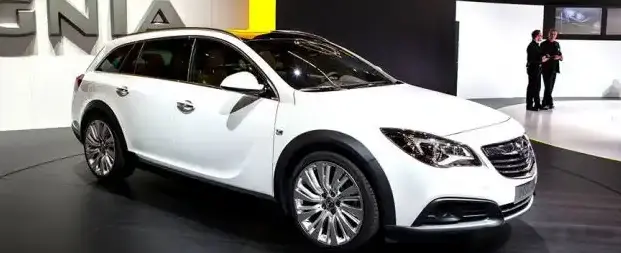
The Opel Insignia Hatchback (A, facelift 2013) 2.0 CDTI (130 hp) Ecotec Automatic represents a mid-cycle refresh of Opel’s flagship D-segment offering. Introduced in July 2013 and continuing through June 2015, this variant aimed to balance fuel efficiency with reasonable performance for European drivers. Positioned as a mid-range trim, it slotted between the lower-powered 1.6L diesel and the more potent 2.0L BiTurbo models. The facelift brought styling updates and revised technology, building upon the original Insignia A platform (based on the GM Epsilon II architecture) launched in 2008. This model was primarily targeted at the European market, where fuel economy and diesel engines were highly valued.
Technical Specifications
| Brand | Opel |
| Model | Insignia |
| Generation | Insignia Hatchback (A, facelift 2013) |
| Type (Engine) | 2.0 CDTI (130 Hp) Ecotec Automatic |
| Start of production | July, 2013 |
| End of production | June, 2015 |
| Powertrain Architecture | Internal Combustion engine |
| Body type | Hatchback |
| Seats | 5 |
| Doors | 5 |
| Fuel consumption (urban) | 7 l/100 km (33.6 US mpg, 40.4 UK mpg, 14.3 km/l) |
| Fuel consumption (extra urban) | 4.3 l/100 km (54.7 US mpg, 65.7 UK mpg, 23.3 km/l) |
| Fuel consumption (combined) | 5.3 l/100 km (44.4 US mpg, 53.3 UK mpg, 18.9 km/l) |
| CO2 emissions | 139 g/km |
| Fuel Type | Diesel |
| Acceleration 0 – 100 km/h | 11.2 sec |
| Acceleration 0 – 62 mph | 11.2 sec |
| Acceleration 0 – 60 mph | 10.6 sec |
| Maximum speed | 204 km/h (126.76 mph) |
| Emission standard | Euro 5 |
| Power | 130 Hp @ 4000 rpm |
| Power per litre | 66.5 Hp/l |
| Torque | 300 Nm @ 1750-2500 rpm (221.27 lb.-ft. @ 1750-2500 rpm) |
| Engine layout | Front, Transverse |
| Engine Model/Code | A20DT |
| Engine displacement | 1956 cm3 (119.36 cu. in.) |
| Number of cylinders | 4 |
| Engine configuration | Inline |
| Cylinder Bore | 83 mm (3.27 in.) |
| Piston Stroke | 90.4 mm (3.56 in.) |
| Number of valves per cylinder | 4 |
| Fuel injection system | Diesel Commonrail |
| Engine aspiration | Turbocharger, Intercooler |
| Engine oil capacity | 4.5 l (4.76 US qt | 3.96 UK qt) |
| Coolant | 9 l (9.51 US qt | 7.92 UK qt) |
| Trunk (boot) space – minimum | 530 l (18.72 cu. ft.) |
| Trunk (boot) space – maximum | 1470 l (51.91 cu. ft.) |
| Fuel tank capacity | 70 l (18.49 US gal | 15.4 UK gal) |
| Length | 4842 mm (190.63 in.) |
| Width | 1856 mm (73.07 in.) |
| Width including mirrors | 2084 mm (82.05 in.) |
| Height | 1498 mm (58.98 in.) |
| Wheelbase | 2737 mm (107.76 in.) |
| Front track | 1587 mm (62.48 in.) |
| Rear (Back) track | 1590 mm (62.6 in.) |
| Minimum turning circle | 11.4 m (37.4 ft.) |
| Drivetrain Architecture | The Internal combustion engine (ICE) drives the front wheels of the vehicle. |
| Drive wheel | Front wheel drive |
| Number of gears and type of gearbox | 6 gears, automatic transmission |
| Assisting systems | ABS (Anti-lock braking system) |
| Steering type | Steering rack and pinion |
Powertrain & Engine Architecture
The heart of this Insignia variant is the A20DT 2.0-liter four-cylinder diesel engine. This engine is a member of Opel/Vauxhall’s Ecotec family, known for its focus on efficiency and refinement. The A20DT utilizes a common rail direct injection system, delivering fuel at extremely high pressures for optimized combustion. A turbocharger with an intercooler is employed to boost power output, providing 130 horsepower at 4000 rpm and a healthy 300 Nm (221 lb-ft) of torque between 1750 and 2500 rpm. The engine features four valves per cylinder and a cast iron block with an aluminum cylinder head. The automatic transmission is a six-speed unit, designed to provide smooth shifts and contribute to fuel economy. While not a dual-clutch transmission, it offers a reasonable level of responsiveness for everyday driving.
Driving Characteristics
The 130 hp 2.0 CDTI Automatic Insignia offers a comfortable and relaxed driving experience. Acceleration is adequate for most situations, with a 0-60 mph time of around 10.6 seconds. However, it’s noticeably slower than the more powerful 2.0 BiTurbo or even the manual versions of the 2.0 CDTI. The automatic transmission prioritizes fuel efficiency, often upshifting quickly to maintain lower engine speeds. This can sometimes result in a slight hesitation when needing to accelerate quickly, such as when overtaking. The gear ratios are tuned for cruising, making it a capable long-distance vehicle. The suspension is tuned for comfort, absorbing bumps and imperfections in the road well, though it doesn’t offer the same level of sporting handling as some of its rivals.
Equipment & Trim Levels
The 2.0 CDTI Automatic trim typically included features such as air conditioning, a CD/MP3 stereo system, alloy wheels, and electric windows. Higher trim levels, often denoted by ‘SE’ or ‘Elite’ designations, added features like leather upholstery, heated front seats, a touchscreen infotainment system with navigation, and parking sensors. Optional extras included a panoramic sunroof, adaptive cruise control, and a premium sound system. Interior upholstery was generally cloth on the base trims, with leather available as an upgrade. The dashboard layout was typical of the Insignia A, featuring a clean and functional design.
Chassis & Braking
The Insignia A utilizes a front-wheel-drive layout with independent suspension at the front (MacPherson strut) and a semi-independent torsion beam setup at the rear. This configuration provides a good balance between comfort and handling. Braking systems varied depending on the trim level. Lower trims typically featured disc brakes at the front and drum brakes at the rear, while higher trims upgraded to disc brakes all around. ABS (Anti-lock Braking System) was standard across the range. Stabilizer bars were fitted front and rear to reduce body roll during cornering.
Market Reception & Comparison
The Opel Insignia 2.0 CDTI Automatic was generally well-received by automotive critics as a practical and fuel-efficient family car. However, some reviewers noted that the automatic transmission could feel sluggish at times, and the engine lacked the outright performance of its more powerful siblings. Compared to the 1.6L diesel, the 2.0 CDTI offered significantly more power and torque, making it a more suitable choice for drivers who frequently carry passengers or travel long distances. Against the 2.0 BiTurbo, it represented a more affordable option, albeit with a noticeable performance deficit. Fuel economy was a strong point, with combined figures around 5.3 l/100 km (44.4 US mpg), making it competitive within its segment.
Legacy
The A20DT engine, when properly maintained, has proven to be a relatively reliable unit. Common issues include diesel particulate filter (DPF) clogging, particularly on vehicles used primarily for short journeys. The six-speed automatic transmission is also generally durable, but regular fluid changes are essential to prevent issues. Today, the Insignia 2.0 CDTI Automatic represents a reasonably affordable used car option, offering a good level of comfort and practicality. Its fuel efficiency and relatively low running costs continue to appeal to budget-conscious buyers. However, potential buyers should be aware of the potential for DPF issues and ensure the vehicle has a full service history.