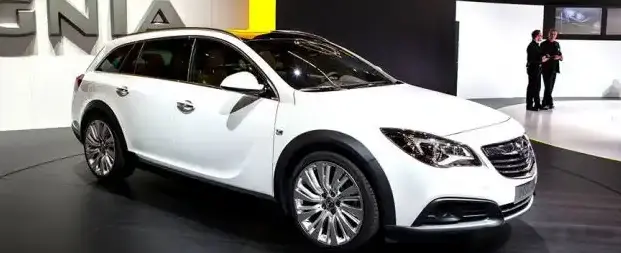
The Opel Insignia, launched in 2008, represented a significant step forward for the German automaker, aiming to compete directly with established players in the mid-size segment like the Ford Mondeo and Volkswagen Passat. The facelifted version introduced in 2013 brought revised styling, updated technology, and refined engine options. Among these, the 2.0 CDTI (163 hp) All-Wheel Drive (AWD) Ecotec Automatic variant occupied a compelling position in the lineup, offering a blend of performance, practicality, and all-weather capability. Production of this specific configuration ran from July 2013 to June 2015, primarily targeting European markets where diesel engines and all-wheel drive systems were highly valued.
Technical Specifications
| Brand | Opel |
| Model | Insignia |
| Generation | Insignia Hatchback (A, facelift 2013) |
| Type (Engine) | 2.0 CDTI (163 Hp) AWD Ecotec Automatic |
| Start of production | July, 2013 |
| End of production | June, 2015 |
| Powertrain Architecture | Internal Combustion engine |
| Body type | Hatchback |
| Seats | 5 |
| Doors | 5 |
| Fuel consumption (urban) | 5.5 l/100 km (42.8 US mpg, 51.4 UK mpg, 18.2 km/l) |
| Fuel consumption (extra urban) | 4.9 l/100 km (48 US mpg, 57.6 UK mpg, 20.4 km/l) |
| Fuel consumption (combined) | 6.2 l/100 km (37.9 US mpg, 45.6 UK mpg, 16.1 km/l) |
| CO2 emissions | 164 g/km |
| Fuel Type | Diesel |
| Acceleration 0 – 100 km/h | 10.5 sec |
| Acceleration 0 – 62 mph | 10.5 sec |
| Acceleration 0 – 60 mph | 10 sec |
| Maximum speed | 210 km/h (130.49 mph) |
| Emission standard | Euro 5 |
| Power | 163 Hp @ 4000 rpm |
| Power per litre | 83.3 Hp/l |
| Torque | 350 Nm @ 1750-2500 rpm (258.15 lb.-ft. @ 1750-2500 rpm) |
| Engine layout | Front, Transverse |
| Engine Model/Code | A20DTH |
| Engine displacement | 1956 cm3 (119.36 cu. in.) |
| Number of cylinders | 4 |
| Engine configuration | Inline |
| Cylinder Bore | 83 mm (3.27 in.) |
| Piston Stroke | 90.4 mm (3.56 in.) |
| Number of valves per cylinder | 4 |
| Fuel injection system | Diesel Commonrail |
| Engine aspiration | Turbocharger, Intercooler |
| Engine oil capacity | 4.5 l (4.76 US qt | 3.96 UK qt) |
| Coolant | 9 l (9.51 US qt | 7.92 UK qt) |
| Trunk (boot) space – minimum | 530 l (18.72 cu. ft.) |
| Trunk (boot) space – maximum | 1470 l (51.91 cu. ft.) |
| Fuel tank capacity | 70 l (18.49 US gal | 15.4 UK gal) |
| Length | 4842 mm (190.63 in.) |
| Width | 1856 mm (73.07 in.) |
| Width including mirrors | 2084 mm (82.05 in.) |
| Height | 1498 mm (58.98 in.) |
| Wheelbase | 2737 mm (107.76 in.) |
| Front track | 1587 mm (62.48 in.) |
| Rear (Back) track | 1590 mm (62.6 in.) |
| Minimum turning circle | 10.9 m (35.76 ft.) |
| Drive wheel | All wheel drive (4×4) |
| Number of gears | 6 |
| Gearbox type | automatic transmission |
| Assisting systems | ABS (Anti-lock braking system) |
| Steering type | Steering rack and pinion |
Powertrain & Engine Architecture
At the heart of the Insignia 2.0 CDTI AWD Automatic lies the A20DTH engine, a 1.956-liter inline-four cylinder diesel. This engine is a member of Opel’s Ecotec family, known for its focus on efficiency and refinement. The A20DTH utilizes a common rail direct injection system, delivering fuel at extremely high pressures for optimized combustion. A turbocharger with an intercooler further enhances performance, boosting power output to 163 horsepower at 4000 rpm and 350 Nm (258 lb-ft) of torque between 1750 and 2500 rpm. The engine also incorporates a diesel particulate filter (DPF) to reduce emissions, meeting Euro 5 standards. The automatic transmission is a six-speed unit, providing smooth and relatively quick shifts. While not a dual-clutch transmission, it was well-regarded for its reliability and suitability for everyday driving.
Driving Characteristics
The 163 hp 2.0 CDTI Automatic powertrain delivered a comfortable and capable driving experience. Acceleration from 0-60 mph took around 10 seconds, which was adequate for most situations but noticeably slower than the more powerful 2.0 Turbo petrol or 2.0 BiTurbo diesel variants. The automatic transmission, while smooth, wasn’t particularly sporty, prioritizing fuel efficiency over aggressive gear changes. The all-wheel drive system provided excellent traction in adverse weather conditions, making this variant a popular choice in regions with frequent rain or snow. The torque curve was relatively flat, providing good responsiveness at lower engine speeds, which was beneficial for everyday driving and overtaking maneuvers. However, the engine could feel strained when pushed hard, especially when fully loaded.
Equipment & Trim Levels
The 2.0 CDTI AWD Automatic typically came equipped with a generous level of standard features. These included air conditioning, alloy wheels, a touchscreen infotainment system with Bluetooth connectivity, and a suite of safety features such as ABS, ESP (Electronic Stability Program), and multiple airbags. Higher trim levels, such as SE Nav or Elite, added features like leather upholstery, heated front seats, a premium audio system, and advanced driver-assistance systems like adaptive cruise control and lane departure warning. Optional extras included a panoramic sunroof, parking sensors, and a rear-view camera.
Chassis & Braking
The Insignia’s chassis was designed to provide a balance between comfort and handling. The front suspension utilized MacPherson struts, while the rear suspension employed a multi-link setup. This configuration delivered a relatively smooth ride, even on uneven surfaces. The all-wheel drive system added weight, but also enhanced stability and cornering grip. Braking duties were handled by disc brakes on all four wheels, providing adequate stopping power. However, some models featured rear drum brakes, depending on the specific trim level and market. A stabilizer bar was fitted to both the front and rear axles to reduce body roll during cornering.
Market Reception & Comparison
The Opel Insignia 2.0 CDTI AWD Automatic was generally well-received by automotive critics. It was praised for its comfortable ride, spacious interior, and all-weather capability. However, some reviewers noted that the engine lacked the outright performance of its petrol counterparts. Compared to the 1.8L petrol version, the diesel offered significantly better fuel economy, but at the expense of acceleration. The 2.0 BiTurbo diesel provided more power and torque, but came at a higher price point. The 1.8L petrol was often seen as the entry-level option, while the 2.0 CDTI AWD Automatic appealed to buyers who prioritized fuel efficiency, practicality, and all-weather performance.
Legacy
The A20DTH engine, when properly maintained, proved to be a relatively reliable unit. Common issues included DPF clogging (particularly with frequent short journeys) and occasional turbocharger problems. The six-speed automatic transmission was generally robust, but required regular fluid changes. Today, the Insignia 2.0 CDTI AWD Automatic represents a good value proposition on the used car market. It offers a comfortable and practical driving experience, with decent fuel economy and all-weather capability. However, potential buyers should be aware of the potential for DPF issues and ensure that the vehicle has been regularly serviced. Its blend of practicality and affordability has ensured a continued presence on European roads, and a growing interest from collectors seeking a well-rounded and capable family car.