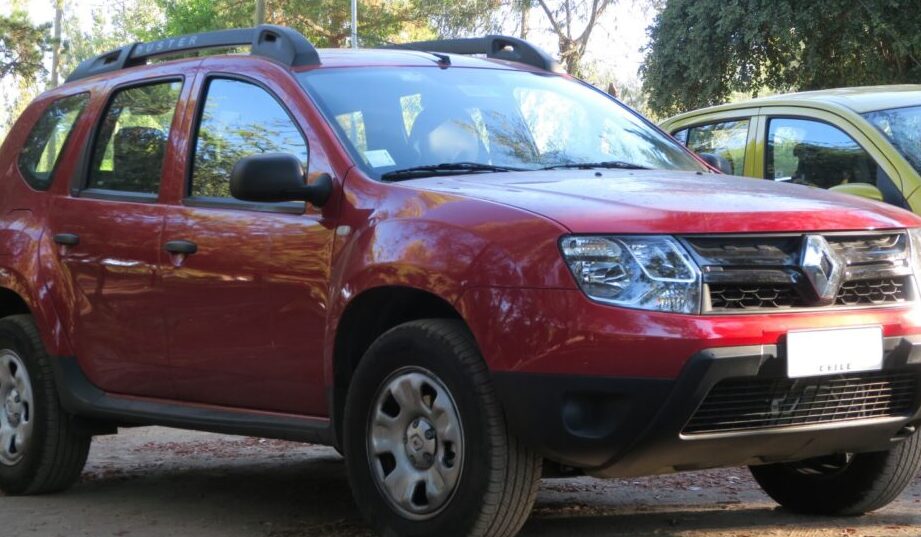
The Renault Duster I (facelift 2015) 1.5 dCi 110 horsepower variant was a popular choice in the European market, particularly for buyers seeking an affordable and practical compact SUV. Produced from June 2015 to May 2021, this version of the Duster sat in the mid-range of the lineup, offering a balance between fuel efficiency, performance, and equipment. It was positioned as a step up from the base engine options, appealing to those who needed a bit more power for highway driving or carrying loads. The facelift brought updated styling and minor equipment revisions to the original Duster, enhancing its appeal.
Technical Specifications
| Brand | Renault |
| Model | Duster |
| Generation | Duster I (facelift 2015) |
| Type (Engine) | 1.5 dCi (110 Hp) |
| Start of production | June, 2015 |
| End of production | May, 2021 |
| Powertrain Architecture | Internal Combustion engine |
| Body type | SUV |
| Seats | 5 |
| Doors | 5 |
| Fuel consumption (urban) | 5.7 l/100 km (41.3 US mpg, 49.6 UK mpg, 17.5 km/l) |
| Fuel consumption (extra urban) | 5.2 l/100 km (45.2 US mpg, 54.3 UK mpg, 19.2 km/l) |
| Fuel consumption (combined) | 5.1 l/100 km (46.1 US mpg, 55.4 UK mpg, 19.6 km/l) |
| CO2 emissions | 135 g/km |
| Fuel Type | Diesel |
| Acceleration 0 – 100 km/h | 12.8 sec |
| Acceleration 0 – 62 mph | 12.8 sec |
| Acceleration 0 – 60 mph | 12.2 sec |
| Maximum speed | 168 km/h (104.39 mph) |
| Emission standard | Euro 4 |
| Weight-to-power ratio | 12 kg/Hp, 83.7 Hp/tonne |
| Weight-to-torque ratio | 5.5 kg/Nm, 182.5 Nm/tonne |
| Power | 110 Hp @ 4000 rpm |
| Power per litre | 75.3 Hp/l |
| Torque | 240 Nm @ 1750 rpm (177.01 lb.-ft. @ 1750 rpm) |
| Engine layout | Front, Transverse |
| Engine Model/Code | K9K |
| Engine displacement | 1461 cm3 (89.16 cu. in.) |
| Number of cylinders | 4 |
| Engine configuration | Inline |
| Cylinder Bore | 76 mm (2.99 in.) |
| Piston Stroke | 80.5 mm (3.17 in.) |
| Compression ratio | 15.7:1 |
| Number of valves per cylinder | 2 |
| Fuel injection system | Diesel Commonrail |
| Engine aspiration | Turbocharger, Intercooler |
| Valvetrain | DOHC |
| Engine oil capacity | 4.5 l (4.76 US qt | 3.96 UK qt) |
| Coolant | 4.5 l (4.76 US qt | 3.96 UK qt) |
| Kerb Weight | 1315 kg (2899.08 lbs.) |
| Max. weight | 1865 kg (4111.62 lbs.) |
| Max load | 550 kg (1212.54 lbs.) |
| Trunk (boot) space – minimum | 475 l (16.77 cu. ft.) |
| Trunk (boot) space – maximum | 1636 l (57.77 cu. ft.) |
| Fuel tank capacity | 50 l (13.21 US gal | 11 UK gal) |
| Permitted trailer load with brakes (12%) | 1500 kg (3306.93 lbs.) |
| Permitted trailer load without brakes | 695 kg (1532.21 lbs.) |
| Length | 4315 mm (169.88 in.) |
| Width | 1822 mm (71.73 in.) |
| Width including mirrors | 2000 mm (78.74 in.) |
| Height | 1695 mm (66.73 in.) |
| Wheelbase | 2674 mm (105.28 in.) |
| Front track | 1559 mm (61.38 in.) |
| Rear (Back) track | 1560 mm (61.42 in.) |
| Front overhang | 816 mm (32.13 in.) |
| Rear overhang | 825 mm (32.48 in.) |
| Ride height (ground clearance) | 205 mm (8.07 in.) |
| Minimum turning circle | 10.76 m (35.3 ft.) |
| Approach angle | 29.3° |
| Departure angle | 34.9° |
| Ramp-over angle | 23° |
| Drivetrain Architecture | The Internal combustion engine (ICE) drives the front wheels of the vehicle. |
| Drive wheel | Front wheel drive |
| Number of gears and type of gearbox | 6 gears, manual transmission |
| Front suspension | Independent type McPherson |
| Rear suspension | Semi-independent, coil spring |
| Front brakes | Ventilated discs |
| Rear brakes | Drum |
| Assisting systems | ABS (Anti-lock braking system) |
| Steering type | Steering rack and pinion |
| Power steering | Electric Steering |
| Tires size | 215/65 R16 |
| Wheel rims size | 6.5J x 16 |
INTRODUCTION
The Renault Duster I, launched in 2010, quickly gained popularity as an affordable and rugged SUV, particularly in emerging markets. The 2015 facelift brought a refreshed look and some mechanical improvements. The 1.5 dCi engine with 110 horsepower was a key variant, offering a good compromise between fuel economy and performance. This engine was part of Renault’s widely used K9K family of diesel engines, known for its durability and efficiency. The Duster, in general, was designed to provide SUV practicality at a price point typically reserved for smaller hatchbacks, making it a compelling option for families and individuals needing a versatile vehicle.
Powertrain & Engine Architecture
The heart of this Duster variant is the K9K 1.5-liter four-cylinder diesel engine. This engine utilizes a common rail direct injection system, delivering fuel directly into the combustion chamber at high pressure for improved efficiency and reduced emissions. The engine features a single overhead camshaft (SOHC) design operating two valves per cylinder. A turbocharger with an intercooler is employed to boost power output and improve torque across the rev range. The 110 horsepower output is achieved through careful tuning of the engine management system. The engine is transversely mounted at the front of the vehicle. The Duster 1.5 dCi 110 was typically paired with a six-speed manual transmission, although an automated manual transmission (AMT) was also available in some markets. The AMT, while offering some convenience, wasn’t as smooth or responsive as a traditional automatic.
Driving Characteristics
The 110 horsepower 1.5 dCi engine provided adequate performance for everyday driving. Acceleration from 0 to 62 mph (0-100 km/h) took around 12.8 seconds, which wasn’t particularly quick, but sufficient for most situations. The engine’s 240 Nm (177 lb-ft) of torque, available from 1750 rpm, provided good pulling power for overtaking and climbing hills. The six-speed manual transmission allowed drivers to keep the engine in its optimal power band. Compared to the lower-powered 90 hp version of the same engine, the 110 hp variant offered a noticeable improvement in responsiveness, especially when fully loaded or driving on inclines. It wasn’t as sporty as some of its gasoline-powered competitors, but it excelled in fuel efficiency and low-speed drivability.
Equipment & Trim Levels
The 1.5 dCi 110 variant of the Duster typically came with a reasonable level of standard equipment. This included air conditioning, power steering, electric front windows, and a basic audio system. Higher trim levels added features such as alloy wheels, fog lights, a more advanced audio system with Bluetooth connectivity, and parking sensors. Interior upholstery was typically cloth, with options for upgraded materials on higher trims. Safety features included ABS brakes, driver and passenger airbags, and seatbelt pretensioners. The Duster was designed to be a practical and functional vehicle, so luxury features were generally kept to a minimum.
Chassis & Braking
The Duster’s chassis was designed to provide a comfortable ride and decent handling. The front suspension utilized an independent McPherson strut setup, while the rear suspension employed a semi-independent coil spring arrangement. This configuration provided a good balance between ride comfort and stability. The braking system consisted of ventilated discs at the front and drum brakes at the rear. ABS (Anti-lock Braking System) was standard, enhancing safety during emergency braking situations. The Duster’s relatively simple suspension setup and robust construction made it well-suited for tackling rough roads and uneven surfaces.
Market Reception & Comparison
The Renault Duster 1.5 dCi 110 received generally positive reviews from automotive critics. It was praised for its affordability, practicality, and fuel efficiency. The engine was considered to be a good all-rounder, providing enough power for most drivers while remaining economical to run. Compared to the 90 hp version, the 110 hp variant was seen as a worthwhile upgrade for those who frequently drove on highways or carried heavy loads. It also offered better resale value. Compared to gasoline-powered rivals, the Duster 1.5 dCi 110 offered significantly better fuel economy, but lacked the refinement and performance of some of the more expensive options.
Legacy
The Renault Duster, and specifically the 1.5 dCi engine family, has proven to be remarkably reliable. The K9K engine is known for its durability and relatively low maintenance costs. Used examples of the Duster 1.5 dCi 110 are still readily available on the used car market and generally hold their value well. Common issues are typically related to wear and tear on suspension components and the occasional turbocharger failure, but these are generally not major concerns. The Duster’s simple construction and robust design have contributed to its longevity, making it a popular choice for budget-conscious buyers seeking a dependable and practical SUV.