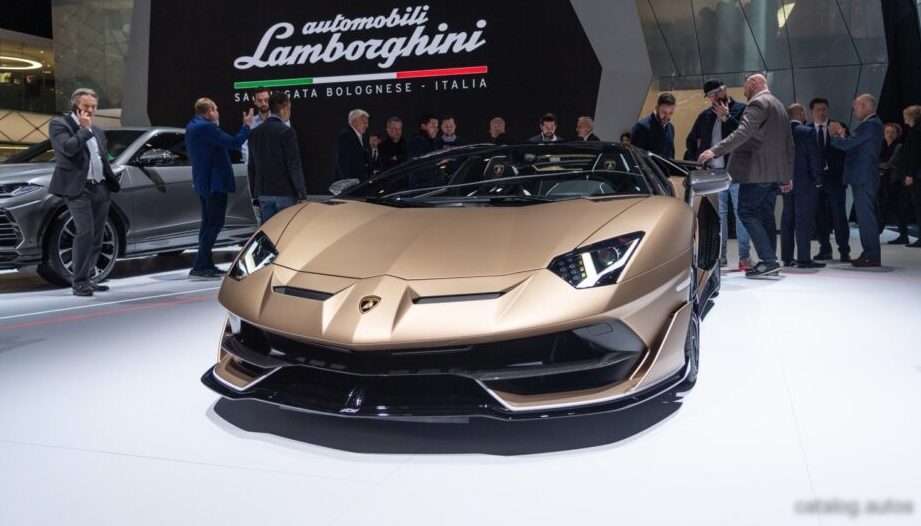
The Lamborghini Aventador SVJ 6.5 V12, produced from 2019 onwards, represents the pinnacle of the first-generation Aventador (LB700-4) model line. Positioned as the highest-performance variant, the SVJ (Superveloce Jota) was engineered to be a track-focused, yet street-legal, supercar. It superseded the Aventador SV, pushing the boundaries of Lamborghini’s naturally aspirated V12 engine and aerodynamic capabilities. The SVJ utilized extensive weight reduction, increased power output, and a recalibrated all-wheel-drive system to achieve exceptional performance metrics. It’s a significant model in Lamborghini’s history, showcasing their commitment to extreme performance and Italian automotive engineering.
Technical Specifications
| Brand | Lamborghini |
| Model | Aventador |
| Generation | Aventador SVJ |
| Type (Engine) | 6.5 V12 (770 Hp) 4WD ISR |
| Start of production | 2019 |
| Powertrain Architecture | Internal Combustion engine |
| Body type | Coupe |
| Seats | 2 |
| Doors | 2 |
| Combined fuel consumption (WLTP) | 17.9 l/100 km (13.1 US mpg, 15.8 UK mpg, 5.6 km/l) |
| CO2 emissions (WLTP) | 486 g/km |
| Fuel consumption (economy) – urban (NEDC) | 31 l/100 km (7.6 US mpg, 9.1 UK mpg, 3.2 km/l) |
| Fuel consumption (economy) – extra urban (NEDC) | 13 l/100 km (18.1 US mpg, 21.7 UK mpg, 7.7 km/l) |
| Fuel consumption (economy) – combined (NEDC) | 19.6 l/100 km (12 US mpg, 14.4 UK mpg, 5.1 km/l) |
| CO2 emissions (NEDC) | 452 g/km |
| Fuel Type | Petrol (Gasoline) |
| Acceleration 0 – 100 km/h | 2.8 sec |
| Acceleration 0 – 62 mph | 2.8 sec |
| Acceleration 0 – 60 mph | 2.9 sec |
| Acceleration 0 – 200 km/h | 8.6 sec |
| Acceleration 0 – 300 km/h | 24.0 sec |
| Maximum speed | 350 km/h (217.48 mph) |
| Weight-to-power ratio | 2 kg/Hp, 504.9 Hp/tonne |
| Weight-to-torque ratio | 2.1 kg/Nm, 472.1 Nm/tonne |
| Power | 770 Hp @ 8500 rpm |
| Power per litre | 118.5 Hp/l |
| Torque | 720 Nm @ 6750 rpm (531.04 lb.-ft. @ 6750 rpm) |
| Maximum engine speed | 8700 rpm |
| Engine layout | Middle, Longitudinal |
| Engine Model/Code | L539 |
| Engine displacement | 6498 cm3 (396.53 cu. in.) |
| Number of cylinders | 12 |
| Engine configuration | V-engine |
| Cylinder Bore | 95 mm (3.74 in.) |
| Piston Stroke | 76.4 mm (3.01 in.) |
| Compression ratio | 11.8:1 |
| Number of valves per cylinder | 4 |
| Fuel injection system | Multi-port manifold injection |
| Engine aspiration | Naturally aspirated engine |
| Valvetrain | VVT |
| Engine oil capacity | 13 l (13.74 US qt | 11.44 UK qt) |
| Coolant | 25 l (26.42 US qt | 22 UK qt) |
| Kerb Weight | 1525 kg (3362.05 lbs.) |
| Max. weight | 2050 kg (4519.48 lbs.) |
| Max load | 525 kg (1157.43 lbs.) |
| Trunk (boot) space – minimum | 140 l (4.94 cu. ft.) |
| Fuel tank capacity | 85 l (22.45 US gal | 18.7 UK gal) |
| Length | 4943 mm (194.61 in.) |
| Width | 2098 mm (82.6 in.) |
| Width including mirrors | 2273 mm (89.49 in.) |
| Height | 1136 mm (44.72 in.) |
| Wheelbase | 2700 mm (106.3 in.) |
| Front track | 1720 mm (67.72 in.) |
| Rear (Back) track | 1680 mm (66.14 in.) |
| Front overhang | 1226 mm (48.27 in.) |
| Rear overhang | 1017 mm (40.04 in.) |
| Ride height (ground clearance) | 115 mm (4.53 in.) |
| Minimum turning circle (turning diameter) | 12.5 m (41.01 ft.) |
| Approach angle | 7-9.9° |
| Departure angle | 16.3° |
| Ramp-over (brakeover) angle | 10.5-12.1° |
| Drivetrain Architecture | The Internal combustion engine (ICE) drives permanently the four wheels of the vehicle. |
| Drive wheel | All wheel drive (4×4) |
| Number of gears and type of gearbox | 7 gears, automatic transmission ISR |
| Front suspension | Double wishbone |
| Rear suspension | Double wishbone |
| Front brakes | Ventilated discs, 400×38 mm |
| Rear brakes | Ventilated discs, 380×38 mm |
| Assisting systems | ABS (Anti-lock braking system) |
| Steering type | Steering rack and pinion |
| Power steering | Hydraulic Steering |
| Tires size | 255/30 ZR20; 355/25 ZR21 |
| Wheel rims size | 9J x 20; 13J x 21 |
Powertrain & Engine Architecture
The heart of the Aventador SVJ is Lamborghini’s naturally aspirated 6.5-liter V12 engine, designated L539. This engine produces 770 horsepower at 8,500 rpm and 531 lb-ft of torque at 6,750 rpm. It features a 60-degree V-angle and utilizes a multi-point fuel injection system. Variable valve timing (VVT) is employed on both intake and exhaust valves to optimize performance across the rev range. The engine’s architecture is a testament to Lamborghini’s commitment to naturally aspirated power, eschewing turbocharging or supercharging in favor of a large displacement and high-revving character. The SVJ utilizes a 7-speed Independent Shifting Rod (ISR) automated manual transmission. This transmission, while quicker than a traditional manual, is known for its somewhat jerky low-speed shifts, a characteristic Lamborghini partially addressed with recalibration in the SVJ.
Driving Characteristics
The Aventador SVJ delivers a visceral and engaging driving experience. The 770 hp engine provides immense acceleration, launching the car from 0 to 60 mph in approximately 2.9 seconds and reaching a top speed of 217 mph. The ISR transmission, while not as smooth as a dual-clutch gearbox, offers rapid upshifts and downshifts when driven aggressively. The all-wheel-drive system provides exceptional traction, allowing the SVJ to put its power down effectively. Compared to the standard Aventador and even the SV, the SVJ benefits from a lighter curb weight and revised aerodynamics, resulting in sharper handling and increased cornering speeds. The SVJ’s suspension is tuned for track performance, offering a firm ride that may not be ideal for everyday driving.
Equipment & Trim Levels
The Aventador SVJ was relatively sparsely equipped compared to some other supercars, prioritizing weight reduction. Standard features included carbon fiber exterior trim, a lightweight interior with Alcantara upholstery, and a performance exhaust system. Optional extras included a variety of carbon fiber interior components, different wheel designs, and a bespoke paint options. The interior focused on a driver-centric layout, with minimal distractions and a clear focus on performance. Infotainment features were present but not a primary focus, reflecting the car’s overall performance-oriented philosophy.
Chassis & Braking
The Aventador SVJ utilizes a carbon fiber monocoque chassis, providing exceptional rigidity and lightness. The suspension features double wishbones at all four corners, with magnetorheological dampers to adjust damping rates in real-time. Braking is handled by ventilated carbon-ceramic discs measuring 400x38mm at the front and 380x38mm at the rear, providing immense stopping power. The SVJ also incorporates an advanced aerodynamic package, including a large rear wing, front splitter, and various air intakes and outlets, to generate significant downforce and improve stability at high speeds.
Market Reception & Comparison
The Lamborghini Aventador SVJ was widely praised by automotive critics for its exceptional performance, handling, and dramatic styling. It was often compared favorably to other high-performance supercars, such as the Ferrari 812 Superfast and the McLaren 720S. While the SVJ’s fuel economy (around 13.1 US mpg combined) was predictably poor, it was not a primary concern for buyers in this segment. The SVJ’s ISR transmission received some criticism for its occasional jerkiness, but its overall performance and exclusivity outweighed this drawback for most enthusiasts. Compared to the standard Aventador, the SVJ offered a significant performance upgrade, justifying its higher price tag.
Legacy
The Aventador SVJ represents a high point in Lamborghini’s naturally aspirated V12 engine development. Its combination of extreme performance, advanced aerodynamics, and dramatic styling has cemented its place as a modern supercar icon. On the used car market, the SVJ commands a premium price, reflecting its limited production numbers and desirability among collectors. The L539 engine, while complex, has proven to be relatively reliable when properly maintained, although servicing costs remain high. The SVJ’s influence can be seen in subsequent Lamborghini models, which continue to push the boundaries of performance and design.