
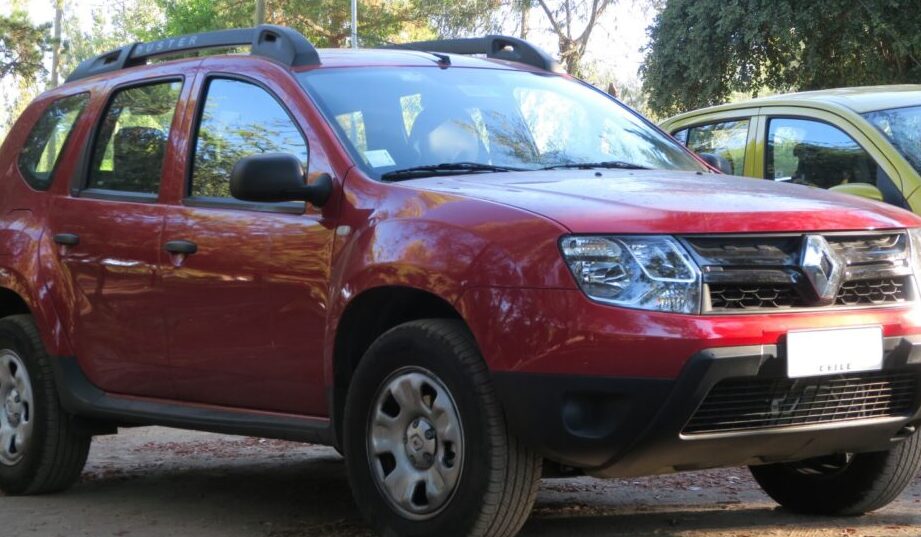
The Renault Duster I (facelift 2015) 1.5 dCi 110 horsepower automatic variant was a significant offering within the first generation of Renault’s popular compact SUV. Produced from June 2015 to May 2021, this version aimed to provide a balance of fuel efficiency, practicality, and ease of driving, appealing to a broader customer base than the base models. It sat in the mid-range of the Duster lineup, offering more power and convenience features than the lower-spec engines, but remaining more affordable than the top-tier trims. The Duster, initially launched in 2010, was a crucial model for Renault, particularly in emerging markets, and the facelifted version brought updated styling and improved equipment levels.
Technical Specifications
| Brand | Renault |
| Model | Duster |
| Generation | Duster I (facelift 2015) |
| Type (Engine) | 1.5 dCi (110 Hp) Automatic |
| Start of production | June, 2015 |
| End of production | May, 2021 |
| Powertrain Architecture | Internal Combustion engine |
| Body type | SUV |
| Seats | 5 |
| Doors | 5 |
| Fuel consumption (combined) | 5.1 l/100 km (46.1 US mpg, 55.4 UK mpg, 19.6 km/l) |
| Fuel Type | Diesel |
| Acceleration 0 – 100 km/h | 12.5 sec |
| Acceleration 0 – 62 mph | 12.5 sec |
| Acceleration 0 – 60 mph | 11.9 sec |
| Maximum speed | 168 km/h (104.39 mph) |
| Power | 110 Hp @ 4000 rpm |
| Power per litre | 75.3 Hp/l |
| Torque | 240 Nm @ 1750 rpm (177.01 lb.-ft. @ 1750 rpm) |
| Engine layout | Front, Transverse |
| Engine Model/Code | K9K |
| Engine displacement | 1461 cm3 (89.16 cu. in.) |
| Number of cylinders | 4 |
| Engine configuration | Inline |
| Cylinder Bore | 76 mm (2.99 in.) |
| Piston Stroke | 80.5 mm (3.17 in.) |
| Compression ratio | 17.6:1 |
| Number of valves per cylinder | 2 |
| Fuel injection system | Diesel Commonrail |
| Engine aspiration | Turbocharger, Intercooler |
| Valvetrain | DOHC |
| Engine oil capacity | 4.5 l (4.76 US qt | 3.96 UK qt) |
| Coolant | 4.5 l (4.76 US qt | 3.96 UK qt) |
| Max. weight | 1813 kg (3996.98 lbs.) |
| Trunk (boot) space – minimum | 475 l (16.77 cu. ft.) |
| Trunk (boot) space – maximum | 1636 l (57.77 cu. ft.) |
| Fuel tank capacity | 50 l (13.21 US gal | 11 UK gal) |
| Length | 4315 mm (169.88 in.) |
| Width | 1822 mm (71.73 in.) |
| Width including mirrors | 2000 mm (78.74 in.) |
| Height | 1695 mm (66.73 in.) |
| Wheelbase | 2674 mm (105.28 in.) |
| Front track | 1559 mm (61.38 in.) |
| Rear (Back) track | 1560 mm (61.42 in.) |
| Front overhang | 816 mm (32.13 in.) |
| Rear overhang | 825 mm (32.48 in.) |
| Ride height (ground clearance) | 205 mm (8.07 in.) |
| Minimum turning circle | 10.76 m (35.3 ft.) |
| Approach angle | 29.3° |
| Departure angle | 34.9° |
| Ramp-over angle | 23° |
| Drivetrain Architecture | The Internal combustion engine (ICE) drives the front wheels of the vehicle. |
| Drive wheel | Front wheel drive |
| Number of gears and type of gearbox | 6 gears, automatic transmission |
| Front suspension | Independent type McPherson |
| Rear suspension | Semi-independent, coil spring |
| Front brakes | Ventilated discs |
| Rear brakes | Drum |
| Assisting systems | ABS (Anti-lock braking system) |
| Steering type | Steering rack and pinion |
| Power steering | Electric Steering |
| Tires size | 215/65 R16 |
| Wheel rims size | 6.5J x 16 |
INTRODUCTION
The Renault Duster I facelift, launched in 2015, represented a significant refresh of the original Duster model. Designed as an affordable and rugged SUV, the Duster quickly gained popularity in Europe, Latin America, and other emerging markets. The 1.5 dCi engine with 110 horsepower, coupled with a six-speed automatic transmission, was introduced to broaden the Duster’s appeal, offering a more convenient driving experience for those who preferred not to operate a manual gearbox. This combination aimed to balance fuel economy with acceptable performance for everyday driving. The facelift brought with it revised front-end styling, interior upgrades, and improved equipment levels, solidifying the Duster’s position as a value-for-money SUV.
Powertrain & Engine Architecture
The heart of this Duster variant is the Renault K9K 1.5-liter four-cylinder diesel engine. This engine, a mainstay in Renault’s lineup, is known for its robustness and fuel efficiency. The K9K utilizes a common rail direct injection system, delivering fuel directly into the combustion chamber at high pressure for optimized combustion. The 110 horsepower output is achieved through a turbocharger with an intercooler, which increases air density entering the engine, boosting power and torque. The engine features a double overhead camshaft (DOHC) valvetrain with two valves per cylinder. The six-speed automatic transmission, sourced from DP0 (Nissan/Renault), is a conventional torque converter automatic. It’s known for its smooth operation but isn’t particularly quick-shifting compared to modern dual-clutch transmissions. The transmission’s gear ratios are tuned for fuel economy and drivability rather than outright performance.
Driving Characteristics
The 1.5 dCi 110 hp automatic Duster delivers adequate, but not exhilarating, performance. Acceleration from 0-60 mph takes around 11.9 seconds, and the top speed is approximately 104 mph. The automatic transmission provides smooth gear changes, making it ideal for urban driving and long journeys. However, the relatively low horsepower and torque output mean that overtaking maneuvers require careful planning. Compared to the more powerful 1.5 dCi 110 hp manual version, the automatic feels slightly more sluggish due to the transmission’s inherent efficiency losses. The automatic transmission’s programming prioritizes fuel economy, resulting in a less responsive feel than the manual counterpart. The Duster’s suspension provides a comfortable ride, absorbing bumps and imperfections in the road well, but it’s not particularly sporty in handling.
Equipment & Trim Levels
The 1.5 dCi 110 hp automatic typically came with a reasonable level of standard equipment. This included air conditioning, power windows, central locking, and an audio system with USB connectivity. Higher trim levels added features such as alloy wheels, fog lights, a trip computer, and upgraded interior upholstery. Optional extras included a navigation system, rear parking sensors, and a leather steering wheel. The interior design was functional and durable, with hard-wearing plastics throughout. The dashboard layout was straightforward and easy to use, prioritizing practicality over aesthetics.
Chassis & Braking
The Duster’s chassis is based on a reinforced version of the Dacia Logan platform. The front suspension utilizes an independent McPherson strut setup, providing a comfortable ride and decent handling. The rear suspension employs a semi-independent coil spring arrangement, which is cost-effective but less sophisticated than a fully independent system. Braking duties are handled by ventilated discs at the front and drum brakes at the rear. Anti-lock Braking System (ABS) is standard, enhancing safety during emergency braking situations. The Duster’s ride height of 205mm (8.07 inches) provides good ground clearance, making it suitable for tackling rough roads and light off-road conditions.
Market Reception & Comparison
The Renault Duster I (facelift 2015) 1.5 dCi 110 hp automatic was generally well-received by automotive critics. It was praised for its affordability, practicality, and fuel efficiency. However, some reviewers noted the engine’s lack of outright power and the automatic transmission’s somewhat sluggish performance. Compared to other SUVs in its class, the Duster offered a compelling value proposition, undercutting many competitors on price. The 1.5 dCi 90 hp manual version offered even better fuel economy but lacked the convenience of the automatic transmission. The higher-powered 1.5 dCi 110 hp manual provided better performance but came at a higher price point.
Legacy
The Renault Duster I, including the 1.5 dCi 110 hp automatic variant, has proven to be a reliable and durable vehicle. The K9K engine is known for its longevity, and the automatic transmission, while not the most advanced, is generally dependable. In the used car market, these Dusters represent a good value for money, offering a practical and affordable SUV option. However, potential buyers should be aware of the typical wear and tear associated with diesel engines, such as potential issues with the turbocharger and fuel injectors. Overall, the Duster I 1.5 dCi 110 hp automatic remains a popular choice for those seeking a budget-friendly and capable SUV.


