
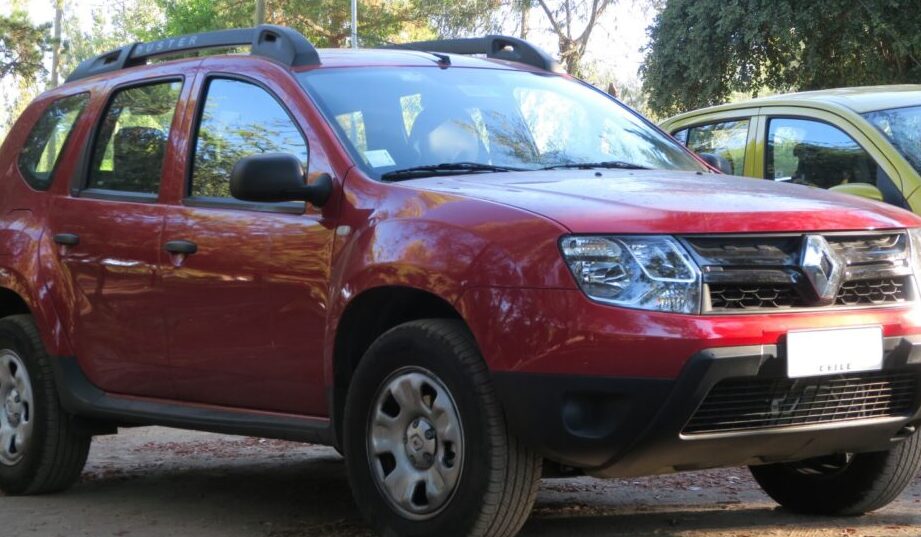
Technical Specifications
| Brand | Renault |
| Model | Duster |
| Generation | Duster I (facelift 2015) |
| Type (Engine) | 1.5 dCi (110 Hp) AWD |
| Start of production | June, 2015 |
| End of production | May, 2021 |
| Powertrain Architecture | Internal Combustion engine |
| Body type | SUV |
| Seats | 5 |
| Doors | 5 |
| Fuel consumption (urban) | 5.7 l/100 km (41.3 US mpg, 49.6 UK mpg, 17.5 km/l) |
| Fuel consumption (extra urban) | 5 l/100 km (47 US mpg, 56.5 UK mpg, 20 km/l) |
| Fuel consumption (combined) | 5.2 l/100 km (45.2 US mpg, 54.3 UK mpg, 19.2 km/l) |
| CO2 emissions | 135 g/km |
| Fuel Type | Diesel |
| Acceleration 0 – 100 km/h | 12.5 sec |
| Acceleration 0 – 62 mph | 12.5 sec |
| Acceleration 0 – 60 mph | 11.9 sec |
| Maximum speed | 168 km/h (104.39 mph) |
| Emission standard | Euro 4 |
| Weight-to-power ratio | 12 kg/Hp, 83.7 Hp/tonne |
| Weight-to-torque ratio | 5.5 kg/Nm, 182.5 Nm/tonne |
| Power | 110 Hp @ 4000 rpm |
| Power per litre | 75.3 Hp/l |
| Torque | 240 Nm @ 1750 rpm (177.01 lb.-ft. @ 1750 rpm) |
| Engine layout | Front, Transverse |
| Engine Model/Code | K9K |
| Engine displacement | 1461 cm3 (89.16 cu. in.) |
| Number of cylinders | 4 |
| Engine configuration | Inline |
| Cylinder Bore | 76 mm (2.99 in.) |
| Piston Stroke | 80.5 mm (3.17 in.) |
| Compression ratio | 15.7:1 |
| Number of valves per cylinder | 2 |
| Fuel injection system | Diesel Commonrail |
| Engine aspiration | Turbocharger, Intercooler |
| Valvetrain | DOHC |
| Engine oil capacity | 4.5 l (4.76 US qt | 3.96 UK qt) |
| Coolant | 4.5 l (4.76 US qt | 3.96 UK qt) |
| Kerb Weight | 1315 kg (2899.08 lbs.) |
| Max. weight | 1865 kg (4111.62 lbs.) |
| Max load | 550 kg (1212.54 lbs.) |
| Trunk (boot) space – minimum | 408 l (14.41 cu. ft.) |
| Trunk (boot) space – maximum | 1604 l (56.64 cu. ft.) |
| Fuel tank capacity | 50 l (13.21 US gal | 11 UK gal) |
| Permitted trailer load with brakes (12%) | 1500 kg (3306.93 lbs.) |
| Permitted trailer load without brakes | 695 kg (1532.21 lbs.) |
| Length | 4315 mm (169.88 in.) |
| Width | 1822 mm (71.73 in.) |
| Width including mirrors | 2000 mm (78.74 in.) |
| Height | 1695 mm (66.73 in.) |
| Wheelbase | 2674 mm (105.28 in.) |
| Front track | 1559 mm (61.38 in.) |
| Rear (Back) track | 1560 mm (61.42 in.) |
| Front overhang | 816 mm (32.13 in.) |
| Rear overhang | 825 mm (32.48 in.) |
| Ride height (ground clearance) | 210 mm (8.27 in.) |
| Minimum turning circle (turning diameter) | 10.76 m (35.3 ft.) |
| Approach angle | 29.3° |
| Departure angle | 34.9° |
| Ramp-over (brakeover) angle | 23° |
| Drive wheel | All wheel drive (4×4) |
| Number of gears and type of gearbox | 6 gears, manual transmission |
| Front suspension | Independent type McPherson |
| Rear suspension | Independent multi-link suspension |
| Front brakes | Ventilated discs |
| Rear brakes | Drum |
| Assisting systems | ABS (Anti-lock braking system) |
| Steering type | Steering rack and pinion |
| Power steering | Electric Steering |
| Tires size | 215/65 R16 |
| Wheel rims size | 6.5J x 16 |
The Renault Duster I (facelift 2015) 1.5 dCi (110 hp) AWD represents a significant offering within the compact SUV segment, particularly in European and emerging markets. Produced from June 2015 to May 2021, this variant combined the practicality of the Duster platform with the fuel efficiency of a diesel engine and the added capability of all-wheel drive. It occupied a mid-range position in the Duster lineup, appealing to buyers seeking a versatile vehicle for both on-road comfort and occasional off-road excursions. The facelifted Duster, introduced in 2015, brought styling updates and revised equipment levels to the already popular first-generation model (introduced in 2010), enhancing its appeal to a broader customer base.
Powertrain & Engine Architecture
The heart of the Duster 1.5 dCi (110 hp) AWD is the K9K engine, a 1.5-liter inline-four diesel engine. This engine, a staple in Renault-Nissan Alliance vehicles, is known for its robustness and fuel efficiency. The 1461cc engine utilizes a common rail direct injection system, delivering fuel at high pressure for optimized combustion. A turbocharger with an intercooler further enhances performance, boosting power output to 110 horsepower at 4000 rpm and 240 Nm (177 lb-ft) of torque at 1750 rpm. The engine features a double overhead camshaft (DOHC) valvetrain with two valves per cylinder. The all-wheel-drive system is typically a part-time system, engaging the rear wheels when traction is needed, enhancing stability on slippery surfaces. The 6-speed manual transmission was the standard offering for this variant, providing a balance between fuel economy and driver control.
Driving Characteristics
The 1.5 dCi (110 hp) AWD Duster offers a practical and capable driving experience. While not a performance-oriented vehicle, the engine provides adequate power for everyday driving and highway cruising. The 240 Nm of torque, available from relatively low engine speeds, provides good responsiveness for overtaking and climbing hills. The six-speed manual transmission allows drivers to keep the engine in its optimal power band. Compared to the higher-output 1.5 dCi variants, this version feels slightly less energetic, but the trade-off is improved fuel economy. The all-wheel-drive system adds a noticeable level of confidence on loose surfaces, making it suitable for light off-road adventures. The ride quality is generally comfortable, although the suspension can feel a bit firm on rough roads.
Equipment & Trim Levels
The Duster 1.5 dCi (110 hp) AWD typically came with a reasonable level of standard equipment. This included air conditioning, power steering, electric front windows, and a basic audio system. Safety features such as ABS (Anti-lock Braking System) and driver/passenger airbags were also standard. Higher trim levels offered additional features like alloy wheels, rear parking sensors, a more advanced audio system with Bluetooth connectivity, and cruise control. Interior upholstery was typically cloth, with a durable and practical design. The dashboard layout was functional and straightforward, prioritizing usability over luxury.
Chassis & Braking
The Duster’s chassis is a robust ladder-frame construction, providing a solid foundation for both on-road and off-road driving. The front suspension utilizes an independent McPherson strut setup, while the rear features an independent multi-link suspension. This configuration provides a good balance between ride comfort and handling. The braking system consists of ventilated discs on the front wheels and drum brakes on the rear. While adequate for most driving situations, the rear drum brakes were a cost-saving measure and didn’t offer the same stopping power as disc brakes. The steering is a rack-and-pinion system with electric power assistance, providing a light and responsive feel.
Market Reception & Comparison
The Renault Duster 1.5 dCi (110 hp) AWD was well-received in markets where affordability and practicality were key considerations. Critics praised its spacious interior, robust build quality, and fuel-efficient engine. Compared to other compact SUVs, the Duster offered a compelling value proposition, particularly in its all-wheel-drive configuration. The 110 hp version was often seen as a sweet spot in the lineup, offering a good balance between performance and economy. The higher-output 1.5 dCi variants provided more power but came at a higher price and with slightly reduced fuel economy. The petrol-powered Dusters were generally less fuel-efficient and lacked the torque of the diesel engines.
Legacy
The Renault Duster I, including the 1.5 dCi (110 hp) AWD variant, has proven to be a reliable and durable vehicle. The K9K engine is known for its longevity, and with proper maintenance, it can withstand high mileage. In the used car market, these Dusters remain popular due to their affordability and practicality. While some may exhibit age-related wear and tear, the overall reliability of the powertrain is generally good. The Duster’s success paved the way for the second-generation model, which continues to build on the strengths of the original, offering a compelling option in the competitive compact SUV segment.


