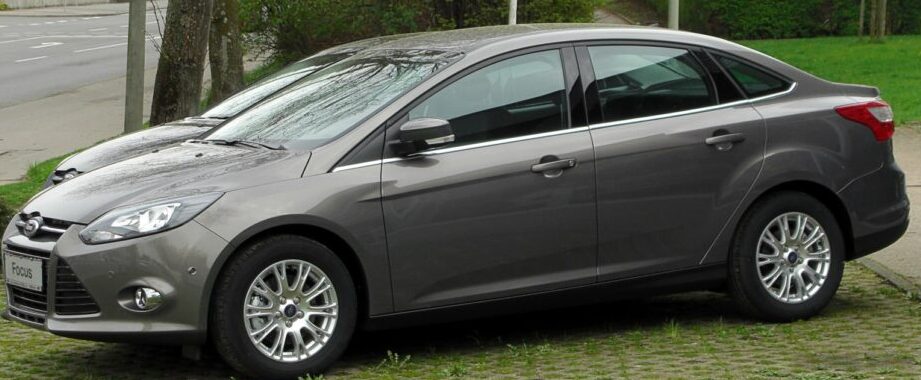
The Ford Focus III Sedan 1.6 TDCi (95 horsepower) with Start/Stop technology represents a significant entry point into the third generation of Ford’s globally successful Focus model. Produced from 2010 to 2014, this variant was primarily aimed at the European market, where fuel efficiency and lower running costs were highly valued. It occupied the lower-mid range of the Focus III sedan lineup, positioned below the higher-powered diesel and gasoline options. This model was a key component of Ford’s strategy to offer a versatile and economical compact sedan to a broad customer base.
Technical Specifications
| Brand | Ford |
| Model | Focus |
| Generation | Focus III Sedan |
| Type (Engine) | 1.6 TDCi (95 Hp) start/stop |
| Start of production | 2010 |
| End of production | 2014 |
| Powertrain Architecture | Internal Combustion engine |
| Body type | Sedan |
| Seats | 5 |
| Doors | 4 |
| Fuel consumption (urban) | 5.1 l/100 km (46.1 US mpg, 55.4 UK mpg, 19.6 km/l) |
| Fuel consumption (extra urban) | 3.7 l/100 km (63.6 US mpg, 76.3 UK mpg, 27 km/l) |
| Fuel consumption (combined) | 4.2 l/100 km (56 US mpg, 67.3 UK mpg, 23.8 km/l) |
| Fuel Type | Diesel |
| Acceleration 0 – 100 km/h | 12.6 sec |
| Acceleration 0 – 62 mph | 12.6 sec |
| Acceleration 0 – 60 mph | 12 sec |
| Maximum speed | 182 km/h (113.09 mph) |
| Power | 95 Hp |
| Engine layout | Front, Transverse |
| Engine Model/Code | TZJA, T3DA, T3DB |
| Engine configuration | Inline |
| Fuel injection system | Diesel Commonrail |
| Engine aspiration | Turbocharger, Intercooler |
| Engine oil capacity | 3.8 l (4.02 US qt, 3.34 UK qt) |
| Coolant capacity | 7.3 l (7.71 US qt, 6.42 UK qt) |
| Engine systems | Start & Stop System |
| Drivetrain Architecture | Front wheel drive, Internal Combustion Engine |
| Number of gears and type of gearbox | 6 gears, manual transmission |
| Assisting systems | ABS (Anti-lock braking system) |
| Steering type | Steering rack and pinion |
Powertrain & Engine Architecture
The heart of this Focus variant is the 1.6-liter Duratorq TDCi diesel engine, specifically utilizing engine codes TZJA, T3DA, or T3DB depending on the specific market and production year. This engine is a four-cylinder, inline configuration, benefiting from a turbocharger and intercooler to enhance power and efficiency. The engine employs a common-rail direct fuel injection system, delivering fuel at extremely high pressure for optimized combustion. This system, coupled with the turbocharger, allows for a relatively high output of 95 horsepower and a respectable amount of torque for its displacement. The Start/Stop system, a key feature of this model, automatically shuts off the engine when the vehicle is stationary (at traffic lights, for example) and restarts it instantly when the clutch is depressed, contributing to fuel savings and reduced emissions. The 6-speed manual transmission was the standard offering, providing a balance between fuel economy and driver control.
Driving Characteristics
The 1.6 TDCi 95 hp engine, paired with the 6-speed manual transmission, delivers a driving experience focused on economy rather than outright performance. Acceleration from 0-60 mph takes approximately 12 seconds, and the top speed is around 113 mph. While not particularly quick, the engine provides sufficient power for everyday driving situations, including highway cruising and city commuting. The turbocharger provides a noticeable boost in power at higher RPMs, but the engine’s torque curve is relatively flat, meaning usable power is available across a wide range of engine speeds. The gear ratios in the 6-speed transmission are well-spaced, allowing the driver to keep the engine in its optimal power band. Compared to the higher-output 1.6 TDCi variants or the gasoline-powered Focus models, this version feels less responsive, but it offers significantly better fuel economy.
Equipment & Trim Levels
The 1.6 TDCi 95 hp model typically served as a mid-range trim level within the Focus III Sedan lineup. Standard equipment generally included air conditioning, power windows, power door locks, a basic audio system with USB connectivity, and ABS brakes. Safety features such as front and side airbags were also standard. Interior upholstery was typically cloth, with a functional and durable design. Optional extras included alloy wheels, upgraded audio systems, rear parking sensors, and a trip computer. Higher trim levels added features like automatic climate control, leather upholstery, and more advanced infotainment systems. The overall interior design prioritized practicality and ease of use, rather than luxury.
Chassis & Braking
The Focus III Sedan utilizes a MacPherson strut front suspension and a multi-link rear suspension, providing a good balance between ride comfort and handling. The suspension was tuned to prioritize comfort, making it well-suited for everyday driving. Braking systems varied slightly depending on the specific market and trim level. Most models featured disc brakes on the front wheels and drum brakes on the rear wheels. ABS (Anti-lock Braking System) was standard across the range, enhancing braking performance and safety. Stabilizer bars were fitted to both the front and rear axles to reduce body roll during cornering. The chassis was designed to be relatively lightweight, contributing to the vehicle’s fuel efficiency.
Market Reception & Comparison
The Ford Focus III Sedan 1.6 TDCi 95 hp Start/Stop was generally well-received by automotive critics for its fuel efficiency and practicality. It was praised for its comfortable ride and decent handling, although its performance was considered adequate rather than exciting. Compared to other trims in the Focus lineup, this variant offered the best fuel economy, making it an attractive option for drivers who prioritized running costs. The 1.6 TDCi engine proved to be relatively reliable, although some owners reported issues with the diesel particulate filter (DPF) system, particularly on vehicles primarily used for short trips. Compared to competitors like the Volkswagen Golf and Opel Astra, the Focus offered a competitive package in terms of price, features, and fuel economy.
Legacy
The 1.6 TDCi engine, in various iterations, became a mainstay in Ford’s European lineup for many years. While later versions addressed some of the early DPF issues, the engine’s overall reliability is generally considered good. On the used car market, the Focus III Sedan 1.6 TDCi 95 hp represents a relatively affordable and economical option. Maintenance costs are generally reasonable, and parts availability is good. However, potential buyers should be aware of the possibility of DPF issues and ensure that the vehicle has been properly maintained. This variant remains a popular choice for drivers seeking a practical and fuel-efficient compact sedan.