
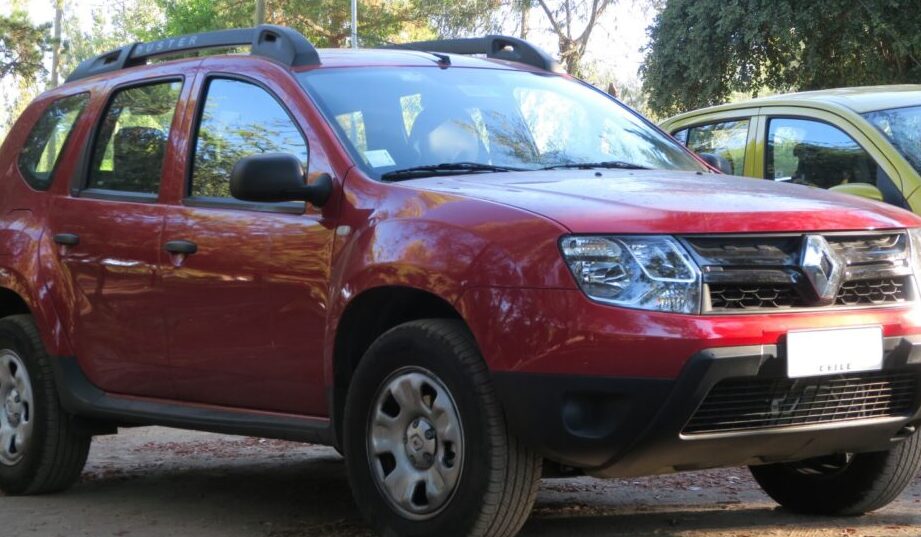
The Renault Duster I (facelift 2015) 1.6, producing 114 horsepower, represents a significant iteration of Renault’s popular budget-friendly SUV. Introduced in June 2015 and continuing through May 2021, this variant played a crucial role in the Duster’s success, particularly in markets outside of North America where the model gained considerable traction. Positioned as a mid-range offering within the Duster I lineup, it aimed to balance affordability with a reasonable level of performance and practicality. The facelift brought updated styling and minor mechanical refinements to the original Duster, which was based on the shared Dacia/Renault B0 platform.
Technical Specifications
| Brand | Renault |
| Model | Duster |
| Generation | Duster I (facelift 2015) |
| Type (Engine) | 1.6 (114 Hp) |
| Start of production | June, 2015 |
| End of production | May, 2021 |
| Powertrain Architecture | Internal Combustion engine |
| Body type | SUV |
| Seats | 5 |
| Doors | 5 |
| Fuel consumption (urban) | 9.3 l/100 km (25.3 US mpg) |
| Fuel consumption (extra urban) | 6.3 l/100 km (37.3 US mpg) |
| Fuel consumption (combined) | 7.4 l/100 km (31.8 US mpg) |
| CO2 emissions | 171 g/km |
| Fuel Type | Petrol (Gasoline) |
| Acceleration 0 – 100 km/h | 10.9 sec |
| Acceleration 0 – 62 mph | 10.9 sec |
| Acceleration 0 – 60 mph | 10.4 sec |
| Maximum speed | 167 km/h (103.77 mph) |
| Emission standard | Euro 5 |
| Weight-to-power ratio | 10.4 kg/Hp |
| Weight-to-torque ratio | 7.6 kg/Nm |
| Power | 114 Hp @ 5500 rpm |
| Torque | 156 Nm @ 4000 rpm (115.06 lb.-ft. @ 4000 rpm) |
| Engine layout | Front, Transverse |
| Engine Model/Code | H4M |
| Engine displacement | 1598 cm3 (97.52 cu. in.) |
| Number of cylinders | 4 |
| Engine configuration | Inline |
| Cylinder Bore | 78 mm (3.07 in.) |
| Piston Stroke | 83.6 mm (3.29 in.) |
| Compression ratio | 10.7:1 |
| Number of valves per cylinder | 4 |
| Fuel injection system | Multi-port manifold injection |
| Engine aspiration | Naturally aspirated engine |
| Engine oil capacity | 4.3 l (4.54 US qt | 3.78 UK qt) |
| Coolant capacity | 4.5 l (4.76 US qt | 3.96 UK qt) |
| Kerb Weight | 1190-1260 kg (2623.5 – 2777.82 lbs.) |
| Max. weight | 1716 kg (3783.13 lbs.) |
| Max load | 456-526 kg (1005.31 – 1159.63 lbs.) |
| Trunk (boot) space – minimum | 475 l (16.77 cu. ft.) |
| Trunk (boot) space – maximum | 1636 l (57.77 cu. ft.) |
| Fuel tank capacity | 50 l (13.21 US gal | 11 UK gal) |
| Permitted trailer load with brakes (12%) | 1500 kg (3306.93 lbs.) |
| Permitted trailer load without brakes | 680 kg (1499.14 lbs.) |
| Length | 4315 mm (169.88 in.) |
| Width | 1822 mm (71.73 in.) |
| Width including mirrors | 2000 mm (78.74 in.) |
| Height | 1695 mm (66.73 in.) |
| Wheelbase | 2674 mm (105.28 in.) |
| Front track | 1559 mm (61.38 in.) |
| Rear (Back) track | 1560 mm (61.42 in.) |
| Front overhang | 816 mm (32.13 in.) |
| Rear overhang | 825 mm (32.48 in.) |
| Ride height (ground clearance) | 205 mm (8.07 in.) |
| Approach angle | 29.3° |
| Departure angle | 34.9° |
| Ramp-over (brakeover) angle | 23° |
| Drivetrain Architecture | The Internal combustion engine (ICE) drives the front wheels of the vehicle. |
| Drive wheel | Front wheel drive |
| Number of gears and type of gearbox | 5 gears, manual transmission |
| Front suspension | Independent, type McPherson with coil spring and anti-roll bar |
| Rear suspension | Semi-independent, coil spring |
| Front brakes | Ventilated discs |
| Rear brakes | Drum |
| Assisting systems | ABS (Anti-lock braking system) |
| Steering type | Steering rack and pinion |
| Power steering | Electric Steering |
| Tires size | 215/65 R16 |
| Wheel rims size | 16 |
INTRODUCTION
The Renault Duster I (facelift 2015) 1.6, with its 114 horsepower output, was a mainstay of the Duster range from its introduction in June 2015 until its replacement in May 2021. This version of the Duster, built on the B0 platform shared with Dacia, was primarily aimed at markets in Europe, Latin America, and parts of Asia. It offered a practical and affordable SUV option, capitalizing on the growing demand for crossover vehicles. The 1.6-liter engine and five-speed manual transmission combination represented a sweet spot in the lineup, providing a balance between fuel efficiency and acceptable performance for everyday driving.
Powertrain & Engine Architecture
At the heart of the Duster 1.6 (114 Hp) lies the Renault H4M engine, a 1.6-liter inline-four cylinder petrol engine. This engine utilizes a multi-point fuel injection system, delivering fuel directly into the intake ports. The H4M engine features a single overhead camshaft (SOHC) design with four valves per cylinder, contributing to its relatively efficient operation. The engine’s 10.7:1 compression ratio further aids in maximizing power output and fuel economy. The engine is transversely mounted in the front of the vehicle. The standard transmission for this variant was a five-speed manual gearbox, designed for durability and ease of use. The gearbox’s ratios were tuned to provide adequate acceleration and cruising ability, though it wasn’t geared for particularly sporty performance.
Driving Characteristics
The driving experience in the Duster 1.6 (114 Hp) is best described as practical and unpretentious. Acceleration from 0-60 mph takes around 10.4 seconds, and top speed is approximately 103.77 mph. While not particularly quick, the engine provides sufficient power for everyday driving situations, including highway merging and overtaking. The five-speed manual transmission offers a decent spread of gears, allowing the driver to keep the engine in its optimal power band. Compared to higher-output versions of the Duster, such as those equipped with the 1.5 dCi diesel engine, the 1.6-liter petrol engine feels less responsive, particularly at lower RPMs. However, it offers a smoother and quieter driving experience than the diesel, and its linear power delivery makes it easy to control.
Equipment & Trim Levels
The Duster 1.6 (114 Hp) typically came equipped with a reasonable level of standard features. Basic trims included power steering, central locking, electric front windows, and an audio system with USB connectivity. Safety features such as ABS (Anti-lock Braking System) were also standard. Higher trim levels offered additional features like air conditioning, alloy wheels, rear parking sensors, and a more comprehensive infotainment system. Interior upholstery was typically cloth, with a durable and practical design. Optional extras included a navigation system, upgraded audio systems, and various styling enhancements.
Chassis & Braking
The Duster’s chassis is designed for robustness and affordability. The front suspension utilizes an independent McPherson strut setup, providing a comfortable ride and decent handling. The rear suspension employs a semi-independent coil spring arrangement, which is simpler and more cost-effective than a fully independent system. Braking duties are handled by ventilated discs at the front and drum brakes at the rear. While adequate for most driving conditions, the braking system isn’t particularly powerful. The Duster’s relatively high ground clearance of 205 mm (8.07 in.) contributes to its off-road capability, allowing it to tackle moderately challenging terrain.
Market Reception & Comparison
The Renault Duster 1.6 (114 Hp) was generally well-received by automotive critics as a value-for-money proposition. It was praised for its spacious interior, practical design, and affordable price point. However, some critics noted that the engine lacked refinement and that the interior materials were somewhat basic. Compared to other trims in the Duster lineup, the 1.6-liter petrol engine offered a more accessible entry point for buyers who prioritized affordability over performance. The diesel variants, while more expensive, provided superior fuel economy and torque. The 1.6L engine was often seen as a good compromise for drivers who didn’t require the extra power or fuel efficiency of the diesel.
Legacy
The Renault Duster I (facelift 2015) 1.6 (114 Hp) has proven to be a reliable and durable vehicle, with many examples still on the road today. The H4M engine is known for its robustness, although regular maintenance is essential to ensure its longevity. On the used car market, this variant of the Duster represents a particularly attractive option for budget-conscious buyers seeking a practical and spacious SUV. Its affordability, combined with its relatively simple mechanical design, makes it an easy and inexpensive vehicle to maintain. The Duster’s enduring popularity is a testament to its practicality and value, solidifying its place as a significant player in the affordable SUV segment.


