
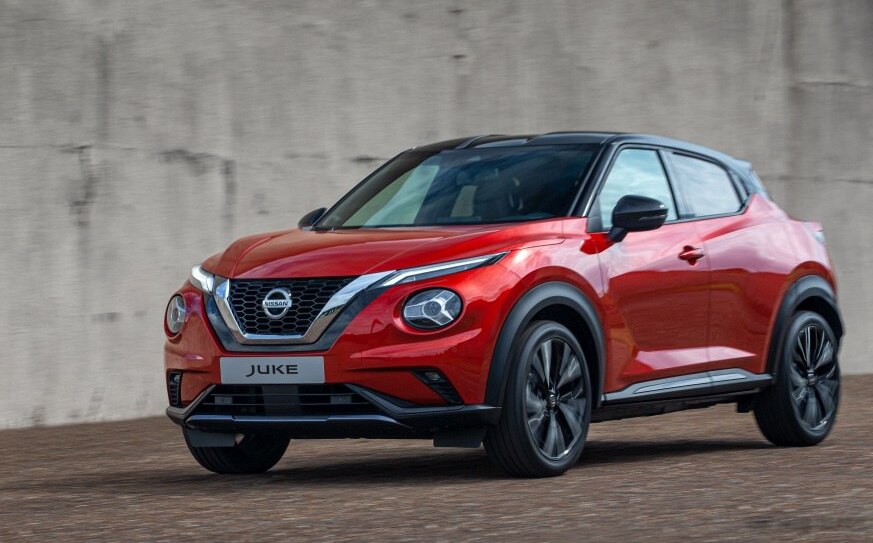
The Nissan Juke II 1.0 DIG-T (114 hp) DCT represents an entry point into the second generation of Nissan’s distinctive subcompact crossover. Introduced in November 2020 and continuing through March 2024, this variant played a significant role in attracting buyers seeking a stylish and fuel-efficient urban vehicle. It’s positioned within the Juke II range – built on the CMF-B platform – as a more accessible option compared to higher-trim levels featuring more powerful engines or advanced technology packages. This model aimed to balance affordability with the Juke’s signature bold design and modern features.
Technical Specifications
| Brand | Nissan |
| Model | Juke |
| Generation | Juke II |
| Type (Engine) | 1.0 DIG-T (114 Hp) DCT |
| Start of production | November, 2020 |
| End of production | March, 2024 |
| Powertrain Architecture | Internal Combustion engine |
| Body type | SUV, Crossover |
| Seats | 5 |
| Doors | 5 |
| Fuel consumption (economy) – urban | 5.7 l/100 km (41.3 US mpg, 49.6 UK mpg, 17.5 km/l) |
| Fuel consumption (economy) – extra urban | 4.6 l/100 km (51.1 US mpg, 61.4 UK mpg, 21.7 km/l) |
| Fuel consumption (economy) – combined | 5.0 l/100 km (47 US mpg, 56.5 UK mpg, 20 km/l) |
| CO2 emissions | 114 g/km |
| Fuel Type | Petrol (Gasoline) |
| Acceleration 0 – 100 km/h | 11.8 sec |
| Acceleration 0 – 62 mph | 11.8 sec |
| Acceleration 0 – 60 mph | 11.2 sec |
| Maximum speed | 180 km/h (111.85 mph) |
| Emission standard | Euro 6d-ISC-FCM |
| Weight-to-power ratio | 10.6 kg/Hp, 94.1 Hp/tonne |
| Weight-to-torque ratio | 6.1 kg/Nm, 165.2 Nm/tonne |
| Power | 114 Hp @ 5000 rpm |
| Power per litre | 114.1 Hp/l |
| Torque | 200 Nm @ 3000 rpm (147.51 lb.-ft. @ 3000 rpm) |
| Engine layout | Front, Transverse |
| Engine Model/Code | HR10DDT |
| Engine displacement | 999 cm3 (60.96 cu. in.) |
| Number of cylinders | 3 |
| Engine configuration | Inline |
| Cylinder Bore | 72.2 mm (2.84 in.) |
| Piston Stroke | 81.3 mm (3.2 in.) |
| Compression ratio | 10.5:1 |
| Number of valves per cylinder | 4 |
| Fuel injection system | Direct injection |
| Engine aspiration | Turbocharger, Intercooler |
| Engine oil capacity | 4.1 l (4.33 US qt | 3.61 UK qt) |
| Coolant | 6.5 l (6.87 US qt | 5.72 UK qt) |
| Kerb Weight | 1211-1268 kg (2669.8 – 2795.46 lbs.) |
| Max. weight | 1725 kg (3802.97 lbs.) |
| Max load | 457-514 kg (1007.51 – 1133.18 lbs.) |
| Trunk (boot) space – minimum | 422 l (14.9 cu. ft.) |
| Trunk (boot) space – maximum | 1305 l (46.09 cu. ft.) |
| Fuel tank capacity | 46 l (12.15 US gal | 10.12 UK gal) |
| Permitted trailer load with brakes (12%) | 1250 kg (2755.78 lbs.) |
| Permitted trailer load without brakes | 643 kg (1417.57 lbs.) |
| Permitted towbar download | 75 kg (165.35 lbs.) |
| Length | 4210 mm (165.75 in.) |
| Width | 1800 mm (70.87 in.) |
| Width including mirrors | 1983 mm (78.07 in.) |
| Height | 1595 mm (62.8 in.) |
| Wheelbase | 2636 mm (103.78 in.) |
| Minimum turning circle | 10.57 m (34.68 ft.) |
| Drivetrain Architecture | Front wheel drive |
| Number of gears and type of gearbox | 7 gears, automatic transmission DCT |
| Front suspension | Independent type McPherson |
| Rear suspension | Semi-independent, coil spring |
| Front brakes | Ventilated discs |
| Rear brakes | Disc |
| Tires size | 215/60 R17; 225/45 R19 |
| Wheel rims size | 7.0J x 17; 7.0J x 19 |
INTRODUCTION
The Nissan Juke II 1.0 DIG-T (114 hp) DCT, launched in late 2020, marked a significant redesign for Nissan’s popular subcompact crossover. The second-generation Juke moved to the CMF-B platform, shared with other Renault-Nissan-Mitsubishi Alliance vehicles, offering improved rigidity and updated technology. This particular variant, powered by the HR10DDT 1.0-liter turbocharged three-cylinder engine paired with a 7-speed dual-clutch transmission (DCT), was intended to provide a balance of fuel efficiency, affordability, and modern driving experience. It served as the entry-level powertrain option in many European and Asian markets, appealing to buyers prioritizing economy and ease of use over outright performance.
Powertrain & Engine Architecture
At the heart of the Juke II 1.0 DIG-T lies the HR10DDT, a 999cc three-cylinder gasoline engine. This engine utilizes direct fuel injection and a turbocharger with an intercooler to deliver 114 horsepower at 5000 rpm and 200 Nm (147.51 lb-ft) of torque at 3000 rpm. The engine’s compact size and lightweight construction contribute to the Juke’s overall efficiency. The HR10DDT engine is known for its relatively smooth operation for a three-cylinder unit, thanks to careful engineering and balancing. The 7-speed Dual Clutch Transmission (DCT) provides quick and seamless gear changes, enhancing the driving experience and contributing to improved fuel economy. The DCT operates with both automatic and manual shift modes, allowing drivers to choose their preferred driving style. The engine also incorporates a Start & Stop System and a particulate filter to reduce emissions, meeting Euro 6d-ISC-FCM standards.
Driving Characteristics
The 114 hp 1.0 DIG-T with the DCT delivers adequate performance for urban and highway driving, though it’s not designed for spirited acceleration. The 0-60 mph time of around 11.2 seconds reflects this. The DCT transmission helps to maximize the available power, providing responsive shifts and keeping the engine within its optimal torque band. Compared to higher-output Juke II variants (like those with the 1.6L engine), this version feels less powerful, particularly when fully loaded or tackling steep inclines. The gear ratios are tuned for fuel efficiency, meaning the engine can feel slightly strained at higher speeds. However, the DCT’s quick shifts and the engine’s turbo boost provide sufficient power for overtaking maneuvers. The front-wheel-drive configuration offers predictable handling, and the relatively lightweight nature of the vehicle contributes to its agility.
Equipment & Trim Levels
The Juke II 1.0 DIG-T (114 hp) DCT typically came equipped with a respectable level of standard features. These generally included air conditioning, a touchscreen infotainment system with Apple CarPlay and Android Auto compatibility, Bluetooth connectivity, and a suite of safety features such as automatic emergency braking, lane departure warning, and traffic sign recognition. Interior upholstery was typically cloth, with a focus on durability and practicality. Higher trim levels offered upgrades such as leather seats, a larger touchscreen display, a premium sound system, and additional driver-assistance technologies. Optional extras included a panoramic sunroof, heated seats, and parking sensors.
Chassis & Braking
The Juke II utilizes an independent McPherson strut suspension at the front and a semi-independent coil spring suspension at the rear. This setup provides a comfortable ride quality, absorbing bumps and imperfections in the road surface effectively. The front brakes are ventilated discs, while the rear brakes are solid discs, providing adequate stopping power for the vehicle’s weight and performance. Electric power steering offers light and precise steering feel, making it easy to maneuver in tight spaces. Stabilizer bars are fitted to both the front and rear axles to reduce body roll during cornering.
Market Reception & Comparison
The Nissan Juke II 1.0 DIG-T (114 hp) DCT was generally well-received by critics as a practical and efficient urban crossover. Reviewers praised its stylish design, comfortable interior, and fuel economy. However, some noted that the engine could feel underpowered, particularly when compared to rivals offering more powerful engines. Compared to other Juke II trims, such as those with the 1.6-liter engine, this variant offered a more affordable entry point but sacrificed some performance. In terms of fuel economy, it performed competitively against similar subcompact crossovers, achieving around 47 US mpg on combined cycles. Reliability reports have been generally positive, with the HR10DDT engine proving to be a relatively robust unit.
Legacy
The Nissan Juke II 1.0 DIG-T (114 hp) DCT has established itself as a popular choice in the used car market, particularly for buyers seeking an affordable and fuel-efficient crossover. The HR10DDT engine and DCT transmission have proven to be relatively reliable, although regular maintenance is essential to ensure long-term durability. The Juke II’s distinctive styling and modern features continue to appeal to a wide range of buyers, and this variant remains a viable option for those prioritizing economy and practicality.


