
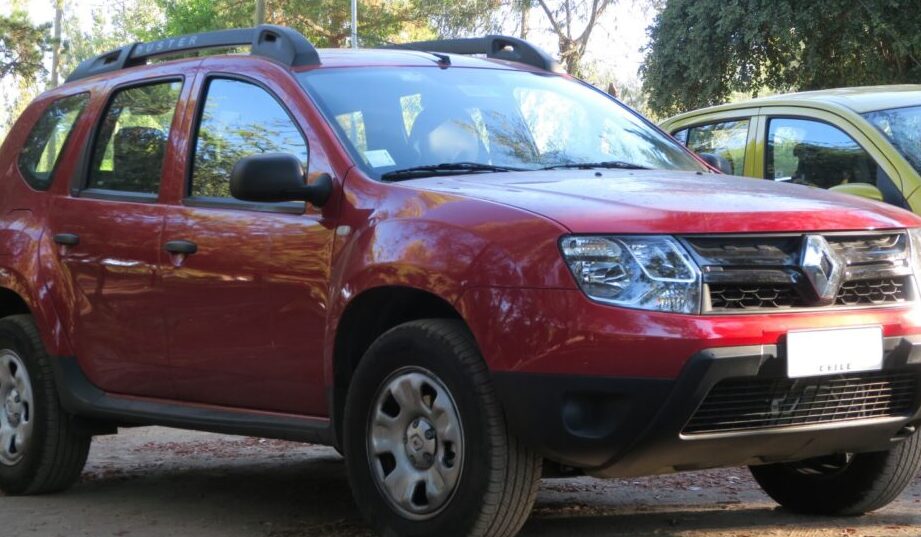
The Renault Duster I (facelift 2015) 1.6 16V, producing 105 horsepower, was a key variant within the first generation of Renault’s popular compact SUV. Introduced in June 2015 and continuing through May 2021, this model served as a core offering in many European and emerging markets, particularly where affordability and practicality were prioritized. It was positioned as an entry-level to mid-range trim, offering a balance between cost and functionality within the Duster lineup. The facelift brought updated styling and minor equipment revisions to the original Duster, enhancing its appeal.
Technical Specifications
| Brand | Renault |
| Model | Duster |
| Generation | Duster I (facelift 2015) |
| Type (Engine) | 1.6 16V (105 Hp) |
| Start of production | June, 2015 |
| End of production | May, 2021 |
| Powertrain Architecture | Internal Combustion engine |
| Body type | SUV |
| Seats | 5 |
| Doors | 5 |
| Fuel consumption (urban) | 9.9 l/100 km (23.8 US mpg, 28.5 UK mpg, 10.1 km/l) |
| Fuel consumption (extra urban) | 6.6 l/100 km (35.6 US mpg, 42.8 UK mpg, 15.2 km/l) |
| Fuel consumption (combined) | 7.6 l/100 km (30.9 US mpg, 37.2 UK mpg, 13.2 km/l) |
| CO2 emissions | 181 g/km |
| Fuel Type | Petrol (Gasoline) |
| Acceleration 0 – 100 km/h | 11.5 sec |
| Acceleration 0 – 62 mph | 11.5 sec |
| Acceleration 0 – 60 mph | 10.9 sec |
| Maximum speed | 165 km/h (102.53 mph) |
| Emission standard | Euro 4 |
| Weight-to-power ratio | 11.2 kg/Hp, 89.7 Hp/tonne |
| Weight-to-torque ratio | 7.9 kg/Nm, 126.4 Nm/tonne |
| Power | 105 Hp @ 5750 rpm |
| Power per litre | 65.7 Hp/l |
| Torque | 148 Nm @ 3750 rpm (109.16 lb.-ft. @ 3750 rpm) |
| Engine layout | Front, Transverse |
| Engine Model/Code | K4M |
| Engine displacement | 1598 cm3 (97.52 cu. in.) |
| Number of cylinders | 4 |
| Engine configuration | Inline |
| Cylinder Bore | 79.5 mm (3.13 in.) |
| Piston Stroke | 80.5 mm (3.17 in.) |
| Compression ratio | 9.8:1 |
| Number of valves per cylinder | 4 |
| Fuel injection system | Multi-port manifold injection |
| Engine aspiration | Naturally aspirated engine |
| Valvetrain | DOHC |
| Engine oil capacity | 4.5 l (4.76 US qt | 3.96 UK qt) |
| Coolant | 4.5 l (4.76 US qt | 3.96 UK qt) |
| Kerb Weight | 1171 kg (2581.61 lbs.) |
| Max. weight | 1721 kg (3794.16 lbs.) |
| Max load | 550 kg (1212.54 lbs.) |
| Trunk (boot) space – minimum | 475 l (16.77 cu. ft.) |
| Trunk (boot) space – maximum | 1636 l (57.77 cu. ft.) |
| Fuel tank capacity | 50 l (13.21 US gal | 11 UK gal) |
| Permitted trailer load with brakes (12%) | 1200 kg (2645.55 lbs.) |
| Permitted trailer load without brakes | 620 kg (1366.87 lbs.) |
| Length | 4315 mm (169.88 in.) |
| Width | 1822 mm (71.73 in.) |
| Width including mirrors | 2000 mm (78.74 in.) |
| Height | 1695 mm (66.73 in.) |
| Wheelbase | 2674 mm (105.28 in.) |
| Front track | 1559 mm (61.38 in.) |
| Rear (Back) track | 1560 mm (61.42 in.) |
| Front overhang | 816 mm (32.13 in.) |
| Rear overhang | 825 mm (32.48 in.) |
| Ride height (ground clearance) | 205 mm (8.07 in.) |
| Minimum turning circle (turning diameter) | 10.76 m (35.3 ft.) |
| Approach angle | 29.3° |
| Departure angle | 34.9° |
| Ramp-over (brakeover) angle | 23° |
| Drivetrain Architecture | The Internal combustion engine (ICE) drives the front wheels of the vehicle. |
| Drive wheel | Front wheel drive |
| Number of gears and type of gearbox | 5 gears, manual transmission |
| Front suspension | Independent, type McPherson with coil spring and anti-roll bar |
| Rear suspension | Semi-independent, coil spring |
| Front brakes | Ventilated discs |
| Rear brakes | Drum |
| Assisting systems | ABS (Anti-lock braking system) |
| Steering type | Steering rack and pinion |
| Power steering | Electric Steering |
| Tires size | 215/65 R16 |
| Wheel rims size | 6.5J x 16 |
Powertrain & Engine Architecture
The Renault Duster 1.6 16V utilized the K4M engine, a naturally aspirated, inline-four cylinder petrol engine. This engine was a mainstay in Renault’s lineup for many years, known for its relative simplicity and durability. The 1598cc engine featured a multi-point fuel injection system and a double overhead camshaft (DOHC) valvetrain, contributing to reasonable performance for its displacement. The 105 horsepower output was achieved at 5750 rpm, with a peak torque of 148 Nm (109.16 lb-ft) delivered at 3750 rpm. The engine’s design prioritized fuel efficiency and ease of maintenance over outright power. The standard transmission was a five-speed manual gearbox, designed to maximize fuel economy and provide adequate acceleration for everyday driving.
Driving Characteristics
The 1.6 16V Duster, paired with the five-speed manual transmission, offered a practical, if not particularly exciting, driving experience. Acceleration from 0-100 km/h took approximately 11.5 seconds, making it suitable for urban and highway driving, but not for spirited performance. The gear ratios were tuned for fuel efficiency, meaning the engine needed to be revved to access its full power potential. Compared to higher-output versions of the Duster, such as those equipped with the 1.5 dCi diesel engine, the 1.6 petrol felt less responsive, especially when fully loaded. However, the petrol engine offered a smoother and quieter operation than the diesel, and its lighter weight contributed to slightly better handling.
Equipment & Trim Levels
The 1.6 16V Duster typically came with a base level of equipment, focusing on essential features. Standard amenities included power steering, central locking, electric front windows, and an AM/FM radio with USB connectivity. Safety features such as ABS (Anti-lock Braking System) were also standard. Higher trim levels offered options like air conditioning, alloy wheels, a more advanced audio system, and rear parking sensors. Interior upholstery was typically cloth, with a durable and practical design. The dashboard layout was functional and straightforward, prioritizing ease of use over aesthetic flair.
Chassis & Braking
The Duster’s chassis was designed to provide a comfortable ride and reasonable handling capabilities. The front suspension utilized an independent McPherson strut setup, while the rear suspension employed a semi-independent coil spring arrangement. This configuration provided a good balance between ride comfort and stability. The braking system consisted of ventilated discs on the front wheels and drum brakes on the rear. While adequate for everyday driving, the rear drum brakes were a cost-saving measure and didn’t offer the same stopping power as disc brakes on all four wheels. The Duster’s relatively high ground clearance of 205mm (8.07 inches) made it well-suited for tackling rough roads and uneven terrain.
Market Reception & Comparison
The Renault Duster 1.6 16V was generally well-received in markets where affordability was a key consideration. Critics praised its spacious interior, practical design, and robust build quality. However, the engine’s performance was often cited as a weakness, particularly when compared to the more powerful diesel options. Fuel economy was considered average for its class, and reliability was generally good, although some owners reported minor issues with the engine’s cooling system. Compared to the 1.5 dCi diesel, the 1.6 petrol offered a lower purchase price but higher running costs due to its lower fuel efficiency.
Legacy
The Renault Duster 1.6 16V remains a popular choice in the used car market, particularly in regions where it was originally sold. Its simple engine design and relatively low maintenance costs make it an attractive option for budget-conscious buyers. While not known for its performance, the K4M engine has proven to be reasonably durable over the long term. The Duster’s overall practicality and affordability have cemented its position as a value-for-money SUV, and the 1.6 16V variant continues to offer a viable transportation solution for those seeking a reliable and economical vehicle.


