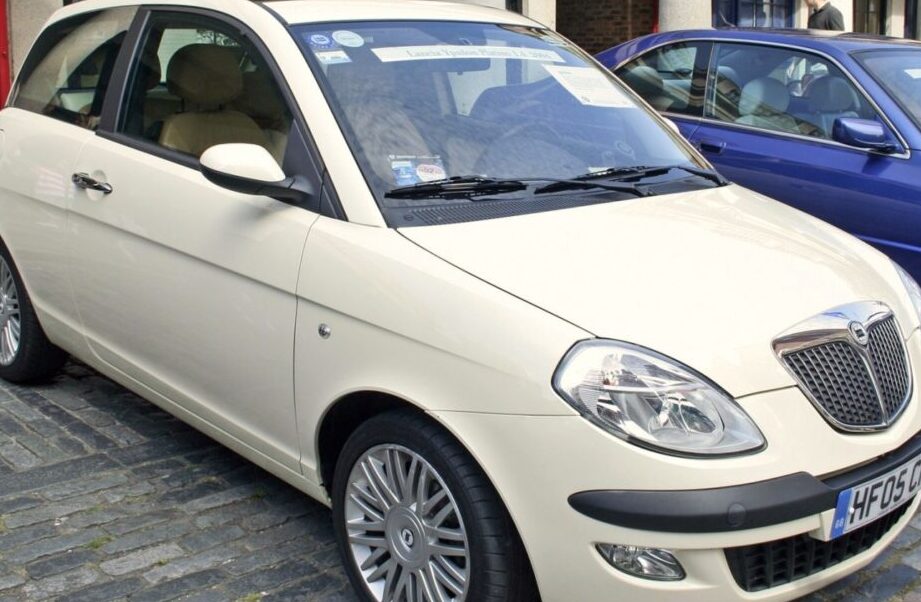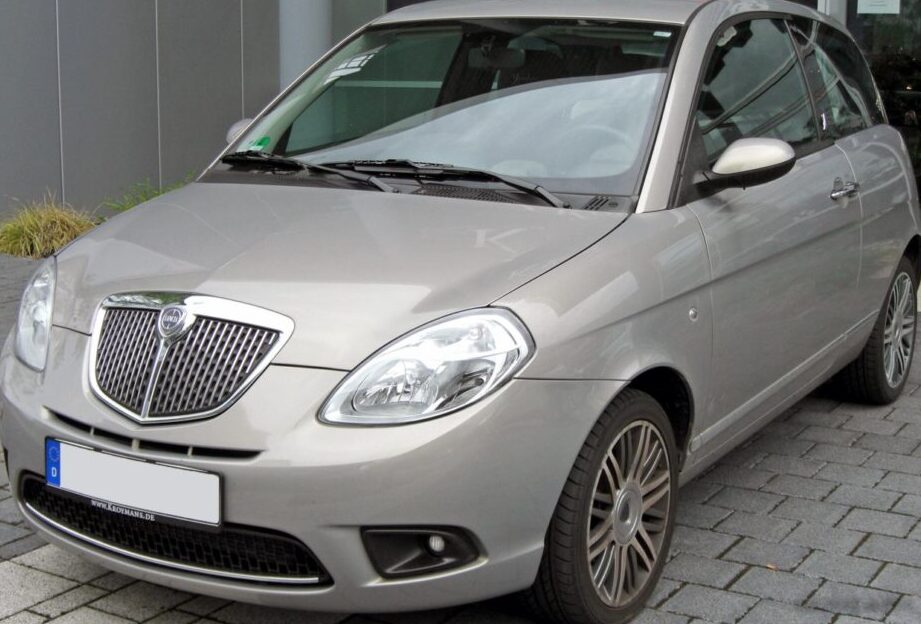
The Lancia Ypsilon (843 series, post-facelift introduced in 2006) 1.2 8V, producing 69 horsepower, represents an entry-level offering within the third generation of Lancia’s popular city car. Production of this specific variant ran from August 2010 to November 2011. Positioned as the most economical and accessible version of the Ypsilon, it catered to buyers prioritizing fuel efficiency and affordability over outright performance. The 843 series Ypsilon, a rebadged Fiat 500, was primarily marketed in Italy and other European countries, embodying Lancia’s focus on stylish, compact vehicles. This model played a crucial role in maintaining Lancia’s presence in the competitive supermini segment.
Technical Specifications
| Brand | Lancia |
| Model | Ypsilon |
| Generation | Ypsilon (843, facelift 2006) |
| Type (Engine) | 1.2 8V (69 Hp) |
| Start of production | August, 2010 |
| End of production | November, 2011 |
| Powertrain Architecture | Internal Combustion engine |
| Body type | Hatchback |
| Seats | 4 |
| Doors | 3 |
| Fuel consumption (urban) | 6.5 l/100 km (36.2 US mpg, 43.5 UK mpg, 15.4 km/l) |
| Fuel consumption (extra urban) | 4 l/100 km (58.8 US mpg, 70.6 UK mpg, 25 km/l) |
| Fuel consumption (combined) | 4.9 l/100 km (48 US mpg, 57.6 UK mpg, 20.4 km/l) |
| CO2 emissions | 114 g/km |
| Fuel Type | Petrol (Gasoline) |
| Acceleration 0 – 100 km/h | 15.8 sec |
| Acceleration 0 – 62 mph | 15.8 sec |
| Acceleration 0 – 60 mph | 15 sec |
| Maximum speed | 160 km/h (99.42 mph) |
| Emission standard | Euro 5 |
| Weight-to-power ratio | 13.7 kg/Hp |
| Weight-to-torque ratio | 9.3 kg/Nm |
| Power | 69 Hp @ 5500 rpm |
| Power per litre | 55.6 Hp/l |
| Torque | 102 Nm @ 3000 rpm (75.23 lb.-ft. @ 3000 rpm) |
| Engine layout | Front, Transverse |
| Engine Model/Code | 169A5000 |
| Engine displacement | 1242 cm3 (75.79 cu. in.) |
| Number of cylinders | 4 |
| Engine configuration | Inline |
| Cylinder Bore | 70.8 mm (2.79 in.) |
| Piston Stroke | 78.86 mm (3.1 in.) |
| Compression ratio | 11:1 |
| Number of valves per cylinder | 2 |
| Fuel injection system | Multi-port manifold injection |
| Engine aspiration | Naturally aspirated |
| Valvetrain | SOHC |
| Engine oil capacity | 2.7 l (2.85 US qt | 2.38 UK qt) |
| Coolant capacity | 4.8 l (5.07 US qt | 4.22 UK qt) |
| Kerb Weight | 945 kg (2083.37 lbs.) |
| Max. weight | 1460 kg (3218.75 lbs.) |
| Max load | 515 kg (1135.38 lbs.) |
| Trunk (boot) space (minimum) | 215 l (7.59 cu. ft.) |
| Fuel tank capacity | 47 l (12.42 US gal | 10.34 UK gal) |
| Max. roof load | 75 kg (165.35 lbs.) |
| Permitted trailer load (with brakes) | 750 kg (1653.47 lbs.) |
| Permitted trailer load (without brakes) | 400 kg (881.85 lbs.) |
| Permitted towbar download | 60 kg (132.28 lbs.) |
| Length | 3810 mm (150 in.) |
| Width | 1704 mm (67.09 in.) |
| Height | 1530 mm (60.24 in.) |
| Wheelbase | 2388 mm (94.02 in.) |
| Front track | 1450 mm (57.09 in.) |
| Rear track | 1440 mm (56.69 in.) |
| Front overhang | 819 mm (32.24 in.) |
| Rear overhang | 603 mm (23.74 in.) |
| Minimum turning circle | 10.49 m (34.42 ft.) |
| Drivetrain | Front wheel drive |
| Number of gears | 5 |
| Gearbox type | Manual transmission |
| Front suspension | Independent, McPherson with coil spring and anti-roll bar |
| Rear suspension | Torsion bar, Transverse stabilizer |
| Front brakes | Disc, 257×12 mm |
| Rear brakes | Drum, 203×38 mm |
| Assisting systems | ABS (Anti-lock braking system) |
| Steering type | Steering rack and pinion |
| Power steering | Electric |
| Tires size | 185/65 R14; 195/55 R15; 195/45 R16 |
| Wheel rims size | 6J x 14; 6J x 15; 6.5J x 16 |
INTRODUCTION
The Lancia Ypsilon 1.2 8V (69 Hp) was a key component of the 843 series facelift, launched in 2006. This iteration of the Ypsilon, built on the Fiat/Lancia 1HX0/A3 platform, aimed to provide an affordable and economical entry point into the Lancia brand. The facelift brought subtle styling updates and improvements to the interior, but the core mechanicals remained largely unchanged. This variant was specifically designed for urban driving, prioritizing fuel efficiency and ease of use over sporty performance. It was a popular choice for first-time car buyers, city dwellers, and those seeking a stylish and practical supermini.
Powertrain & Engine Architecture
At the heart of the Ypsilon 1.2 8V is the 169A5000 engine, a 1.2-liter inline-four cylinder petrol engine. This engine, a staple in many Fiat and Lancia models, features a single overhead camshaft (SOHC) and two valves per cylinder. The engine utilizes a multi-port fuel injection system, delivering fuel directly into the intake manifold. The 69 horsepower output is achieved at 5500 rpm, with a torque figure of 102 Nm (75.23 lb.-ft.) available at 3000 rpm. The engine’s relatively simple design contributes to its reliability and ease of maintenance. The Ypsilon 1.2 8V was exclusively offered with a five-speed manual transmission, optimized for fuel economy and smooth operation. The transmission’s gear ratios are geared towards maximizing efficiency in urban environments, with a relatively tall final drive.
Driving Characteristics
The Ypsilon 1.2 8V offers a predictable and undemanding driving experience. Acceleration is modest, taking approximately 15.8 seconds to reach 62 mph (100 km/h). The engine feels most comfortable in the lower to mid-range of the rev band, providing adequate power for city driving and short highway journeys. Compared to higher-output versions of the Ypsilon, such as those equipped with the 1.4-liter engine, the 1.2 8V feels noticeably slower. However, the manual transmission allows for precise control and efficient gear changes. The steering is light and responsive, making maneuvering in tight spaces easy. The suspension is tuned for comfort, absorbing bumps and imperfections in the road surface effectively.
Equipment & Trim Levels
The Ypsilon 1.2 8V typically came equipped with a basic but functional set of features. Standard equipment generally included power steering, central locking, electric front windows, and an audio system. Interior upholstery was typically cloth, with a simple and durable design. Optional extras included air conditioning, alloy wheels, and a more advanced audio system. Higher trim levels offered additional features such as a leather-wrapped steering wheel, upgraded interior trim, and fog lights. The dashboard layout was straightforward and user-friendly, with clearly labeled controls.
Chassis & Braking
The Ypsilon 1.2 8V utilizes a front-wheel-drive layout with an independent McPherson strut suspension at the front and a torsion bar suspension at the rear. This setup provides a good balance between ride comfort and handling. The front brakes are disc brakes, while the rear brakes are drum brakes. ABS (Anti-lock Braking System) was standard equipment, enhancing safety and stability during braking. The relatively lightweight construction of the Ypsilon contributes to its nimble handling characteristics. Stabilizer bars were fitted to both the front and rear axles to reduce body roll during cornering.
Market Reception & Comparison
The Lancia Ypsilon 1.2 8V was generally well-received by critics as an affordable and practical city car. Its fuel efficiency and low running costs were particularly praised. However, its modest performance was often cited as a drawback. Compared to other trims in the Ypsilon lineup, such as the 1.4-liter versions, the 1.2 8V offered a more economical option but at the expense of performance. Against competitors like the Fiat Panda and Renault Twingo, the Ypsilon 1.2 8V offered a more stylish and refined interior, but often at a slightly higher price point.
Legacy
The Lancia Ypsilon 1.2 8V has proven to be a relatively reliable and durable vehicle. The 169A5000 engine is known for its longevity, provided it is properly maintained. In the used car market, these Ypsilons are often sought after by buyers looking for an affordable and economical city car. While not a performance icon, the Ypsilon 1.2 8V represents a practical and stylish option for those prioritizing fuel efficiency and ease of use. Its simple mechanicals make it relatively easy and inexpensive to repair, contributing to its continued popularity among budget-conscious buyers.