
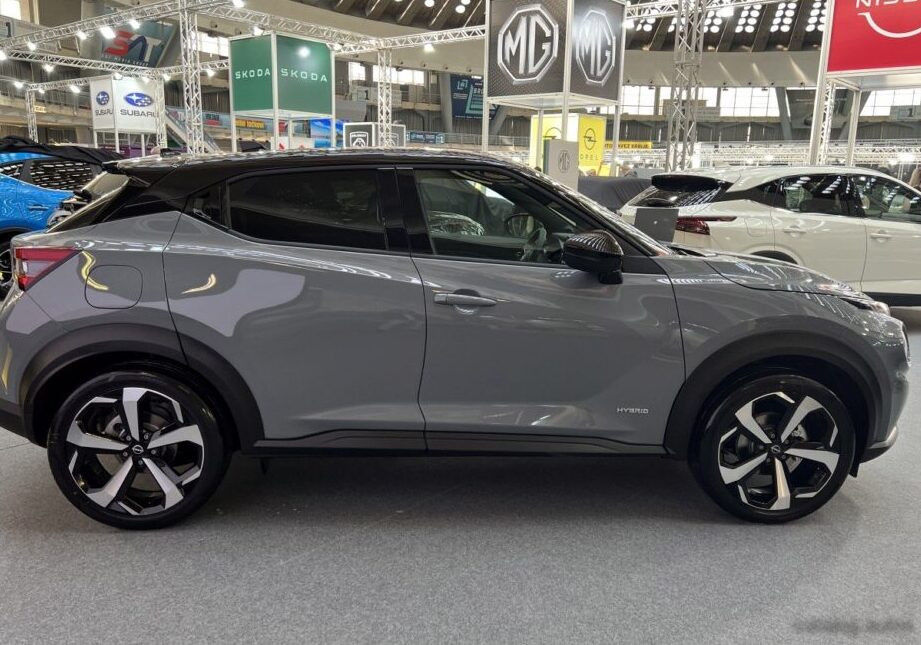
The Nissan Juke II 1.6 Hybrid Automatic, launched in June 2022 and produced through March 2024, represents Nissan’s entry into the hybrid crossover market with its second-generation Juke. This variant utilizes a full hybrid electric vehicle (FHEV) powertrain, combining a 1.6-liter gasoline engine with an electric motor to deliver improved fuel efficiency and reduced emissions. Positioned as a mainstream offering within the Juke II lineup, it aimed to appeal to buyers seeking a practical, stylish, and economical compact SUV. The Juke II is built on the CMF-B platform, shared with other Renault-Nissan-Mitsubishi Alliance vehicles.
Technical Specifications
| Brand | Nissan |
| Model | Juke |
| Generation | Juke II |
| Type (Engine) | 1.6 (143 Hp) Hybrid Automatic |
| Start of production | June, 2022 |
| End of production | March, 2024 |
| Powertrain Architecture | FHEV (Full Hybrid Electric Vehicle) |
| Body type | SUV, Crossover |
| Seats | 5 |
| Doors | 5 |
| Fuel consumption at Low speed (WLTP) | 4.9-5 l/100 km (48 – 47 US mpg, 57.6 – 56.5 UK mpg, 20.4 – 20 km/l) |
| Fuel consumption at Medium speed (WLTP) | 4.4 l/100 km (53.5 US mpg, 64.2 UK mpg, 22.7 km/l) |
| Fuel consumption at high speed (WLTP) | 4.5 l/100 km (52.3 US mpg, 62.8 UK mpg, 22.2 km/l) |
| Fuel consumption at very high speed (WLTP) | 5.9-6 l/100 km (39.9 – 39.2 US mpg, 47.9 – 47.1 UK mpg, 16.9 – 16.7 km/l) |
| Combined fuel consumption (WLTP) | 5-5.1 l/100 km (47 – 46.1 US mpg, 56.5 – 55.4 UK mpg, 20 – 19.6 km/l) |
| CO2 emissions (WLTP) | 114-115 g/km |
| Fuel Type | Petrol (Gasoline) |
| Acceleration 0 – 100 km/h | 10.1 sec |
| Acceleration 0 – 62 mph | 10.1 sec |
| Acceleration 0 – 60 mph | 9.6 sec |
| Maximum speed | 166 km/h (103.15 mph) |
| Emission standard | Euro 6d-ISC-FCM |
| Weight-to-power ratio | 9 kg/Hp, 111.1 Hp/tonne |
| Weight-to-torque ratio | 8.7 kg/Nm, 115 Nm/tonne |
| Gross battery capacity | 1.2 kWh |
| Battery technology | Lithium-ion (Li-Ion) |
| Max speed (electric) | 55 km/h (34.18 mph) |
| Electric motor power | 49 Hp |
| Electric motor Torque | 205 Nm (151.2 lb.-ft.) |
| Electric motor location | Integrated into the transmission |
| System power | 143 Hp |
| System torque | 148 Nm @ 3600 rpm (109.16 lb.-ft. @ 3600 rpm) |
| Power | 94 Hp |
| Power per litre | 58.8 Hp/l |
| Torque | 148 Nm (109.16 lb.-ft.) |
| Engine layout | Front, Transverse |
| Engine Model/Code | HR16DE |
| Engine displacement | 1598 cm3 (97.52 cu. in.) |
| Number of cylinders | 4 |
| Engine configuration | Inline |
| Compression ratio | 10.5:1 |
| Number of valves per cylinder | 4 |
| Fuel injection system | Multi-port manifold injection |
| Engine aspiration | Naturally aspirated engine |
| Engine oil capacity | 4.8 l (5.07 US qt | 4.22 UK qt) |
| Coolant | 6.9 l (7.29 US qt | 6.07 UK qt) |
| Kerb Weight | 1287-1296 kg (2837.35 – 2857.19 lbs.) |
| Max. weight | 1735 kg (3825.02 lbs.) |
| Max load | 439-448 kg (967.83 – 987.67 lbs.) |
| Trunk (boot) space – minimum | 354 l (12.5 cu. ft.) |
| Trunk (boot) space – maximum | 1237 l (43.68 cu. ft.) |
| Fuel tank capacity | 46 l (12.15 US gal | 10.12 UK gal) |
| Permitted trailer load with brakes (12%) | 750 kg (1653.47 lbs.) |
| Permitted trailer load without brakes | 500 kg (1102.31 lbs.) |
| Permitted towbar download | 75 kg (165.35 lbs.) |
| Length | 4210 mm (165.75 in.) |
| Width | 1800 mm (70.87 in.) |
| Width including mirrors | 1983 mm (78.07 in.) |
| Height | 1595 mm (62.8 in.) |
| Wheelbase | 2636 mm (103.78 in.) |
| Minimum turning circle (turning diameter) | 10.57 m (34.68 ft.) |
| Drivetrain Architecture | The Internal combustion engine (ICE) and electric motor drive the front wheels of the car with the ability to work in full electric or mixed mode. |
| Drive wheel | Front wheel drive |
| Number of gears and type of gearbox | 4 gears, automatic transmission AMT |
| Front suspension | Independent type McPherson |
| Rear suspension | Semi-independent, coil spring |
| Front brakes | Ventilated discs |
| Rear brakes | Disc |
| Assisting systems | ABS (Anti-lock braking system) |
| Steering type | Steering rack and pinion |
| Power steering | Electric Steering |
| Tires size | 215/60 R17; 225/45 R19 |
| Wheel rims size | 7.0J x 17; 7.0J x 19 |
Powertrain & Engine Architecture
The heart of the Juke II Hybrid is the HR16DE 1.6-liter inline-four cylinder gasoline engine. This engine produces 94 horsepower and 148 Nm (109.16 lb.-ft.) of torque. It utilizes multi-port fuel injection and a compression ratio of 10.5:1. The engine is paired with a 49 horsepower electric motor, integrated with an automatic transmission. The combined system output is 143 horsepower and 148 Nm (109.16 lb.-ft.) of torque. The transmission is an automatic with 4 forward gears. The hybrid system allows for electric-only driving at lower speeds and assists the gasoline engine during acceleration, contributing to improved fuel economy. The 1.2 kWh lithium-ion battery pack is relatively small, prioritizing weight savings over extended electric-only range.
Driving Characteristics
The Juke II 1.6 Hybrid Automatic offers a comfortable and refined driving experience, particularly in urban environments. The electric motor provides instant torque, resulting in brisk acceleration from a standstill. While the 0-60 mph time of around 9.6 seconds isn’t particularly quick, the hybrid system delivers adequate performance for everyday driving. The automatic transmission provides smooth gear changes, although it isn’t as responsive as some dual-clutch transmissions. Compared to the standard gasoline-powered Juke, the hybrid variant offers quieter operation and improved fuel economy. The hybrid system prioritizes efficiency, so the engine can sometimes feel strained during aggressive acceleration. The relatively small battery pack limits the distance that can be traveled on electric power alone, typically only a few miles.
Equipment & Trim Levels
The Juke II 1.6 Hybrid Automatic was typically offered in well-equipped trim levels. Standard features generally included automatic climate control, a touchscreen infotainment system with Apple CarPlay and Android Auto compatibility, and a suite of safety features such as automatic emergency braking, lane departure warning, and traffic sign recognition. Higher trim levels added features like a premium audio system, heated seats, and a 360-degree camera system. Interior upholstery was typically cloth or a combination of cloth and synthetic leather. Optional extras included a panoramic sunroof and metallic paint finishes.
Chassis & Braking
The Juke II utilizes a McPherson strut front suspension and a semi-independent coil spring rear suspension. This setup provides a comfortable ride quality, although it isn’t as sporty as some competitors. The front brakes are ventilated discs, while the rear brakes are solid discs. ABS (Anti-lock Braking System) is standard. The steering is electric power-assisted, providing light and precise steering feel. The Juke II’s chassis is tuned for comfort and practicality, rather than outright performance. The weight distribution is fairly balanced, contributing to stable handling.
Market Reception & Comparison
The Nissan Juke II 1.6 Hybrid Automatic was generally well-received by critics, who praised its fuel efficiency, comfortable ride, and stylish design. However, some reviewers noted that its performance wasn’t particularly exciting and that the interior materials could be improved. Compared to the standard gasoline-powered Juke, the hybrid variant offered significantly better fuel economy, but at a higher price point. Compared to other hybrid crossovers in its class, such as the Toyota C-HR, the Juke II offered a more affordable entry point, but lacked the Toyota’s reputation for reliability.
Legacy
The Nissan Juke II 1.6 Hybrid Automatic represents Nissan’s commitment to electrification and its efforts to offer more fuel-efficient vehicles. While it’s still relatively new to the market, early reports suggest that the hybrid powertrain is proving to be reliable. The Juke II Hybrid is likely to remain a popular choice for buyers seeking a stylish, practical, and economical compact SUV. As the used car market matures, the Juke II Hybrid is expected to hold its value well, particularly among buyers who prioritize fuel efficiency and low running costs.


