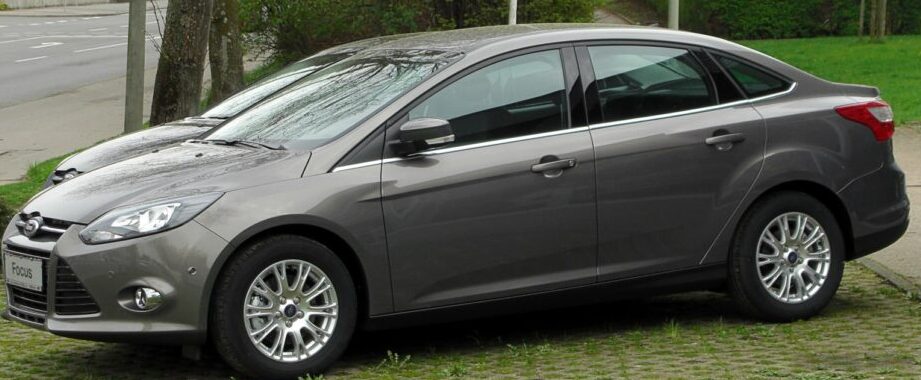
The Ford Focus III Sedan 2.0 Ti-VCT (160 hp) represents a significant offering in the North American market for those seeking a compact sedan with a balance of fuel efficiency and performance. Produced from 2010 to 2014, this variant occupied a mid-range position within the Focus III Sedan lineup, slotting above the base 1.6L engine and below potential performance-oriented trims. It was part of the global Ford Focus III generation (internally known as the 2010-2014 model years), built on the C-segment platform shared with other Ford and partner vehicles. This particular engine and transmission combination aimed to provide a more engaging driving experience than the base engine while remaining accessible to a broader customer base.
Technical Specifications
| Brand | Ford |
| Model | Focus |
| Generation | Focus III Sedan |
| Type (Engine) | 2.0 Ti-VCT (160 Hp) |
| Start of production | 2010 |
| End of production | 2014 |
| Powertrain Architecture | Internal Combustion engine |
| Body type | Sedan |
| Seats | 5 |
| Doors | 4 |
| Fuel consumption (urban) | 9 l/100 km (26.1 US mpg) |
| Fuel consumption (extra urban) | 6.5 l/100 km (36.2 US mpg) |
| Fuel consumption (combined) | 7.8 l/100 km (30.2 US mpg) |
| Fuel Type | Petrol (Gasoline) |
| Emission standard | SULEV |
| Weight-to-power ratio | 8.2 kg/Hp |
| Weight-to-torque ratio | 6.7 kg/Nm |
| Power | 160 Hp @ 6500 rpm |
| Power per litre | 80 Hp/l |
| Torque | 198 Nm @ 4450 rpm (146.04 lb.-ft. @ 4450 rpm) |
| Engine layout | Front, Transverse |
| Engine Model/Code | Duratec |
| Engine displacement | 1999 cm3 (121.99 cu. in.) |
| Number of cylinders | 4 |
| Engine configuration | Inline |
| Cylinder Bore | 87.5 mm (3.44 in.) |
| Piston Stroke | 83.1 mm (3.27 in.) |
| Compression ratio | 12:1 |
| Number of valves per cylinder | 4 |
| Fuel injection system | Direct injection |
| Engine aspiration | Naturally aspirated engine |
| Valvetrain | DOHC, Ti-VCT |
| Engine oil capacity | 4.3 l (4.54 US qt | 3.78 UK qt) |
| Coolant capacity | 5 l (5.28 US qt | 4.4 UK qt) |
| Kerb Weight | 1319 kg (2907.9 lbs.) |
| Trunk (boot) space | 374 l (13.21 cu. ft.) |
| Fuel tank capacity | 47 l (12.42 US gal | 10.34 UK gal) |
| Length | 4534 mm (178.5 in.) |
| Width | 1824 mm (71.81 in.) |
| Height | 1466 mm (57.72 in.) |
| Wheelbase | 2649 mm (104.29 in.) |
| Front track | 1554 mm (61.18 in.) |
| Rear track | 1534 mm (60.39 in.) |
| Minimum turning circle | 11 m (36.09 ft.) |
| Drivetrain Architecture | Front wheel drive |
| Number of gears | 5 |
| Gearbox type | Manual transmission |
| Front suspension | Independent, McPherson with coil spring and anti-roll bar |
| Rear suspension | Independent multi-link with stabilizer |
| Front brakes | Ventilated discs, 278 mm |
| Rear brakes | Drum, 228 mm |
| Assisting systems | ABS |
| Steering type | Steering rack and pinion |
| Power steering | Electric |
| Tires size | 195/65 R15; 215/55 R16; 215/50 R17; 235/40 R18 |
| Wheel rims size | 15; 16; 17; 18 |
INTRODUCTION
The Ford Focus III Sedan 2.0 Ti-VCT (160 hp) was introduced as a key component of Ford’s strategy to offer a compelling compact sedan in the North American market. Launched in 2010, it represented a significant upgrade over previous Focus generations, boasting a more modern design, improved interior quality, and a range of advanced features. The 2.0 Ti-VCT engine was positioned as a step up from the base 1.6L engine, providing more power and a more refined driving experience. This model aimed to appeal to buyers who desired a balance between fuel economy, performance, and practicality.
Powertrain & Engine Architecture
At the heart of this Focus variant lies the 2.0-liter Duratec Ti-VCT inline-four cylinder engine. The “Ti-VCT” designation stands for Twin Independent Variable Camshaft Timing, a technology that optimizes valve timing for improved performance and fuel efficiency across the engine’s operating range. This engine utilizes direct fuel injection, further enhancing combustion efficiency and reducing emissions. The engine code is crucial for identifying specific components and service intervals. The Duratec engine family is known for its relatively simple design and robust construction. The 5-speed manual transmission was the standard offering, providing a direct connection between the engine and the front wheels. The transmission’s gear ratios were tuned to balance acceleration and fuel economy, with a relatively tall fifth gear for highway cruising.
Driving Characteristics
The 2.0 Ti-VCT engine delivers a noticeable improvement in performance compared to the base 1.6L engine. With 160 horsepower and 146 lb-ft of torque, the Focus Sedan offers brisk acceleration and sufficient power for everyday driving situations. While not a sports car, the 2.0L engine provides a more confident and engaging driving experience, particularly when merging onto highways or overtaking other vehicles. The 5-speed manual transmission allows for precise control over gear selection, enabling drivers to maximize engine performance. Compared to automatic transmission options available on other Focus trims, the manual transmission provides a more direct and responsive feel. The suspension is tuned for a comfortable ride, but it also offers decent handling characteristics, making the Focus Sedan a pleasant vehicle to drive on both city streets and winding roads.
Equipment & Trim Levels
The 2.0 Ti-VCT trim typically included standard features such as air conditioning, power windows and locks, a basic audio system with auxiliary input, and steel wheels with wheel covers. Higher trim levels, often denoted by names like “SE” or “SEL”, added features such as alloy wheels, upgraded audio systems with more speakers and connectivity options, cruise control, and a leather-wrapped steering wheel. Optional extras included a sunroof, heated front seats, and a navigation system. Interior upholstery was typically cloth, with higher trims offering leather seating surfaces. The dashboard layout was functional and straightforward, with easy-to-read gauges and intuitive controls.
Chassis & Braking
The Focus III Sedan utilizes an independent McPherson strut front suspension and an independent multi-link rear suspension. This suspension setup provides a good balance between ride comfort and handling performance. The front suspension incorporates a stabilizer bar to reduce body roll during cornering. The braking system consists of ventilated discs at the front and drum brakes at the rear. Anti-lock Braking System (ABS) was standard, enhancing braking performance and stability in emergency situations. The chassis was designed to be lightweight yet rigid, contributing to the vehicle’s handling characteristics and crash safety.
Market Reception & Comparison
The Ford Focus III Sedan 2.0 Ti-VCT received generally positive reviews from automotive critics. It was praised for its improved interior quality, comfortable ride, and engaging driving dynamics. The 2.0L engine was considered a good compromise between performance and fuel economy. Compared to the base 1.6L engine, the 2.0L offered a more satisfying driving experience, but it came at a slightly higher price point. Fuel economy figures were competitive with other compact sedans in its class. Reliability was generally considered average, with some reports of minor issues with the engine and transmission. Compared to rivals like the Honda Civic and Toyota Corolla, the Focus offered a more European-inspired driving experience, but it may not have had the same reputation for long-term reliability.
Legacy
The Ford Focus III Sedan 2.0 Ti-VCT remains a relatively affordable and practical option in the used car market. The Duratec 2.0L engine is generally considered reliable, although regular maintenance is essential to ensure its longevity. Common maintenance items include oil changes, spark plug replacements, and timing chain inspections. The 5-speed manual transmission is also relatively durable, but it may require occasional servicing. Overall, the Focus III Sedan 2.0 Ti-VCT represents a solid choice for buyers seeking a well-rounded compact sedan with a balance of performance, fuel economy, and features. Its lasting appeal lies in its blend of practicality and driving enjoyment, making it a popular choice among used car shoppers.