
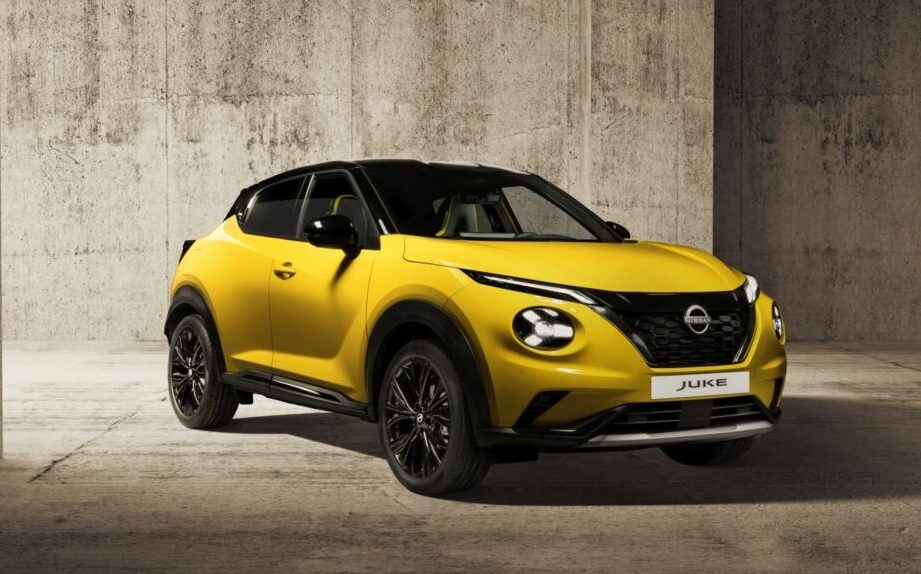
The Nissan Juke II 1.0 DIG-T (114 hp) represents an entry point into the second generation of Nissan’s distinctive subcompact crossover. Introduced with the facelift in March 2024, this variant is positioned as a fuel-efficient and accessible option within the Juke II lineup, primarily targeting buyers seeking a stylish and practical urban vehicle. It builds upon the foundation of the Juke II, which debuted in 2020 as a significant redesign from the original, polarizing first-generation model. The Juke II is built on the CMF-B platform, shared with other Renault-Nissan-Mitsubishi Alliance vehicles, and is primarily marketed in Europe and other international markets.
Technical Specifications
| Brand | Nissan |
| Model | Juke |
| Generation | Juke II (facelift 2024) |
| Type (Engine) | 1.0 DIG-T (114 Hp) |
| Start of production | March, 2024 |
| Powertrain Architecture | Internal Combustion engine |
| Body type | SUV, Crossover |
| Seats | 5 |
| Doors | 5 |
| Fuel consumption at Low speed (WLTP) | 6.9 l/100 km (34.1 US mpg, 40.9 UK mpg, 14.5 km/l) |
| Fuel consumption at Medium speed (WLTP) | 5.4-5.5 l/100 km (43.6 – 42.8 US mpg, 52.3 – 51.4 UK mpg, 18.5 – 18.2 km/l) |
| Fuel consumption at high speed (WLTP) | 5.1 l/100 km (46.1 US mpg, 55.4 UK mpg, 19.6 km/l) |
| Fuel consumption at very high speed (WLTP) | 6.4-6.5 l/100 km (36.8 – 36.2 US mpg, 44.1 – 43.5 UK mpg, 15.6 – 15.4 km/l) |
| Combined fuel consumption (WLTP) | 5.8-5.9 l/100 km (40.6 – 39.9 US mpg, 48.7 – 47.9 UK mpg, 17.2 – 16.9 km/l) |
| CO2 emissions (WLTP) | 133-135 g/km |
| Fuel Type | Petrol (Gasoline) |
| Acceleration 0 – 100 km/h | 10.7 sec |
| Acceleration 0 – 62 mph | 10.7 sec |
| Acceleration 0 – 60 mph | 10.2 sec |
| Maximum speed | 180 km/h (111.85 mph) |
| Emission standard | Euro 6d-ISC-FCM |
| Weight-to-power ratio | 10.5 kg/Hp, 95.1 Hp/tonne |
| Weight-to-torque ratio | 6 kg/Nm, 166.8 Nm/tonne |
| Power | 114 Hp @ 5000 rpm |
| Torque | 200 Nm @ 3000 rpm (147.51 lb.-ft. @ 3000 rpm) |
| Engine layout | Front, Transverse |
| Engine Model/Code | HR10DDT |
| Engine displacement | 999 cm3 (60.96 cu. in.) |
| Number of cylinders | 3 |
| Engine configuration | Inline |
| Cylinder Bore | 72.2 mm (2.84 in.) |
| Piston Stroke | 81.4 mm (3.2 in.) |
| Compression ratio | 10.5:1 |
| Number of valves per cylinder | 4 |
| Fuel injection system | Direct injection |
| Engine aspiration | Turbocharger, Intercooler |
| Engine oil capacity | 4.1 l (4.33 US qt | 3.61 UK qt) |
| Coolant | 6.5 l (6.87 US qt | 5.72 UK qt) |
| Kerb Weight | 1199-1243 kg (2643.34 – 2740.35 lbs.) |
| Max. weight | 1700 kg (3747.86 lbs.) |
| Max load | 457-501 kg (1007.51 – 1104.52 lbs.) |
| Trunk (boot) space – minimum | 422 l (14.9 cu. ft.) |
| Trunk (boot) space – maximum | 1305 l (46.09 cu. ft.) |
| Fuel tank capacity | 46 l (12.15 US gal | 10.12 UK gal) |
| Permitted trailer load with brakes (12%) | 1250 kg (2755.78 lbs.) |
| Permitted trailer load without brakes | 631 kg (1391.12 lbs.) |
| Permitted towbar download | 75 kg (165.35 lbs.) |
| Length | 4210 mm (165.75 in.) |
| Width | 1800 mm (70.87 in.) |
| Width including mirrors | 1983 mm (78.07 in.) |
| Height | 1593 mm (62.72 in.) |
| Wheelbase | 2636 mm (103.78 in.) |
| Minimum turning circle | 10.57 m (34.68 ft.) |
| Drivetrain Architecture | Front wheel drive |
| Number of gears and type of gearbox | 6 gears, manual transmission |
| Front brakes | Ventilated discs |
| Rear brakes | Disc |
| Tires size | 215/60 R17; 225/45 R19 |
| Wheel rims size | 7.0J x 17; 7.5J x 19 |
Powertrain & Engine Architecture
The heart of this Juke variant is the HR10DDT, a 1.0-liter turbocharged three-cylinder gasoline engine. This engine is part of Nissan’s DIG-T (Direct Injection Gasoline – Turbocharged) series, known for its compact size and efficiency. The HR10DDT utilizes direct fuel injection, which improves combustion efficiency and power output. It also features a turbocharger with an intercooler to boost performance. The engine produces 114 horsepower at 5,000 rpm and 200 Nm (147.51 lb-ft) of torque at 3,000 rpm. This engine is paired with a 6-speed manual transmission, delivering power to the front wheels. The engine’s relatively small displacement and turbocharging contribute to its fuel efficiency, making it a suitable choice for urban driving.
Driving Characteristics
The 1.0 DIG-T with the manual transmission offers a reasonable driving experience, though it’s not geared towards outright performance. Acceleration from 0-60 mph takes around 10.2 seconds, and the top speed is 111.85 mph. The turbocharger provides a noticeable boost in power, but the engine can feel somewhat strained at higher speeds or when fully loaded. The 6-speed manual transmission is well-matched to the engine, offering precise shifts and allowing drivers to maintain optimal engine speed. Compared to higher-output Juke variants, this version prioritizes fuel economy and ease of driving over sporty performance. The gear ratios are tuned for efficiency, resulting in a comfortable and economical ride.
Equipment & Trim Levels
The 1.0 DIG-T typically serves as the entry-level trim for the Juke II. Standard equipment generally includes air conditioning, a touchscreen infotainment system with Apple CarPlay and Android Auto compatibility, Bluetooth connectivity, and a suite of safety features such as automatic emergency braking, lane departure warning, and traffic sign recognition. Higher trim levels add features like larger touchscreen displays, navigation, upgraded audio systems, and more advanced driver-assistance systems. Interior upholstery is typically cloth, with options for partial leather trim on higher trims. Optional extras often include a panoramic sunroof, parking sensors, and a rearview camera.
Chassis & Braking
The Juke II utilizes a front-wheel-drive chassis with a MacPherson strut front suspension and a torsion beam rear suspension. This setup provides a good balance between ride comfort and handling. The facelifted model maintains the same suspension setup as the original Juke II. Braking is handled by ventilated discs on the front wheels and solid discs on the rear. The braking system is equipped with ABS (Anti-lock Braking System) and EBD (Electronic Brakeforce Distribution) for enhanced safety. The Juke II’s chassis is designed to be lightweight, contributing to its fuel efficiency and agility.
Market Reception & Comparison
The Nissan Juke II 1.0 DIG-T has been generally well-received as an affordable and efficient option in the subcompact crossover segment. Critics have praised its stylish design, comfortable interior, and fuel-efficient engine. However, some have noted that the engine can feel underpowered, especially when fully loaded or on steep inclines. Compared to other Juke II trims, such as those with more powerful engines, the 1.0 DIG-T offers a lower price point and better fuel economy, making it an attractive choice for budget-conscious buyers. Its fuel economy figures of 5.8-5.9 l/100 km (40.6 – 39.9 US mpg) are competitive within its class.
Legacy
The HR10DDT engine has proven to be a relatively reliable unit in other Nissan and Renault models. While long-term reliability data for the Juke II 1.0 DIG-T is still emerging, early indications suggest that the powertrain is durable and dependable. The Juke II, in general, has gained popularity as a stylish and practical urban vehicle. The 1.0 DIG-T variant continues to be a popular choice in the used car market due to its affordability and fuel efficiency. As with any turbocharged engine, regular maintenance, including oil changes and air filter replacements, is crucial to ensure its longevity.


