
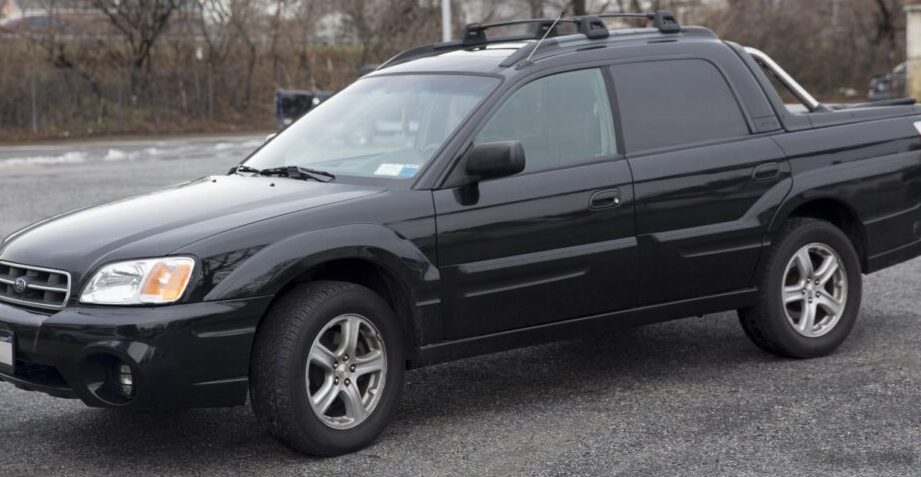
The Subaru Baja 2.5i 16V 4WD, produced from 2002 to 2006, represents a unique and somewhat controversial entry into the compact pickup truck segment. Built on the Subaru Legacy platform (BE/BH), the Baja aimed to blend the practicality of a pickup with the comfort and handling characteristics of a passenger car. It was positioned as a lifestyle vehicle, targeting active individuals and those seeking a versatile vehicle capable of both work and recreation. The “2.5i” designation refers to the 2.5-liter naturally aspirated four-cylinder engine paired with a four-speed automatic transmission, representing a significant portion of Baja sales. The Baja was discontinued after a relatively short production run, largely due to slow sales and a market that didn’t fully embrace its unconventional design.
Technical Specifications
| Brand | Subaru |
| Model | Baja |
| Generation | Baja |
| Type (Engine) | 2.5 i 16V (165 Hp) 4WD |
| Start of production | 2002 |
| End of production | 2006 |
| Powertrain Architecture | Internal Combustion engine |
| Body type | Pick-up |
| Seats | 5 |
| Doors | 4 |
| Fuel consumption (combined) | 10 l/100 km (23.5 US mpg, 28.2 UK mpg, 10 km/l) |
| Fuel Type | Petrol (Gasoline) |
| Weight-to-power ratio | 9.6 kg/Hp, 104.3 Hp/tonne |
| Weight-to-torque ratio | 7 kg/Nm, 142.2 Nm/tonne |
| Power | 165 Hp @ 5600 rpm |
| Power per litre | 67.2 Hp/l |
| Torque | 225 Nm @ 4000 rpm (165.95 lb.-ft. @ 4000 rpm) |
| Engine layout | Front, Longitudinal |
| Engine Model/Code | EJ25 |
| Engine displacement | 2457 cm3 (149.94 cu. in.) |
| Number of cylinders | 4 |
| Engine configuration | Boxer |
| Cylinder Bore | 99.5 mm (3.92 in.) |
| Piston Stroke | 79 mm (3.11 in.) |
| Compression ratio | 10:1 |
| Number of valves per cylinder | 4 |
| Fuel injection system | Multi-port manifold injection |
| Engine aspiration | Naturally aspirated engine |
| Valvetrain | DOHC |
| Engine oil capacity | 4 l (4.23 US qt | 3.52 UK qt) |
| Coolant capacity | 6.8 l (7.19 US qt | 5.98 UK qt) |
| Kerb Weight | 1582 kg (3487.71 lbs.) |
| Fuel tank capacity | 65 l (17.17 US gal | 14.3 UK gal) |
| Length | 4910 mm (193.31 in.) |
| Width | 1781 mm (70.12 in.) |
| Height | 1590 mm (62.6 in.) |
| Wheelbase | 2649 mm (104.29 in.) |
| Front track | 1470 mm (57.87 in.) |
| Rear track | 1465 mm (57.68 in.) |
| Drive wheel | All wheel drive (4×4) |
| Number of gears and type of gearbox | 4 gears, automatic transmission |
| Front suspension | Coil spring |
| Rear suspension | Coil spring |
| Front brakes | Ventilated discs |
| Rear brakes | Disc |
| Assisting systems | ABS (Anti-lock braking system) |
| Steering type | Steering rack and pinion |
| Power steering | Hydraulic Steering |
| Tires size | 225/60 R16 |
Powertrain & Engine Architecture
The heart of the Baja 2.5i is the EJ25 phase 2 engine, a 2.5-liter horizontally opposed (boxer) four-cylinder. This engine, common in many Subaru models of the era, is known for its relatively smooth operation and inherent balance due to the opposing piston design. The EJ25 features a dual overhead camshaft (DOHC) per cylinder bank, operating four valves per cylinder. Fuel delivery is handled by a multi-point fuel injection system. The engine produces 165 horsepower at 5600 rpm and 166 lb-ft of torque at 4000 rpm. Paired with this engine is a four-speed automatic transmission, which was a popular choice for buyers prioritizing ease of use over outright performance. The transmission is electronically controlled and features adaptive shifting logic.
Driving Characteristics
The 2.5i automatic Baja delivers adequate, but not exhilarating, performance. The four-speed automatic transmission, while smooth, lacks the responsiveness of a manual gearbox or a more modern automatic with additional gears. Acceleration is best described as leisurely, with 0-60 mph times typically in the 9-10 second range. The automatic transmission’s gear ratios are geared towards fuel efficiency and comfortable cruising rather than spirited driving. Compared to the available five-speed manual transmission, the automatic version feels noticeably slower. The Baja’s symmetrical all-wheel drive system provides excellent traction in various conditions, making it a capable vehicle in snow and light off-road situations. However, the relatively high curb weight of around 3,500 pounds does impact handling agility.
Equipment & Trim Levels
The Baja 2.5i typically came standard with features such as air conditioning, power windows and locks, a CD player, and a tilt steering wheel. Higher trim levels, such as the Limited, added features like leather upholstery, heated front seats, a premium sound system, and alloy wheels. Optional extras included a power sunroof, a navigation system, and upgraded audio options. The interior design was functional and durable, reflecting the Baja’s intended use as a versatile vehicle. The rear seats fold up, creating a small, covered cargo area, a unique feature of the Baja.
Chassis & Braking
The Baja utilizes a MacPherson strut front suspension and a double-wishbone rear suspension, providing a comfortable ride quality. Stabilizer bars are fitted to both the front and rear axles to reduce body roll during cornering. Braking duties are handled by ventilated disc brakes at the front and solid disc brakes at the rear. Anti-lock brakes (ABS) are standard, enhancing safety and control during emergency braking situations. The steering system is a rack-and-pinion setup with hydraulic power assist, providing responsive and precise steering feel.
Market Reception & Comparison
The Subaru Baja received mixed reviews from automotive critics. While praised for its unique design, versatility, and all-wheel-drive capability, it was often criticized for its unconventional styling and relatively high price point. Compared to other compact pickups of the time, such as the Ford Ranger or the Chevrolet Colorado, the Baja offered a more refined driving experience and a higher level of standard equipment. However, its limited cargo capacity and lack of a traditional pickup bed were seen as drawbacks by some. Fuel economy for the 2.5i automatic was rated at around 23.5 mpg combined, which was competitive for its class. Reliability was generally good, typical of Subaru vehicles, although some owners reported minor issues with the automatic transmission.
Legacy
The Subaru Baja, despite its short production run, has developed a cult following among Subaru enthusiasts. Its unique design and versatile nature have made it a popular choice for those seeking a vehicle that stands out from the crowd. The EJ25 engine, when properly maintained, is known for its durability and longevity. Used Baja 2.5i models are relatively affordable, making them an attractive option for budget-conscious buyers. While not a mainstream success, the Baja remains a testament to Subaru’s willingness to experiment and challenge conventional automotive norms. The Baja’s influence can be seen in later crossover vehicles that attempt to blend the practicality of a pickup with the comfort of a passenger car.
