
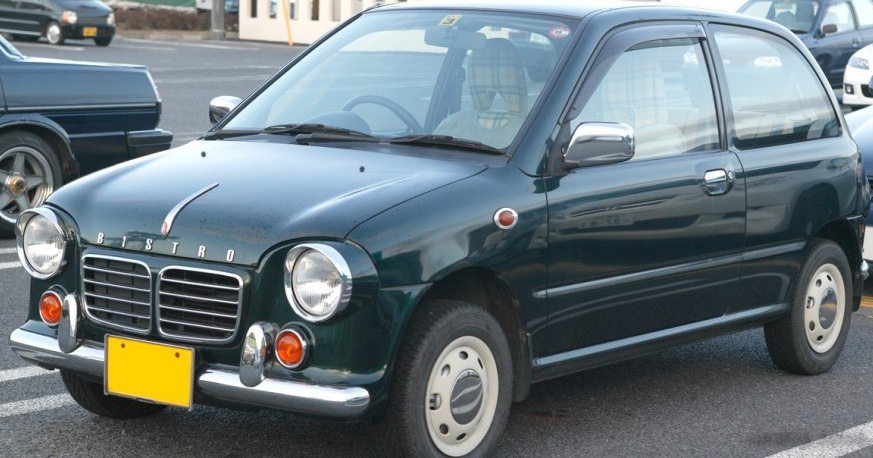
The Subaru Bistro 0.66 T, produced between 1995 and 2000, represents a unique and somewhat unusual entry in Subaru’s history. This diminutive hatchback, primarily aimed at the Japanese domestic market (JDM) and select European countries, was designed as an affordable and economical city car. It’s a notable departure from Subaru’s typically rally-inspired, all-wheel-drive focused lineup. The Bistro, based on a rebadged Daihatsu Mira, offered a practical and compact solution for urban transportation, and the 0.66 T variant, with its 64 horsepower engine, was a core component of the Bistro range. It occupied the entry-level position within the Bistro lineup, prioritizing fuel efficiency and low running costs over outright performance.
Technical Specifications
| Brand | Subaru |
| Model | Bistro |
| Generation | Bistro |
| Type (Engine) | 0.66 T (64 Hp) |
| Start of Production | 1995 |
| End of Production | 2000 |
| Powertrain Architecture | Internal Combustion Engine |
| Body Type | Hatchback |
| Seats | 4 |
| Doors | 3 |
| Fuel Type | Petrol (Gasoline) |
| Power | 64 Hp |
| Engine Model/Code | EN07 |
| Engine Aspiration | Naturally Aspirated |
Powertrain & Engine Architecture
The heart of the Bistro 0.66 T is the EN07 engine, a 658cc three-cylinder, naturally aspirated petrol engine. This engine, sourced from Daihatsu, is a relatively simple design, featuring a single overhead camshaft (SOHC) and two valves per cylinder. Fuel delivery is managed by a multi-point fuel injection system, a common feature for engines of this era aiming for improved efficiency and reduced emissions. The EN07 engine isn’t known for its high-performance characteristics; instead, it prioritizes fuel economy and reliability. The engine’s modest output of 64 horsepower at around 6,000 rpm and approximately 58 lb-ft of torque is geared towards providing adequate power for city driving. The Bistro 0.66 T exclusively utilized a three-speed automatic transmission. This transmission was chosen to enhance ease of use, particularly for the target demographic of urban commuters. The three-speed configuration, while not offering the most refined driving experience, contributes to the engine’s fuel efficiency by keeping the engine operating within its optimal power band.
Driving Characteristics
The driving experience in the Bistro 0.66 T is best described as utilitarian. The 64 horsepower engine and three-speed automatic transmission result in leisurely acceleration. Expect a 0-60 mph time well over 15 seconds. The focus is clearly on fuel efficiency rather than spirited driving. The automatic transmission’s gear ratios are optimized for low-speed maneuverability and maximizing fuel economy. The transmission shifts smoothly, but lacks the responsiveness of more modern automatic gearboxes. Compared to potential higher-spec Bistro variants (if any existed with larger engines), the 0.66 T would feel significantly underpowered. The small engine requires frequent downshifts when encountering hills or overtaking maneuvers. However, within the confines of city streets, the Bistro 0.66 T is perfectly adequate, offering a comfortable and easy-to-drive experience. The light steering and compact dimensions make it easy to navigate tight spaces and park in congested areas.
Equipment & Trim Levels
The Bistro 0.66 T was positioned as the entry-level model, and as such, its standard equipment list was relatively basic. Typically, it included features such as power steering, a basic audio system (often a cassette player), and manually adjustable windows and door locks. Air conditioning was often an optional extra, and its presence significantly increased the vehicle’s price. Interior upholstery was typically a simple cloth material, available in a limited range of colors. The dashboard design was functional and straightforward, prioritizing practicality over aesthetics. Optional extras, beyond air conditioning, could include upgraded audio systems, alloy wheels (though rare), and color-coded bumpers. The overall interior ambiance was spartan but durable, reflecting the car’s affordable price point.
Chassis & Braking
The Bistro 0.66 T utilizes a relatively simple chassis design. It features a MacPherson strut front suspension and a torsion beam rear suspension. This setup provides a comfortable ride quality, particularly on smooth roads, but doesn’t offer the handling precision of more sophisticated suspension systems. The braking system consists of disc brakes on the front wheels and drum brakes on the rear wheels. This configuration was common for vehicles in this price range during the 1990s. The brakes are adequate for normal driving conditions, but lack the stopping power of larger, more powerful vehicles. The Bistro 0.66 T does not feature anti-lock brakes (ABS) as standard equipment, which is typical for a car of its class and era. Stabilizer bars were generally absent, contributing to a slightly increased level of body roll during cornering.
Market Reception & Comparison
The Subaru Bistro 0.66 T was not a critical darling. Reviews generally acknowledged its affordability and fuel efficiency but criticized its lack of performance and basic interior. It was primarily seen as a practical and economical city car, rather than an exciting or engaging driving experience. Compared to other Kei cars and small hatchbacks available in Japan and Europe at the time, the Bistro 0.66 T offered a competitive price point. However, rivals often provided more features or slightly better performance. Fuel economy was a strong point, with the Bistro 0.66 T achieving around 50-55 mpg in real-world driving conditions. Reliability was generally good, thanks to the simple engine design and robust construction. However, maintenance costs could be higher due to the limited availability of parts outside of Japan.
Legacy
The Subaru Bistro, and particularly the 0.66 T variant, remains a relatively obscure vehicle. It’s not widely recognized outside of enthusiast circles. However, it represents an interesting chapter in Subaru’s history, demonstrating the company’s willingness to experiment with different market segments. The EN07 engine, while not a technological marvel, proved to be a reliable and durable powerplant. Today, the Bistro 0.66 T is a rare sight on the roads. Those that remain are often cherished by collectors and enthusiasts who appreciate its unique character and historical significance. The used car market values for these vehicles are slowly increasing, particularly for well-maintained examples. Parts availability can be a challenge, but a dedicated community of Subaru enthusiasts helps to keep these little hatchbacks running. The Bistro 0.66 T serves as a reminder that even a company known for performance and all-wheel drive can produce a charming and practical city car.
