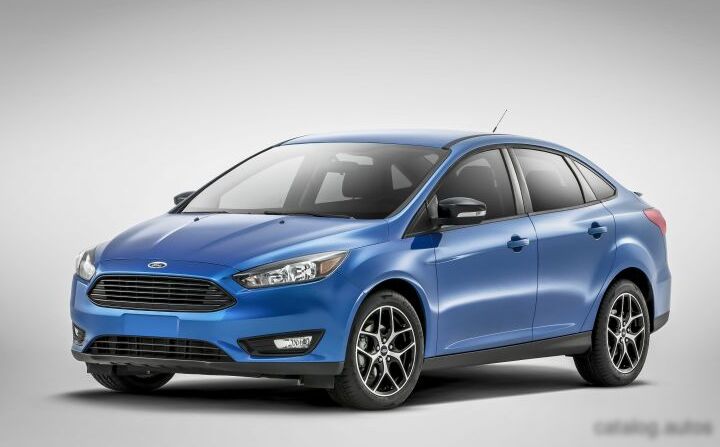
The Ford Focus III Sedan, specifically the facelifted version introduced in 2014, represented a significant step forward for Ford’s compact offerings in the global market. This iteration of the Focus, built from 2014 through 2018, aimed to blend European driving dynamics with the practicality demanded by sedan buyers. Among the engine options available, the 1.5 EcoBoost with 150 horsepower and the Start/Stop system (S&S) occupied a middle ground in the lineup, offering a balance of fuel efficiency and performance. This variant was particularly popular in markets where fuel costs were a concern and automatic transmissions were preferred, though a six-speed manual was also offered.
Technical Specifications
| Brand | Ford |
| Model | Focus |
| Generation | Focus III Sedan (facelift 2014) |
| Type (Engine) | 1.5 EcoBoost (150 Hp) S&S |
| Start of production | 2014 |
| End of production | 2018 |
| Powertrain Architecture | Internal Combustion engine |
| Body type | Sedan |
| Seats | 5 |
| Doors | 4 |
| Fuel consumption (urban) | 7.1 l/100 km (33.1 US mpg, 39.8 UK mpg, 14.1 km/l) |
| Fuel consumption (extra urban) | 4.7 l/100 km (50 US mpg, 60.1 UK mpg, 21.3 km/l) |
| Fuel consumption (combined) | 5.6 l/100 km (42 US mpg, 50.4 UK mpg, 17.9 km/l) |
| CO2 emissions | 128 g/km |
| Fuel Type | Petrol (Gasoline) |
| Acceleration 0 – 100 km/h | 9 sec |
| Acceleration 0 – 62 mph | 9 sec |
| Acceleration 0 – 60 mph | 8.6 sec |
| Maximum speed | 210 km/h (130.49 mph) |
| Emission standard | Euro 6 |
| Weight-to-power ratio | 9.1 kg/Hp, 110.5 Hp/tonne |
| Weight-to-torque ratio | 5.7 kg/Nm, 176.7 Nm/tonne |
| Power | 150 Hp @ 6000 rpm |
| Power per litre | 100.1 Hp/l |
| Torque | 240 Nm @ 1600-4000 rpm (177.01 lb.-ft. @ 1600-4000 rpm) |
| Engine layout | Front, Transverse |
| Engine Model/Code | M8DA, M8DB |
| Engine displacement | 1499 cm3 (91.47 cu. in.) |
| Number of cylinders | 4 |
| Engine configuration | Inline |
| Cylinder Bore | 79 mm (3.11 in.) |
| Piston Stroke | 76.4 mm (3.01 in.) |
| Compression ratio | 10:1 |
| Number of valves per cylinder | 4 |
| Fuel injection system | Direct injection |
| Engine aspiration | Turbocharger, Intercooler |
| Valvetrain | DOHC |
| Engine oil capacity | 4.1 l (4.33 US qt | 3.61 UK qt) |
| Coolant | 5.8 l (6.13 US qt | 5.1 UK qt) |
| Kerb Weight | 1358 kg (2993.88 lbs.) |
| Max. weight | 1900 kg (4188.78 lbs.) |
| Max load | 542 kg (1194.91 lbs.) |
| Trunk (boot) space – minimum | 372 l (13.14 cu. ft.) |
| Fuel tank capacity | 55 l (14.53 US gal | 12.1 UK gal) |
| Length | 4534 mm (178.5 in.) |
| Width | 1823 mm (71.77 in.) |
| Height | 1484 mm (58.43 in.) |
| Wheelbase | 2648 mm (104.25 in.) |
| Front track | 1544 mm (60.79 in.) |
| Rear (Back) track | 1559 mm (61.38 in.) |
| Minimum turning circle | 11 m (36.09 ft.) |
| Drivetrain Architecture | Front wheel drive |
| Drive wheel | Front wheel drive |
| Number of gears | 6 gears, manual transmission |
| Front suspension | Independent, type McPherson with coil spring and anti-roll bar |
| Rear suspension | Independent multi-link suspension |
| Front brakes | Disc |
| Rear brakes | Disc |
| Assisting systems | ABS (Anti-lock braking system) |
| Steering type | Steering rack and pinion |
| Tires size | 205/55 R16; 215/50 R17 |
| Wheel rims size | 6.5J x 16; 7.0J x 17 |
Powertrain & Engine Architecture
The heart of this Focus variant is the 1.5-liter EcoBoost inline-four cylinder engine, specifically the M8DA or M8DB engine code depending on the specific market and calibration. This engine is a member of Ford’s EcoBoost family, characterized by direct fuel injection and turbocharging. The direct injection system, operating at pressures up to 200 bar, ensures precise fuel delivery for improved combustion efficiency and reduced emissions. The single scroll turbocharger, coupled with an intercooler, provides a boost in power and torque without significantly sacrificing fuel economy. The engine utilizes a dual overhead camshaft (DOHC) valvetrain with four valves per cylinder, optimizing airflow for enhanced performance. The Start/Stop system, denoted by the “S&S” designation, automatically shuts off the engine when the vehicle is stationary (e.g., at a red light) to further reduce fuel consumption and emissions. The six-speed manual transmission was the standard offering, providing drivers with full control over gear selection.
Driving Characteristics
The 1.5 EcoBoost engine, producing 150 horsepower and 177 lb-ft of torque, provided adequate performance for everyday driving. Acceleration from 0-60 mph took approximately 8.6 seconds, making it competitive within its class. While not as quick as the higher-output EcoBoost variants or the diesel options, the 1.5L engine offered a responsive driving experience, with peak torque available from 1600-4000 rpm. The six-speed manual transmission allowed for precise gear changes, enhancing driver engagement. The gear ratios were tuned to prioritize fuel efficiency, resulting in a slightly less aggressive feel compared to sportier trims. The suspension, tuned for comfort, provided a reasonably smooth ride, although it wasn’t as firm or engaging as the suspension found on performance-oriented Focus models.
Equipment & Trim Levels
The 1.5 EcoBoost S&S trim typically fell into the mid-range of the Focus Sedan lineup. Standard equipment generally included air conditioning, power windows and locks, a basic audio system with USB connectivity, and steel wheels with wheel covers. Higher trim levels, such as the Titanium, added features like alloy wheels, a more advanced infotainment system with touchscreen display, automatic climate control, and parking sensors. Optional extras for the 1.5 EcoBoost S&S could include a sunroof, upgraded audio system, and various driver-assistance features. Interior upholstery was typically cloth, with higher trims offering leather options.
Chassis & Braking
The Focus III Sedan utilized an independent McPherson strut front suspension and an independent multi-link rear suspension. This setup provided a good balance of ride comfort and handling. The front suspension incorporated a coil spring and anti-roll bar to reduce body roll during cornering. Braking duties were handled by disc brakes on all four wheels, providing adequate stopping power. An Anti-lock Braking System (ABS) was standard, enhancing safety and control during emergency braking situations. The steering system employed a rack and pinion setup, offering precise and responsive steering feel.
Market Reception & Comparison
The 1.5 EcoBoost S&S variant of the Focus Sedan received generally positive reviews. Critics praised its fuel efficiency and responsive engine, noting that it provided a good balance of performance and economy. However, some reviewers found the engine to be slightly underpowered compared to the larger EcoBoost options. Compared to the 1.0 EcoBoost, the 1.5 offered more power and torque, making it a better choice for drivers who frequently carried passengers or cargo. Against the diesel variants, the 1.5 EcoBoost offered a smoother and quieter driving experience, but typically at the expense of fuel economy.
Legacy
The 1.5 EcoBoost engine proved to be a relatively reliable powertrain, although some owners have reported issues with the turbocharger and direct injection system over the long term. Regular maintenance, including oil changes and timely replacement of wear items, is crucial for ensuring the longevity of this engine. In the used car market, the 1.5 EcoBoost Focus Sedan remains a popular choice for buyers seeking a fuel-efficient and practical compact sedan. Its blend of affordability, features, and driving dynamics continues to make it a competitive option in its segment.