
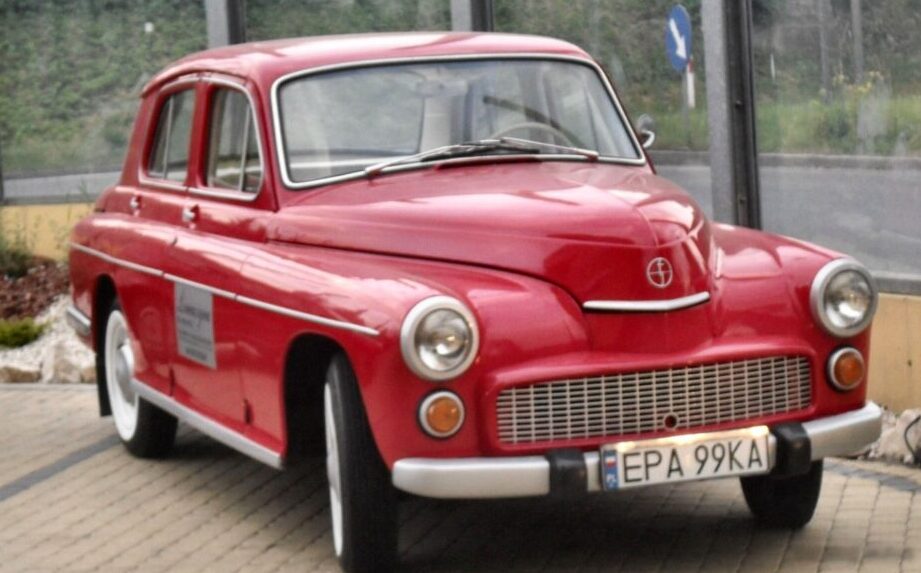
The FSO Warszawa 223 2.1, producing 77 horsepower, was a significant model in the Polish automotive industry, manufactured from 1967 to 1973. It represented a modernization of the earlier Warszawa models, aiming to provide a more comfortable and reliable vehicle for the Polish market and limited export. The 223 series, built upon the foundations of the original Warszawa design from the 1950s, sought to address criticisms of the earlier cars while maintaining affordability and practicality. This 2.1-liter variant occupied a middle ground in the Warszawa 223 lineup, offering a balance between performance and fuel economy, positioned above the smaller engine options but below the more powerful, though less common, versions.
Technical Specifications
| Brand | FSO |
| Model | Warszawa |
| Generation | Warszawa 223 |
| Type (Engine) | 2.1 (77 Hp) |
| Start of production | 1967 |
| End of production | 1973 |
| Powertrain Architecture | Internal Combustion engine |
| Body type | Sedan |
| Seats | 5 |
| Doors | 4 |
| Fuel consumption (combined) | 12 l/100 km (19.6 US mpg, 23.5 UK mpg, 8.3 km/l) |
| Fuel Type | Petrol (Gasoline) |
| Acceleration 0 – 100 km/h | 37.5 sec |
| Acceleration 0 – 62 mph | 37.5 sec |
| Acceleration 0 – 60 mph | 35.6 sec |
| Maximum speed | 130 km/h (80.78 mph) |
| Weight-to-power ratio | 17.9 kg/Hp (56 Hp/tonne) |
| Power | 77 Hp @ 4000 rpm |
| Power per litre | 36.3 Hp/l |
| Engine layout | Front, Longitudinal |
| Engine Model/Code | S-21 |
| Engine displacement | 2120 cm3 (129.37 cu. in.) |
| Number of cylinders | 4 |
| Engine configuration | Inline |
| Cylinder Bore | 82 mm (3.23 in.) |
| Piston Stroke | 100 mm (3.94 in.) |
| Compression ratio | 7.5:1 |
| Number of valves per cylinder | 2 |
| Fuel injection system | Carburettor |
| Engine aspiration | Naturally aspirated engine |
| Valvetrain | OHV |
| Engine oil capacity | 6 l (6.34 US qt | 5.28 UK qt) |
| Coolant capacity | 10.5 l (11.1 US qt | 9.24 UK qt) |
| Kerb Weight | 1375 kg (3031.36 lbs.) |
| Max. weight | 1870 kg (4122.64 lbs.) |
| Max load | 495 kg (1091.29 lbs.) |
| Fuel tank capacity | 55 l (14.53 US gal | 12.1 UK gal) |
| Length | 4740 mm (186.61 in.) |
| Width | 1695 mm (66.73 in.) |
| Height | 1565 mm (61.61 in.) |
| Wheelbase | 2700 mm (106.3 in.) |
| Front track | 1395 mm (54.92 in.) |
| Rear track | 1402 mm (55.2 in.) |
| Front overhang | 800 mm (31.5 in.) |
| Rear overhang | 1240 mm (48.82 in.) |
| Ride height (ground clearance) | 195 mm (7.68 in.) |
| Drivetrain Architecture | Rear wheel drive |
| Drive wheel | Rear wheel drive |
| Number of gears and type of gearbox | 3 gears, manual transmission |
| Front suspension | Independent coil spring, Wishbone |
| Rear suspension | Leaf spring |
| Front brakes | Drum |
| Rear brakes | Drum |
| Steering type | Cone worm with recirculation balls |
| Tires size | 195/75 R15 |
| Wheel rims size | 15 |
Powertrain & Engine Architecture
The heart of the Warszawa 223 2.1 was the S-21 engine, a 2.1-liter (2120 cc) inline-four cylinder unit. This engine, while based on earlier designs, featured improvements aimed at increasing reliability and drivability. It utilized a single carburetor for fuel delivery, a common setup for the period, and an overhead valve (OHV) valvetrain. The engine produced 77 horsepower at 4000 rpm, and while not a high output by modern standards, it was considered adequate for the vehicle’s weight and intended use. The engine was mounted longitudinally in the front of the vehicle. The transmission was a three-speed manual gearbox, providing relatively simple and robust operation. The drivetrain was configured for rear-wheel drive, a standard layout for European sedans of the era.
Driving Characteristics
The Warszawa 223 2.1 with the three-speed manual transmission offered a driving experience typical of cars from the 1960s and early 1970s. Acceleration was modest, taking approximately 37.5 seconds to reach 100 km/h (62 mph). The gear ratios were spaced to prioritize fuel economy and ease of driving rather than outright performance. Compared to potential higher-output versions (which were rare), the 2.1-liter engine provided a more relaxed driving experience, suitable for everyday commuting and longer journeys. The rear-wheel drive configuration offered predictable handling, but the leaf spring rear suspension could result in a somewhat firm ride, particularly when the vehicle was loaded. The steering, utilizing a cone worm and recirculation balls system, was known for being relatively heavy but provided decent feedback.
Equipment & Trim Levels
The Warszawa 223 2.1 was generally equipped with basic, functional features. Standard interior appointments included cloth upholstery, a simple dashboard layout with basic instrumentation (speedometer, fuel gauge, temperature gauge), and manually operated windows and door locks. Trim levels were relatively limited; the 2.1 version typically offered a slightly more refined interior compared to the base models, potentially including upgraded seat fabrics or minor trim details. Optional extras were available, such as a radio, heater, and whitewall tires, but these were not commonly specified due to cost considerations in the Polish market. The focus was on providing a durable and practical vehicle rather than luxurious amenities.
Chassis & Braking
The Warszawa 223 2.1 utilized a body-on-frame construction, a common practice for the time, contributing to its robust build. The front suspension employed independent coil springs and wishbone arms, offering a degree of ride comfort and handling precision. The rear suspension, however, relied on a traditional leaf spring setup, which was less sophisticated but durable and capable of handling heavier loads. The braking system consisted of drum brakes on all four wheels. While adequate for the vehicle’s performance capabilities, the drum brakes lacked the stopping power and fade resistance of disc brakes. Steering was accomplished through a cone worm and recirculation balls system.
Market Reception & Comparison
The FSO Warszawa 223 2.1 was well-received in Poland as a relatively modern and reliable vehicle, particularly compared to the older Warszawa models it replaced. It served as a popular choice for both private owners and state-owned enterprises. Critics noted its improved comfort and build quality, but also pointed out its modest performance and somewhat dated design. Compared to other vehicles available in the Eastern Bloc, the Warszawa 223 2.1 offered a reasonable balance of features and affordability. Fuel economy, at 12 liters per 100 kilometers, was typical for vehicles of its size and era. Reliability was generally good, although maintenance could be demanding due to the car’s relatively simple but robust mechanicals.
Legacy
The FSO Warszawa 223 2.1 holds a significant place in Polish automotive history. It represented a period of modernization and aspiration for the Polish automotive industry. While production ceased in 1973, the Warszawa continued to be a common sight on Polish roads for many years afterward. Today, the Warszawa 223 2.1 is a sought-after classic car among collectors and enthusiasts in Poland and increasingly, elsewhere in Europe. The S-21 engine, while not particularly advanced, proved to be durable and relatively easy to maintain, contributing to the longevity of many Warszawa models. Parts availability can be a challenge, but a dedicated community of owners and restorers helps to keep these vehicles on the road. The 2.1-liter variant, with its balance of performance and reliability, remains a particularly desirable version of the Warszawa 223.
