
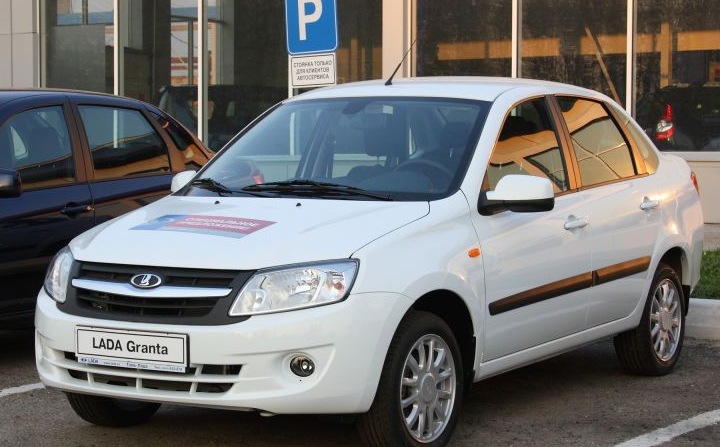
The Lada Granta I Sedan 1.6 (106 hp) represents a significant entry point into the Lada model range, produced from 2011 to 2018. Positioned as a budget-friendly sedan, it was a key component of Lada’s revitalization efforts following its acquisition by the Renault-Nissan Alliance. The Granta, built on the aging but robust 2190 platform (derived from the earlier Lada 2170), aimed to provide affordable transportation with a degree of modern convenience. This 1.6-liter, 106 horsepower variant served as the mainstay of the Granta lineup, offering a balance between fuel economy and acceptable performance for everyday driving. It was primarily marketed towards cost-conscious buyers in Russia and other Eastern European markets, where practicality and affordability were paramount.
Technical Specifications
| Brand | Lada |
| Model | Granta |
| Generation | Granta I Sedan |
| Type (Engine) | 1.6 (106 Hp) |
| Start of production | 2011 |
| End of production | 2018 |
| Powertrain Architecture | Internal Combustion engine |
| Body type | Sedan |
| Seats | 5 |
| Doors | 4 |
| Fuel consumption (urban) | 8.6 l/100 km (27.4 US mpg) |
| Fuel consumption (extra urban) | 5.6 l/100 km (42 US mpg) |
| Fuel consumption (combined) | 6.7 l/100 km (35.1 US mpg) |
| Fuel Type | Petrol (Gasoline) |
| Acceleration 0 – 100 km/h | 10.9 sec |
| Acceleration 0 – 62 mph | 10.9 sec |
| Acceleration 0 – 60 mph | 10.4 sec |
| Maximum speed | 183 km/h (113.71 mph) |
| Weight-to-power ratio | 10.1 kg/Hp |
| Weight-to-torque ratio | 7.3 kg/Nm |
| Power | 106 Hp @ 5800 rpm |
| Torque | 148 Nm @ 4000 rpm (109.16 lb.-ft. @ 4000 rpm) |
| Engine layout | Front, Transverse |
| Engine Model/Code | 21127 |
| Engine displacement | 1596 cm3 (97.39 cu. in.) |
| Number of cylinders | 4 |
| Engine configuration | Inline |
| Number of valves per cylinder | 4 |
| Fuel injection system | Multi-port manifold injection |
| Engine aspiration | Naturally aspirated engine |
| Engine oil capacity | 3.2 l (3.38 US qt | 2.82 UK qt) |
| Coolant capacity | 6.5 l (6.87 US qt | 5.72 UK qt) |
| Kerb Weight | 1075 kg (2369.97 lbs.) |
| Max. weight | 1560 kg (3439.21 lbs.) |
| Max load | 485 kg (1069.24 lbs.) |
| Trunk (boot) space – minimum | 520 l (18.36 cu. ft.) |
| Fuel tank capacity | 50 l (13.21 US gal | 11 UK gal) |
| Permitted trailer load with brakes (12%) | 900 kg (1984.16 lbs.) |
| Permitted trailer load without brakes | 450 kg (992.08 lbs.) |
| Length | 4260 mm (167.72 in.) |
| Width | 1700 mm (66.93 in.) |
| Height | 1500 mm (59.06 in.) |
| Wheelbase | 2476 mm (97.48 in.) |
| Front track | 1430 mm (56.3 in.) |
| Rear (Back) track | 1414 mm (55.67 in.) |
| Ride height (ground clearance) | 160 mm (6.3 in.) |
| Drivetrain Architecture | Front wheel drive |
| Number of gears and type of gearbox | 5 gears, manual transmission |
| Front suspension | Independent, type McPherson with coil spring and anti-roll bar |
| Rear suspension | Semi-independent, coil spring |
| Assisting systems | ABS (Anti-lock braking system) |
| Steering type | Steering rack and pinion |
| Tires size | 175/65 R14; 185/60 R14; 185/55 R15 |
| Wheel rims size | 14; 15 |
Powertrain & Engine Architecture
The Lada Granta 1.6 utilizes the 21127 engine, a four-cylinder, inline engine with a displacement of 1596 cc (97.39 cubic inches). This engine is a development of the older Lada 1.6, but incorporates improvements in fuel injection and engine management. It features a multi-point fuel injection system, providing a more efficient fuel delivery compared to earlier carburetor-equipped Lada models. The engine employs a single overhead camshaft (SOHC) operating four valves per cylinder. The 106 hp output is achieved at 5800 rpm, while peak torque of 148 Nm (109.16 lb-ft) is delivered at 4000 rpm. The engine is transversely mounted, driving the front wheels. The standard transmission for this variant was a five-speed manual gearbox. While an automated manual transmission (AMT) was offered on some Granta models, it was less common with the 1.6-liter engine due to its lower power output.
Driving Characteristics
The Granta 1.6 (106 hp) offers modest performance. Acceleration from 0 to 100 km/h (0-62 mph) takes approximately 10.9 seconds, and the top speed is around 183 km/h (113.71 mph). Compared to higher-output Granta variants, such as those with the 1.6-liter 16-valve engine or the later 1.8-liter options, the 106 hp version feels noticeably less responsive. The five-speed manual transmission is geared for economy, with relatively tall gear ratios. This contributes to decent fuel economy but requires more frequent downshifting when overtaking or climbing hills. The power delivery is linear, but lacks the punch of more powerful engines. The suspension is tuned for comfort, providing a relatively soft ride, but this comes at the expense of handling precision.
Equipment & Trim Levels
The Granta 1.6 (106 hp) typically came with a basic level of equipment. Standard features generally included power steering, central locking, electric front windows, and an audio system with USB connectivity. Air conditioning was often an optional extra, as were features like alloy wheels and fog lights. Interior upholstery was typically cloth, with a simple dashboard layout. Higher trim levels, such as the “Comfort” or “Luxe” variants, added features like air conditioning, heated front seats, and more sophisticated audio systems. The overall interior design was functional but lacked the refinement of more modern vehicles.
Chassis & Braking
The Granta I Sedan utilizes a McPherson strut front suspension with a coil spring and anti-roll bar. The rear suspension is a semi-independent torsion beam setup, also with coil springs. This configuration is cost-effective and provides adequate ride comfort for everyday use. Braking is typically accomplished with disc brakes on the front wheels and drum brakes on the rear wheels. ABS (Anti-lock Braking System) was standard equipment, enhancing safety. The steering is a rack and pinion system, providing reasonable steering feel. The Granta’s chassis is relatively simple and robust, prioritizing durability over outright handling performance.
Market Reception & Comparison
The Lada Granta 1.6 (106 hp) was generally well-received in its target market as an affordable and practical sedan. Critics acknowledged its low price point and decent fuel economy, but also noted its basic interior and modest performance. Compared to other trims in the Granta lineup, the 1.6-liter version offered the best fuel economy but the slowest acceleration. The 1.6-liter 16-valve engine provided a noticeable performance boost, while the 1.8-liter engine offered even more power. In terms of reliability, the Granta 1.6 proved to be reasonably dependable, although build quality was not always consistent. Its low running costs and readily available spare parts made it an attractive option for budget-conscious buyers.
Legacy
The Lada Granta I Sedan 1.6 (106 hp) played a crucial role in establishing Lada as a competitive player in the budget car segment. While it may not have been a technological marvel, it provided affordable and reliable transportation for a large number of drivers. On the used car market, these Granta models remain relatively affordable and are often sought after by first-time car buyers or those needing a dependable and inexpensive vehicle. The 21127 engine, while aging, is known for its simplicity and relative ease of maintenance. However, potential buyers should be aware of the potential for corrosion, particularly in regions with harsh winters. The Granta ultimately paved the way for subsequent Lada models, incorporating lessons learned from its development and market reception.

