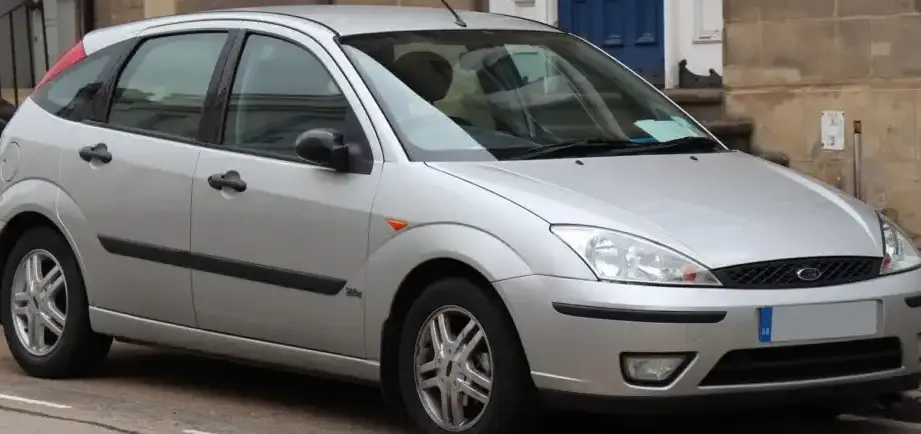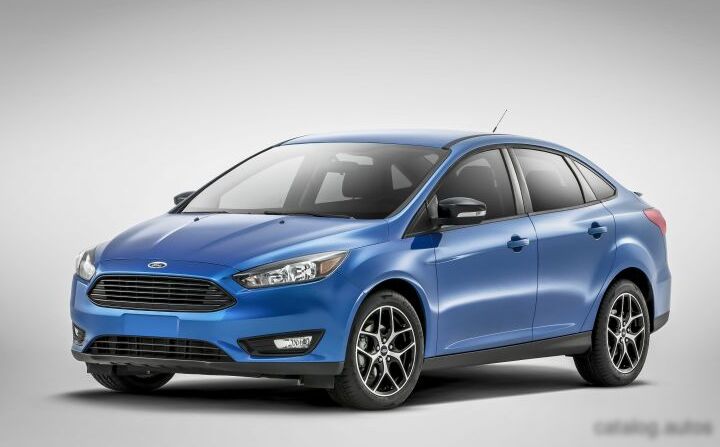
The Ford Focus III Sedan (facelift, 2014) 1.6 TDCi 95 horsepower Start/Stop (S&S) model represents a key offering in Ford’s global compact car lineup. Introduced as part of the mid-cycle refresh of the third-generation Focus, this variant was primarily aimed at European and Asian markets where fuel efficiency and lower running costs were highly valued. Production spanned from 2014 to 2015, positioning it within the broader 1HX0/A3 platform family. This specific configuration – the 1.6-liter diesel with 95 hp paired with a manual transmission – served as an entry-level option, offering a balance between affordability and practicality.
Technical Specifications
| Brand | Ford |
| Model | Focus |
| Generation | Focus III Sedan (facelift 2014) |
| Type (Engine) | 1.6 TDCi (95 Hp) S&S |
| Start of production | 2014 |
| End of production | 2015 |
| Powertrain Architecture | Internal Combustion engine |
| Body type | Sedan |
| Seats | 5 |
| Doors | 4 |
| Fuel consumption (urban) | 5.1 l/100 km (46.1 US mpg, 55.4 UK mpg, 19.6 km/l) |
| Fuel consumption (extra urban) | 3.7 l/100 km (63.6 US mpg, 76.3 UK mpg, 27 km/l) |
| Fuel consumption (combined) | 4.2 l/100 km (56 US mpg, 67.3 UK mpg, 23.8 km/l) |
| CO2 emissions | 109 g/km |
| Fuel Type | Diesel |
| Acceleration 0 – 100 km/h | 12.6 sec |
| Acceleration 0 – 62 mph | 12.6 sec |
| Acceleration 0 – 60 mph | 12 sec |
| Maximum speed | 191 km/h (118.68 mph) |
| Emission standard | Euro 6 |
| Weight-to-power ratio | 14.1 kg/Hp, 70.9 Hp/tonne |
| Weight-to-torque ratio | 6.2 kg/Nm, 160.6 Nm/tonne |
| Power | 95 Hp @ 3800 rpm |
| Power per litre | 60.9 Hp/l |
| Torque | 215 Nm @ 1750 rpm (158.58 lb.-ft. @ 1750 rpm) |
| Engine layout | Front, Transverse |
| Engine Model/Code | TZJA, T3DA, T3DB |
| Engine displacement | 1560 cm3 (95.2 cu. in.) |
| Number of cylinders | 4 |
| Engine configuration | Inline |
| Cylinder Bore | 75 mm (2.95 in.) |
| Piston Stroke | 88.3 mm (3.48 in.) |
| Compression ratio | 16:1 |
| Number of valves per cylinder | 2 |
| Fuel injection system | Diesel Commonrail |
| Engine aspiration | Turbocharger, Intercooler |
| Valvetrain | DOHC |
| Engine oil capacity | 3.85 l (4.07 US qt | 3.39 UK qt) |
| Coolant | 7.3 l (7.71 US qt | 6.42 UK qt) |
| Kerb Weight | 1339 kg (2951.99 lbs.) |
| Max. weight | 1900 kg (4188.78 lbs.) |
| Max load | 561 kg (1236.79 lbs.) |
| Trunk (boot) space – minimum | 372 l (13.14 cu. ft.) |
| Fuel tank capacity | 53 l (14 US gal | 11.66 UK gal) |
| Length | 4534 mm (178.5 in.) |
| Width | 1823 mm (71.77 in.) |
| Height | 1484 mm (58.43 in.) |
| Wheelbase | 2648 mm (104.25 in.) |
| Front track | 1544 mm (60.79 in.) |
| Rear (Back) track | 1559 mm (61.38 in.) |
| Minimum turning circle | 11 m (36.09 ft.) |
| Drivetrain Architecture | Front wheel drive |
| Number of gears | 6 gears, manual transmission |
| Front suspension | Independent, type McPherson with coil spring and anti-roll bar |
| Rear suspension | Independent multi-link suspension |
| Front brakes | Disc |
| Rear brakes | Drum |
| Assisting systems | ABS (Anti-lock braking system) |
| Steering type | Steering rack and pinion |
| Tires size | 205/55 R16; 215/50 R17 |
| Wheel rims size | 6.5J x 16; 7.0J x 17 |
Powertrain & Engine Architecture
The heart of this Focus variant is the 1.6-liter TDCi diesel engine, specifically utilizing engine codes TZJA, T3DA, or T3DB depending on the specific market and production date. This engine is a four-cylinder, inline configuration, featuring a turbocharger with intercooling to enhance power and efficiency. The engine employs a common rail direct injection system, delivering fuel directly into the combustion chamber at extremely high pressure for optimized combustion. The double overhead camshaft (DOHC) valvetrain, with two valves per cylinder, contributes to efficient gas exchange. The Start/Stop system, denoted by the “S&S” designation, automatically shuts off the engine when the vehicle is stationary (e.g., at traffic lights) to reduce fuel consumption and emissions. The engine produces 95 horsepower at 3800 rpm and 215 Nm (158.58 lb-ft) of torque at 1750 rpm. This torque output, available relatively low in the rev range, is a characteristic of diesel engines and contributes to good drivability. The engine is transversely mounted in the front of the vehicle, driving the front wheels through a six-speed manual transmission.
Driving Characteristics
The 1.6 TDCi 95 hp model offers a practical and economical driving experience. While not designed for outright performance, the engine provides sufficient power for everyday driving situations. Acceleration from 0 to 100 km/h (0-62 mph) takes approximately 12.6 seconds, and the top speed is around 191 km/h (118.68 mph). The six-speed manual transmission allows drivers to effectively manage the engine’s power band. Compared to higher-output versions of the Focus, such as those equipped with the 1.5 EcoBoost or 2.0 TDCi engines, this variant feels less responsive. However, the lower power output translates to improved fuel economy. The gear ratios are tuned for efficiency, prioritizing fuel savings over rapid acceleration. The engine’s torque delivery makes it relatively easy to drive in urban environments, requiring minimal gear changes.
Equipment & Trim Levels
The 1.6 TDCi 95 hp S&S typically represented an entry-level or mid-range trim level within the Focus Sedan lineup. Standard equipment generally included air conditioning, power windows, power door locks, a basic audio system (often with USB connectivity), and ABS brakes. Safety features such as airbags were also standard. Interior upholstery was typically cloth, and the dashboard featured a functional, if somewhat basic, design. Optional extras could include alloy wheels, upgraded audio systems, parking sensors, and a trip computer. Higher trim levels offered features like automatic climate control, leather upholstery, and more advanced infotainment systems.
Chassis & Braking
The Focus III Sedan utilizes an independent front suspension with McPherson struts and a coil spring/anti-roll bar setup. The rear suspension is an independent multi-link system, designed to provide a comfortable ride and good handling characteristics. The front brakes are disc brakes, while the rear brakes are drum brakes – a cost-saving measure common in entry-level models. ABS (Anti-lock Braking System) is standard, enhancing braking performance and safety. The chassis is tuned to balance ride comfort with handling precision, making it suitable for a variety of driving conditions.
Market Reception & Comparison
The 1.6 TDCi 95 hp S&S variant was generally well-received by critics and consumers seeking an economical and practical compact sedan. Its fuel efficiency was a major selling point, particularly in Europe where diesel fuel was often cheaper than gasoline. Compared to the more powerful Focus variants, this model offered a lower purchase price and reduced running costs. However, some reviewers noted that the engine lacked the refinement and performance of its competitors. Reliability was generally good, although, like all diesel engines, it required regular maintenance, including oil changes and filter replacements. The drum brakes on the rear were sometimes criticized for lacking the stopping power of disc brakes.
Legacy
The 1.6 TDCi engine, in various iterations, proved to be a durable and reliable powertrain. While not known for exceptional performance, it offered a good balance of fuel efficiency and longevity. In the used car market, these Focus Sedans are often sought after by buyers looking for an affordable and economical vehicle. The Start/Stop system, while contributing to fuel savings, has been known to experience occasional issues with the dual-mass flywheel and starter motor. Overall, the 1.6 TDCi 95 hp S&S variant remains a viable option for those seeking a practical and fuel-efficient compact sedan, provided it has been well-maintained.